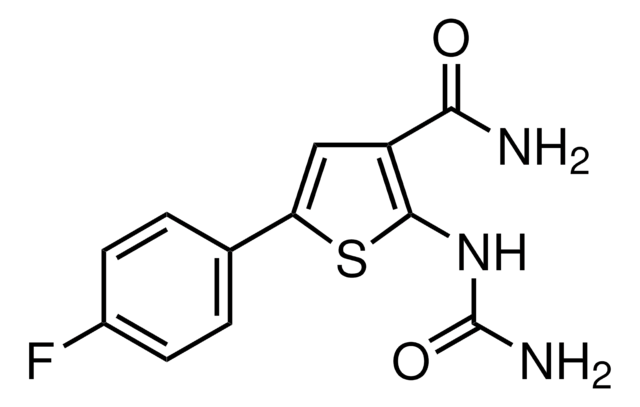
CAS Number507475-17-4
Synonyms5-(4-Fluorophenyl)-2-ureidothiophene-3-carboxamide; TPCA-1; 2-(Carbamoylamino)-5-(4-fluorophenyl)-3-thiophenecarboxamide; 2-(Carbamoylamino)-5-(4-fluorophenyl)thiophene-3-carboxamide; 3qfv; GW683965 GW683965A [5-(p-Fluorophenyl)-2-ureido]thiophene-3-carboxamide; 2-((aminocarbonyl)amino)-5-(4-fluorophenyl)-3-thiophenecarboxamide
Molecular FormulaC12H10FN3O2S
Molecular Weight279.29
Purity≥95 (HPLC)%
Density1.5±0.1 g/cm3
Boiling Point442.6±45.0 °C at 760 mmHg
Appearancepowder
EINECS0
Symbol
Signal WordWarning
| Chemical & Physical Properties | |
|---|---|
| CAS Number | 507475-17-4 |
| Catalog No. | 2A-0141984 |
| Chinese Name | TPCA-1 |
| Synonyms | 5-(4-Fluorophenyl)-2-ureidothiophene-3-carboxamide; TPCA-1; 2-(Carbamoylamino)-5-(4-fluorophenyl)-3-thiophenecarboxamide; 2-(Carbamoylamino)-5-(4-fluorophenyl)thiophene-3-carboxamide; 3qfv; GW683965 GW683965A [5-(p-Fluorophenyl)-2-ureido]thiophene-3-carboxamide; 2-((aminocarbonyl)amino)-5-(4-fluorophenyl)-3-thiophenecarboxamide |
| Molecular Formula | C12H10FN3O2S |
| Molecular Weight | 279.29 |
| Purity | ≥95 (HPLC) |
| Density | 1.5±0.1 g/cm3 |
| Boiling Point | 442.6±45.0 °C at 760 mmHg |
| Appearance | powder |
| Water Solubility | DMSO: soluble5mg/mL, clear |
| Storage Condition | 2-8°C |
| Application | TPCA-1 is a potent and selective inhibitor of IKK-2 with an IC50 value of 17.9 nM. |
| EINECS | 0 |
| HTC | 0 |
| UN(IATA) | 0 |
| PubChem ID | 329826675 |
| MDL Number | MFCD09037541 |
| SMILES | NC(=O)Nc1sc(cc1C(N)=O)-c2ccc(F)cc2 |
| InChI | 1S/C12H10FN3O2S/c13-7-3-1-6(2-4-7)9-5-8(10(14)17)11(19-9)16-12(15)18/h1-5H,(H2,14,17)(H3,15,16,18) |
| InChI Key | SAYGKHKXGCPTLX-UHFFFAOYSA-N |
| NACRES Code | NA.77 |
| UNSPSC | 12352200 |
| Hazard Symbols | transportation |
| MSDS | msds/141984_2_507475_17_4.pdf |
| Bioactivity | TPCA-1 is a potent and selective inhibitor of IKK-2 with IC50 of 17.9 nM. Related Catalog Signaling Pathways >> NF-κB >> IKK Research Areas >> Inflammation/Immunology Target IKK-2:17.9 nM (IC50) In Vitro TPCA-1 significantly represses pro-inflammatory cytokines IL-8 and GRO-α in NPECs[1]. TPCA-1 inhibit NFκB activity as well as glioma cell proliferation and IL8 expression, and at concentrations of 2.5 and 5 μM, it blocks the TNF-induced p65 translocation into the nucleus of U87 cells[2]. TPCA-1 inhibits lipopolysaccharide-induced human monocyte production of TNF-α, IL-6, and IL-8 with an IC50=170 to 320 nM[3]. In Vivo TPCA-1 (3, 10, or 20 mg/kg, i.p.) results in a dose-dependent reduction in the severity of murine collagen-induced arthritis (CIA). TPCA-1 (10 mg/kg, i.p., b.i.d.) in vivo results in significantly decreased collagen-induced T cell proliferation ex vivo[3]. Kinase Assay Recombinant human IKK-2 (residues 1-756) is expressed in baculovirus as an N-terminal GST-tagged fusion protein, and its activity is assessed using a time-resolved fluorescence resonance energy transfer assay. In brief, IKK-2 (5 nM final) diluted in assay buffer (50 mM HEPES, 10 mM MgCl2, 1 mM CHAPS, pH 7.4, with 1 mM DTT and 0.01% w/v BSA) is added to wells containing various concentrations of compound or dimethyl sulfoxide (DMSO) vehicle (3% final). The reaction is initiated by the addition of GST-IκBα substrate (25 nM final)/ATP (1 μM final), in a total volume of 30 μL. The reaction is incubated for 30 min at room temperature, then terminated by the addition of 15 μL of 50 mM EDTA. Detection reagent (15 μL) in buffer (100 mM HEPES, pH 7.4, 150 mM NaCl, and 0.1% w/v BSA) containing antiphosphoserine-IκBα-32/36 monoclonal antibody 12C2, labeled with W-1024 europium chelate, and an allophycocyanin-labeled anti-GST antibody is added, and the reaction is further incubated for 60 min at room temperature. The degree of phosphorylation of GST-IκBα is measured as a ratio of specific 665-nm energy transfer signal to reference europium 620-nm signal, using a Packard Discovery plate reader. Cell Assay Ten μLs of 3-(4,5-Dimethylthiazol-2-yl)-2,5-diphenyltetrazolium bromide (MTT) from stock solution (10 mg/mL) is added to each well of 96-well plates containing glioma cells and incubated at 37°C for 2-4 h. Oxidized MTT is solubilized by adding 100 μL of 10% sodium dodecyl sulfate (SDS) in 0.01 N HCl, and plates are incubated at 37°C for 4 h in a humidified chamber. Plates are read at 570 nm on a Bio-Rad plate reader. Animal Admin Male DBA/1 OlaHsd mice are age of 6 to 8 weeks. On day 0, 10- to 12-week-old male DBA/1 mice are immunized intradermally at the base of the tail with a total of 100 μL of complete Freund's adjuvant containing 200 μg of bovine type II collagen and 250 μg of Mycobacterium tuberculosis H37Ra. On day 21, mice are boosted intradermally with 100 μL of PBS containing 200 μg of bovine type II collagen. In all studies, TPCA-1 is administered in a vehicle consisting of 0.9% DMSO, 7% dimethylacetoacetamide (DMA), and 10% Cremophor El. Etanercept (Enbrel) is administered in PBS. Where the effects of TPCA-1 and etanercept are compared, both treatment groups as well as their relevant vehicle-treated control groups are included in the same study. For prophylactic studies, TPCA-1 in vehicle or vehicle alone is administered i.p., b.i.d., beginning on day 1. Etanercept in PBS or PBS alone is administered i.p. every other day beginning on day 1. The incidence of disease exhibited by both vehicle-treated control groups (PBS- and DMSO/DMA/Cremophor-treated mice) is 100%. For therapeutic studies, administration of TPCA-1, etanercept, or their respective vehicles is initiated (day 1) once an animal exhibited a clinical score of "1" or greater for 2 consecutive days. Mice are scored daily for clinical symptoms of disease using a micrometer caliper to measure paw thickness. References [1]. Sachse F, et al. IKK-2 inhibitor TPCA-1 represses nasal epithelial inflammation in vitro.Rhinology. 2011 Jun;49(2):168-73. [2]. Du Z, et al. Inhibition of Type I Interferon-Mediated Antiviral Action in Human Glioma Cells by the IKK Inhibitors BMS-345541 and TPCA-1.J Interferon Cytokine Res. 2012 Aug;32(8):368-77. Epub 2012 Apr 17. [3]. Podolin PL, et al. Attenuation of murine collagen-induced arthritis by a novel, potent, selective small molecule inhibitor of IkappaB Kinase 2, TPCA-1 (2-[(aminocarbonyl)amino]-5-(4-fluorophenyl)-3-thiophenecarboxamide), occurs via reduction of proinflamm [4]. Chu D, et al. Neutrophil-Mediated Delivery of Therapeutic Nanoparticles across Blood Vessel Barrier for Treatment of Inflammation and Infection. ACS Nano. 2015 Dec 22;9(12):11800-11. Chemical & Physical Properties Density 1.5±0.1 g/cm3 Boiling Point 442.6±45.0 °C at 760 mmHg Molecular Formula C12H10FN3O2S Molecular Weight 279.290 Flash Point 221.5±28.7 °C Exact Mass 279.047760 PSA 126.45000 LogP 2.72 Appearance of Characters white to light brown Vapour Pressure 0.0±1.1 mmHg at 25°C Index of Refraction 1.686 InChIKey SAYGKHKXGCPTLX-UHFFFAOYSA-N SMILES NC(=O)Nc1sc(-c2ccc(F)cc2)cc1C(N)=O Storage condition 2-8°C Water Solubility DMSO: soluble5mg/mL, clear |
| Use of | TPCA-1 is a potent and selective inhibitor of IKK-2 with IC50 of 17.9 nM. Properties Articles11 Name 2-(carbamoylamino)-5-(4-fluorophenyl)thiophene-3-carboxamide Synonym More Synonyms TPCA-1 Biological Activity Description TPCA-1 is a potent and selective inhibitor of IKK-2 with IC50 of 17.9 nM. Related Catalog Signaling Pathways >> NF-κB >> IKK Research Areas >> Inflammation/Immunology IKK-2:17.9 nM (IC50) References [1]. Sachse F, et al. IKK-2 inhibitor TPCA-1 represses nasal epithelial inflammation in vitro.Rhinology. 2011 Jun;49(2):168-73. [2]. Du Z, et al. Inhibition of Type I Interferon-Mediated Antiviral Action in Human Glioma Cells by the IKK Inhibitors BMS-345541 and TPCA-1.J Interferon Cytokine Res. 2012 Aug;32(8):368-77. Epub 2012 Apr 17. [3]. Podolin PL, et al. Attenuation of murine collagen-induced arthritis by a novel, potent, selective small molecule inhibitor of IkappaB Kinase 2, TPCA-1 (2-[(aminocarbonyl)amino]-5-(4-fluorophenyl)-3-thiophenecarboxamide), occurs via reduction of proinflamm Chemical & Physical Properties Molecular Formula C12H10FN3O2S Exact Mass 279.047760 PSA 126.45000 Appearance of Characters white to light brown Index of Refraction 1.686 InChIKey SAYGKHKXGCPTLX-UHFFFAOYSA-N |
| Transport Info | Shipping Name: UN |
| MSDS Transport Info | Module 14. Shipping information 14.1 UN dangerous goods number European Land Transport Dangerous Regulations: -International Maritime Dangerous Regulations: -International Air Transport Dangerous Regulations: - 14.2 United Nations shipping name European Land Transport Dangerous Regulations: Non-dangerous goods IMDG Code: Non-dangerous goods International air transport dangerous goods regulations: non-dangerous goods 14.3 Transport hazard categories European Land Transport Dangerous Regulations: -International Maritime Dangerous Regulations: -International Air Transport Dangerous Regulations: - 14.4 Package group European Land Transport Dangerous Regulations: -International Maritime Dangerous Regulations: -International Air Transport Dangerous Regulations: - 14.5 Environmental hazards European Land Transport Danger Regulations: No International Maritime Danger Regulations International Air Transport Danger Regulations: No Marine pollutants (yes/no): No 14.6 Special reminder to users No data available |
| Related Products in Heterocyclic Building Blocks | ||
|---|---|---|
| 5-(4-CHLOROBENZYL)-1H-TETRAZOLE | 14064-61-0 | 2A-0141946 |
| 5-(4-CHLOROPHENETHYLSULFONYL)-1-PHENYL-1H-TETRAZOLE | 1372784-40-1 | 2A-0141948 |
| 5-(4-CHLOROPHENYL)OXAZOLE-4-CARBOXYLIC ACID | 143659-14-7 | 2A-0141964 |
| 5-(4-ETHYLPHENYL)-3-HYDRAZINYL-1,2,4-TRIAZINE | 915924-89-9 | 2A-0141970 |
| 5-(4-FLUOROPHENETHYLSULFONYL)-1-PHENYL-1H-TETRAZOLE | 1370411-43-0 | 2A-0141979 |
| 5-(4-FLUOROPHENYL)-3-(3-NITROPHENYL)-1,2,4-OXADIAZOLE | 421581-70-6 | 2A-0141986 |
| 5-(4-FLUOROPHENYL)ISOXAZOLE | 138716-37-7 | 2A-0141989 |
| 5-(4-FLUOROPHENYL)ISOXAZOLE-3-CARBOXYLIC ACID | 33282-24-5 | 2A-0141990 |
| 5-(4-FLUOROPHENYL)ISOXAZOLE-4-CARBOXYLIC ACID | 618383-51-0 | 2A-1141991 |
| 5-(4-HYDROXYBENZYL)PYRIMIDINE-2,4(1H,3H)-DIONE | 17187-50-7 | 2A-0142003 |
| Browse all Heterocyclic Building Blocks products » | ||
Phone:
630-322-8886
630-322-8887
Email:
Office Locations:
Chicago, IL, USA
San Francisco, CA, USA


 EN
EN


 SDS
SDS