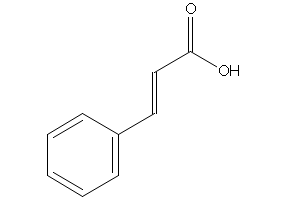
CAS Number621-82-9
Synonyms(E)-3-Phenylprop-2-enoic acid; Cinnamic acid; (2E)-3-Phenylacrylic acid; trans-Cinnamic Acid; EINECS 205-398-1; MFCD00004369; QV1U1R &&Trans or E Form; 4-09-00-02002 (Beilstein Handbook Reference); trans-b-Carboxystyrene
Molecular FormulaC9H8O2
Molecular Weight148.16
Purity98.00%
Density1.2±0.1 g/cm3
Boiling Point265.0±0.0 °C at 760 mmHg
Melting Point133ºC
AppearanceWhite crystalline powder
| Chemical & Physical Properties | |
|---|---|
| CAS Number | 621-82-9 |
| Catalog No. | 2A-9014110 |
| Chinese Name | 肉桂酸 |
| Synonyms | (E)-3-Phenylprop-2-enoic acid; Cinnamic acid; (2E)-3-Phenylacrylic acid; trans-Cinnamic Acid; EINECS 205-398-1; MFCD00004369; QV1U1R &&Trans or E Form; 4-09-00-02002 (Beilstein Handbook Reference); trans-b-Carboxystyrene |
| Molecular Formula | C9H8O2 |
| Molecular Weight | 148.16 |
| Purity | 98.00 |
| Density | 1.2±0.1 g/cm3 |
| Boiling Point | 265.0±0.0 °C at 760 mmHg |
| Melting Point | 133ºC |
| Appearance | White crystalline powder |
| Storage Condition | Store in a sealed container in a cool, ventilated, |
| Application | Cinnamic acid has potential use in cancer intervention, with IC50 values of 1-4.5 mM for glioblastoma, melanoma, prostate cancer, and lung cancer cells. |
| HTC | 2916190090 |
| MDL Number | C9H8O2 |
| SMILES | OC(=O)\C=C\c1ccccc1 |
| InChI | InChI=1S/C9H8O2/c10-9(11)7-6-8-4-2-1-3-5-8/h1-7H,(H,10,11)/b7-6+ |
| InChI Key | InChIKey=WBYWAXJHAXSJNI-VOTSOKGWSA-N |
| MSDS | msds/14110_1_621_82_9.pdf |
| Bioactivity | Cinnamic acid has potential use in cancer intervention, with IC50s of 1-4.5 mM in glioblastoma, melanoma, prostate and lung carcinoma cells. Related Catalog Natural Products >> Acids and Aldehydes Research Areas >> Cancer Target Human Endogenous Metabolite In Vitro Treatment with Cinnamic acid (CINN) of various tumor cells of epithelial and neuroectodermal origin result in dose-dependent growth inhibition following a 3-day exposure. The inhibitory concentrations causing a 50% reduction in tumor-cell proliferation (IC50) are between 1.2 to 4.5 mM. It is also showed that 20 mM Cinnamic acid is needed to cause an IC50 in FS4 cells, i.e. 5 to 20 times more than for tumor cells. In addition to inhibiting tumor-cell proliferation, Cinnamic acid causes morphological changes consistent with melanocyte differentiation. Within 5 days of treatment with 5 mM Cinnamic acid, melanoma 1011 cells appear enlarged with a markedly increased cytoplasm-to-nuclear ratio and well organized cytoskeleton, developed long dendritic processes and became highly melanotic. The change in the capacity of Cinnamic acid -treated melanoma 1011, A375(M) and SKMEL28 cells to degrade and cross tissue barriers is assessed by an in vitro invasion assay using modified Boyden chambers with matrigel-coated filters. After 3 days of continuous treatment with Cinnamic acid, a dose-dependent loss of invasive capacity in 3 tested tumor lines is observed. Treatment with 5 mM Cinnamic acid results in 75-95% loss of invasiveness[1]. Cell Assay The cell lines used, established from human malignant tumors, are A549 (lung cancer); PC3(M), Du145, and LNCaP (prostate cancer); A172, U251 (glioblastoma); and SKMEL28, A375(M), 1011 (melanoma). Growth rates are determined by cell counting. Briefly, 5 X10⁴ cells are plated in each well of a 24-well plate, allowed to attach overnight, and treated with compounds (e.g., Cinnamic acid: 2.5, 5, 10, 20, 30 mM) the following day. Cells are grown for 3 days at 37°C in the presence or absence of the drug, then detached with trypsin/EDTA and counted in a Coulter counter. Viability is determined by Trypan-blue exclusion assay[1]. References [1]. Liu L, et al. Cinnamic acid: a natural product with potential use in cancer intervention. Int J Cancer. 1995 Jul 28;62(3):345-50. Chemical & Physical Properties Density 1.2±0.1 g/cm3 Boiling Point 265.0±0.0 °C at 760 mmHg Melting Point 133ºC Molecular Formula C9H8O2 Molecular Weight 148.159 Flash Point 189.5±9.6 °C Exact Mass 148.052429 PSA 37.30000 LogP 2.41 Vapour Pressure 0.0±0.5 mmHg at 25°C Index of Refraction 1.616 Stability Stable. Combustible. Incompatible with strong oxidizing agents. |
| Use of | Properties Name cinnamic acid Synonym More Synonyms Cinnamic acid Biological Activity Related Catalog Natural Products >> Acids and Aldehydes Research Areas >> Cancer Human Endogenous Metabolite References [1]. Liu L, et al. Cinnamic acid: a natural product with potential use in cancer intervention. Int J Cancer. 1995 Jul 28;62(3):345-50. Chemical & Physical Properties Molecular Formula C9H8O2 Exact Mass 148.052429 PSA 37.30000 Index of Refraction 1.616 Stability Stable. Combustible. Incompatible with strong oxidizing agents. |
| Tax Rebate | 9.0% |
| Supervision | None MFN tariff: 6.5% Ordinary tariff: 30.0% |
| Transport Info | Product name: Summary 2916399090 other aromatic monocarboxylic acids, their anhydrides, halides, peroxides, peroxyacids and their derivatives VAT:17.0% Tax rebate rate:9.0% Supervision conditions:none MFN tariff:6.5% General tariff:30.0% |
| Related Products in Specialty Chemicals | ||
|---|---|---|
| Chromium(II) fluoride | 10049-10-2 | 2A-9014105 |
| Chromium(III) 2-ethylhexanoate | 3444-17-5 | 2A-9014106 |
| Chromium(iii) nitrate hydrate | 2A-401101 | 2A-9014107 |
| Chromium(III) telluride | 12053-39-3 | 2A-9014108 |
| Chromous iodide | 13478-28-9 | 2A-9014109 |
| cis-1,2,3,6-Tetrahydrophthalimide | 1469-48-3 | 2A-9014111 |
| cis-4-Cyclohexene-1,2-dicarboximide | 27813-21-4 | 2A-9014112 |
| Cobalt | 7440-48-4 | 2A-9014113 |
| Cobalt (II) phosphate hydrate | 13455-36-2 | 2A-9014114 |
| Cobalt 2-ethylcaproate; COBALT OCTOATE | 136-52-7 | 2A-9014115 |
| Browse all Specialty Chemicals products » | ||
Phone:
630-322-8886
630-322-8887
Email:
Office Locations:
Chicago, IL, USA
San Francisco, CA, USA


 EN
EN


 SDS
SDS