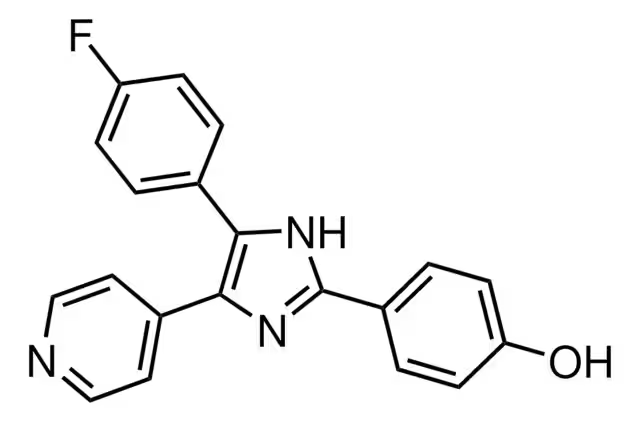
CAS Number152121-30-7
Synonyms4-[4-(4-Fluorophenyl)-5-(4-pyridinyl)-1H-imidazol-2-yl]phenol; 4-(4-(4-fluorophenyl)-5-(pyridin-4-yl)-2H-imidazol-2-yl)phenol; 4-[4-(4-Fluorophenyl)-5-(pyridin-4-yl)-1H-imidazol-2-yl]phenol; 4-[5-(4-Fluorophenyl)-4-(pyridin-4-yl)-1H-imidazol-2-yl]phenol; 4-(4-Fluorophenyl)-2-(4-hydroxyphenyl)-5-(4-pyridyl)-1H-imidazole; FHPI; 4-[4-(4-fluorophenyl)-5-pyridin-4-yl-1,3-dihydroimidazol-2-ylidene]cyclohexa-2,5-dien-1-one; 4-(4-fluorophenyl)-2-(4-hydroxyphenyl)-5-(4-pyridyl)imidazole; SB202190; SB 202190
Molecular FormulaC20H14FN3O
Molecular Weight331.34
Purity≥98 (HPLC)%
Density1.3±0.1 g/cm3
Boiling Point565.7±50.0 °C at 760 mmHg
Melting Point240-243℃
Appearancepowder
EINECS0
Symbol
Signal WordWarning
| Chemical & Physical Properties | |
|---|---|
| CAS Number | 152121-30-7 |
| Catalog No. | 2A-1135016 |
| Chinese Name | SB202190 (FHPI) |
| Synonyms | 4-[4-(4-Fluorophenyl)-5-(4-pyridinyl)-1H-imidazol-2-yl]phenol; 4-(4-(4-fluorophenyl)-5-(pyridin-4-yl)-2H-imidazol-2-yl)phenol; 4-[4-(4-Fluorophenyl)-5-(pyridin-4-yl)-1H-imidazol-2-yl]phenol; 4-[5-(4-Fluorophenyl)-4-(pyridin-4-yl)-1H-imidazol-2-yl]phenol; 4-(4-Fluorophenyl)-2-(4-hydroxyphenyl)-5-(4-pyridyl)-1H-imidazole; FHPI; 4-[4-(4-fluorophenyl)-5-pyridin-4-yl-1,3-dihydroimidazol-2-ylidene]cyclohexa-2,5-dien-1-one; 4-(4-fluorophenyl)-2-(4-hydroxyphenyl)-5-(4-pyridyl)imidazole; SB202190; SB 202190 |
| Molecular Formula | C20H14FN3O |
| Molecular Weight | 331.34 |
| Purity | ≥98 (HPLC) |
| Density | 1.3±0.1 g/cm3 |
| Boiling Point | 565.7±50.0 °C at 760 mmHg |
| Melting Point | 240-243℃ |
| Appearance | powder |
| Storage Condition | 2-8°C |
| Application | SB 202190 is a cell-permeable p38 MAPK inhibitor with IC50s of 50 nM and 100 nM for p38 and p38β2 inhibition, respectively. |
| EINECS | 0 |
| HTC | 29333990 |
| UN(IATA) | 0 |
| PubChem ID | 24278272 |
| MDL Number | MFCD00941964 |
| SMILES | Oc1ccc(cc1)-c2nc(-c3ccc(F)cc3)c([nH]2)-c4ccncc4 |
| InChI | 1S/C20H14FN3O/c21-16-5-1-13(2-6-16)18-19(14-9-11-22-12-10-14)24-20(23-18)15-3-7-17(25)8-4-15/h1-12,25H,(H,23,24) |
| InChI Key | QHKYPYXTTXKZST-UHFFFAOYSA-N |
| NACRES Code | NA.77 |
| UNSPSC | 12352200 |
| Hazard Symbols | transportation |
| MSDS | msds/135016_1_152121_30_7.pdf |
| Bioactivity | SB 202190 is a cell-permeable p38 MAP kinase inhibitor with IC50s of 50 nM and 100 nM for p38 and p38β2, respectively. Related Catalog Signaling Pathways >> Autophagy >> Autophagy Signaling Pathways >> MAPK/ERK Pathway >> p38 MAPK Research Areas >> Cancer Target IC50: 50 nM (p38), 100 nM (p38β2)[1] In Vitro Treatment of cells with SB 202190 (SB202190) significantly inhibits both basal and anti-Fas antibody-induced MAPKAPK 2 activity in a dose-dependent manner as measured in immune complex kinase assays with GST-hsp27 as a substrate. Jurkat cells are treated with SB202190 or left untreated. After 24 h, cells are harvested, and the activity of CPP32-like caspases in cell extracts is measured by cleavage of the fluorescent peptide DEVD-AMC, which is a specific substrate of CPP32-like caspases. The cleavage of DEVD-AMC is significantly increased in cells treated with SB202190 but not in the control[2]. In Vivo In HCT-116-derived colorectal tumors, administration of SB 202190 (SB202190), Sorafenib or a combination of both give similar results in terms of measurement of external tumor size (around 58% growth reduction compare with control tumors). SB202190 induces a 28% reduction of tumor growth, compare with a 31% reduction promoted by Sorafenib, while combination of both drugs reduce tumor growth by 55%[3]. Compare to the model group, the SB202190 group exhibits significantly shorter escape latencies in the Morris water maze hidden platform trials (P<0.01) and longer times in the original platform quadrant during probe trials (P<0.01). The SB202190 group also shows significantly reduced neuronal apoptosis in the hippocampus compared to VaD model rats (P<0.01) as well as higher (antiapoptotic) Bcl-2 expression and lower (proapoptotic) caspase-3 expression (P<0.01 for both). In conclusion, blockade of the p38 MAPK signaling pathway by SB202190 following permanent 2-OV reduced apoptosis of hippocampal neurons and rescued spatial learning and memory deficits[4]. Kinase Assay MAPKAPK 2 assays are performed. Briefly, Jurkat cells are serum-starved for 24 h and then incubated with or without the specific p38 inhibitor SB 202190 for 30 min prior to treatment with anti-Fas mAb (100 ng/mL) for 2 h or left alone as indicated in the figure legends. The cells are harvested in lysis buffer and clarified by centrifugation. Endogenous MAPKAPK 2 is immunoprecipitated with anti-MAPKAPK 2 polyclonal antibody for 3 h at 4°C. The activity of the immune complex is assayed at 30°C for 30 min in 30 μL of kinase buffer in the presence of 1 μM ATP/10 μCi [γ-32P]ATP (10 Ci/mmol) with GST-hsp27 as a substrate. The reactions are terminated with Laemmli sample buffer. The proteins are resolved by 13% SDS-polyacrylamide gel electrophoresis followed by autoradiography. The phosphorylated proteins are quantitated by a PhosphorImager[2]. Cell Assay Jurkat/neo or Jurkat/bcl-2 cells (106 cells) are treated with or without SB202190 (50 μM), PD098059 (50 μM) in the presence or absence of caspase inhibitor benzyloxycarbonyl-Val-Ala-Asp (zVAD)-fluoromethylketone for 24 h. The cells are then harvested in lysis buffer (25 mM Hepes, pH 7.4, 0.25% Nonidet P-40, 10 μg/mL leupeptin, 10 μg/mL aprotinin, 5 mM EDTA, 2 mM dithiothreitol, and 10 mM digitonin). The lysates are clarified by centrifugation, and the supernatants are used for caspase assays. The caspase activity is measured in a reaction mixture containing 20 μg of cell extracts, 20 μM fluoregenic peptide acetyl-Asp-Glu-Val-Asp-aminomethylcoumarin (DEVD-AMC). Fluorescent AMC product formation is measured at excitation 360 nm, emission 460 nm using a Cytofluor II fluorescent plate reader[2]. Animal Admin Mice[3] Female CD-1 athymic nude mice (6-8 week old) are used. 10×106 HT-29 or 10×106 HCT-116 cells are injected subcutaneously into the flanks (0.2 mL per flank) of female athymic nude CD-1 mice. The volume of the tumors is measured every 2-3 d. The tumor volume is calculated using the following formula: volume (mm3)=(width)2×length×0.5. When the tumor volume reaches 60 mm3, mice are randomized into four treatment groups (n≥6 for each group): vehicle (control), Sorafenib 30 mg/kg/d, SB202190 25 μg/kg/d, and Sorafenib 30 mg/kg/d plus SB202190 25 μg/kg/d. Drug treatment is given daily by gavage for Sorafenib and intraperitoneally for SB202190. Mice are treated for 12 d and tumor volume and body weight are recorded every 2-3 d. At the end of the treatment, mice are sacrificed and tumors explanted for histologic and immunohistochemical analysis. Rats[4] Specific pathogen-free (SPF) male Wistar rats (3 month old, 250±10 g) are used. The 60 Wistar rats are randomly assigned to the sham-operated group, the VaD model group, and the SB 202190 group (20 animals each) using a random number table. The VaD rat model (n=40) is established by separating and ligating the bilateral carotid artery via two-vessel occlusion (2-VO). For animals of the sham-operated group (n=20), the bilateral carotid artery is separated using the same methods but without ligation. After recovery, animals of the SB 202190 group receive intracerebroventricular (ICV) injection of SB 202190 and both the VaD model and sham-operated groups received ICV injection of equal volume 0.1% DMSO. In each group, eight rats are examined in the Morris water maze to assess spatial learning and memory, six rats are sacrificed and brain sections are prepared for TUNEL staining and Bcl-2/caspase-3 immunohistochemistry, and six rats are sacrificed and tissue homogenates are prepared for Western blot assay of phospho-p38 MAPK expression. References [1]. Davies SP, et al. Specificity and mechanism of action of some commonly used protein kinase inhibitors. Biochem J. 2000 Oct 1;351(Pt 1):95-105. [2]. Nemoto S, et al. Induction of apoptosis by SB202190 through inhibition of p38beta mitogen-activated protein kinase. J Biol Chem. 1998 Jun 26;273(26):16415-20. [3]. Grossi V, et al. Sorafenib inhibits p38α activity in colorectal cancer cells and synergizes with the DFG-in inhibitor SB202190 to increase apoptotic response. Cancer Biol Ther. 2012 Dec;13(14):1471-81. [4]. Yang S, et al. Protective effects of p38 MAPK inhibitor SB202190 against hippocampal apoptosis and spatial learning and memory deficits in a rat model of vascular dementia. Biomed Res Int. 2013;2013:215798. [5]. Zhang Y, et al. PP2AC Level Determines Differential Programming of p38-TSC-mTOR Signaling and Therapeutic Response to p38-Targeted Therapy in Colorectal Cancer. EBioMedicine. 2015 Nov 19;2(12):1944-56. Chemical & Physical Properties Density 1.3±0.1 g/cm3 Boiling Point 565.7±50.0 °C at 760 mmHg Melting Point 240-243℃ Molecular Formula C20H14FN3O Molecular Weight 331.343 Flash Point 295.9±30.1 °C Exact Mass 331.112091 PSA 61.80000 LogP 5.00 Vapour Pressure 0.0±1.6 mmHg at 25°C Index of Refraction 1.653 InChIKey QHKYPYXTTXKZST-UHFFFAOYSA-N SMILES Oc1ccc(-c2nc(-c3ccc(F)cc3)c(-c3ccncc3)[nH]2)cc1 Storage condition 2-8°C |
| Use of | SB 202190 is a cell-permeable p38 MAP kinase inhibitor with IC50s of 50 nM and 100 nM for p38 and p38β2, respectively. Properties Articles14 Name sb-202190 Synonym More Synonyms SB202190 (FHPI) Biological Activity Description SB 202190 is a cell-permeable p38 MAP kinase inhibitor with IC50s of 50 nM and 100 nM for p38 and p38β2, respectively. Related Catalog Signaling Pathways >> Autophagy >> Autophagy Signaling Pathways >> MAPK/ERK Pathway >> p38 MAPK Research Areas >> Cancer IC50: 50 nM (p38), 100 nM (p38β2)[1] In Vitro Treatment of cells with SB 202190 (SB202190) significantly inhibits both basal and anti-Fas antibody-induced MAPKAPK 2 activity in a dose-dependent manner as measured in immune complex kinase assays with GST-hsp27 as a substrate. Jurkat cells are treated with SB202190 or left untreated. After 24 h, cells are harvested, and the activity of CPP32-like caspases in cell extracts is measured by cleavage of the fluorescent peptide DEVD-AMC, which is a specific substrate of CPP32-like caspases. The cleavage of DEVD-AMC is significantly increased in cells treated with SB202190 but not in the control[2]. References [1]. Davies SP, et al. Specificity and mechanism of action of some commonly used protein kinase inhibitors. Biochem J. 2000 Oct 1;351(Pt 1):95-105. [2]. Nemoto S, et al. Induction of apoptosis by SB202190 through inhibition of p38beta mitogen-activated protein kinase. J Biol Chem. 1998 Jun 26;273(26):16415-20. [3]. Grossi V, et al. Sorafenib inhibits p38α activity in colorectal cancer cells and synergizes with the DFG-in inhibitor SB202190 to increase apoptotic response. Cancer Biol Ther. 2012 Dec;13(14):1471-81. [4]. Yang S, et al. Protective effects of p38 MAPK inhibitor SB202190 against hippocampal apoptosis and spatial learning and memory deficits in a rat model of vascular dementia. Biomed Res Int. 2013;2013:215798. [5]. Zhang Y, et al. PP2AC Level Determines Differential Programming of p38-TSC-mTOR Signaling and Therapeutic Response to p38-Targeted Therapy in Colorectal Cancer. EBioMedicine. 2015 Nov 19;2(12):1944-56. Chemical & Physical Properties Molecular Formula C20H14FN3O Exact Mass 331.112091 PSA 61.80000 Index of Refraction 1.653 InChIKey QHKYPYXTTXKZST-UHFFFAOYSA-N |
| Transport Info | Product name: Purity: 99.0% |
| MSDS Transport Info | Module 14. Shipping information 14.1 UN dangerous goods number European Land Transport Dangerous Regulations: -International Maritime Dangerous Regulations: -International Air Transport Dangerous Regulations: - 14.2 Names specified by the United Nations (UN) European Land Transport Dangerous Regulations: Non-dangerous goods IMDG Code: Non-dangerous goods International air transport dangerous goods regulations: non-dangerous goods 14.3 Transport hazard categories European Land Transport Dangerous Regulations: -International Maritime Dangerous Regulations: -International Air Transport Dangerous Regulations: - 14.4 Package group European Land Transport Dangerous Regulations: -International Maritime Dangerous Regulations: -International Air Transport Dangerous Regulations: - 14.5 Environmental hazards European Land Transport Dangerous Regulations: No International Maritime Transport Dangerous Regulations Maritime Pollutants: No International Air Transport Risk Regulations: No 14.6 Special reminder to users No data available |
| Related Products in Specialty Chemicals | ||
|---|---|---|
| 4-(4-((4'-CHLORO-4,4-DIMETHYL-3,4,5,6-TETRAHYDRO-[1,1'-BIPHENYL]-2-YL)METHYL)PIPERAZIN-1-YL)BENZOIC ACID HYDROCHLORIDE | 1305320-63-1 | 2A-0134993 |
| 4-(4-((4-AMINOBENZOYL)OXY)-3-METHYLBUTOXY)BUTYL 4-AMINOBENZOATE | 163578-99-2 | 2A-0134994 |
| 4-(4-(1-(3-METHOXYPHENYL)-1H-PYRAZOL-4-YL)PYRIMIDIN-2-YL)-1-METHYLPIPERAZIN-2-ONE | 1227699-63-9 | 2A-0134996 |
| 4-(4-(1-(4-METHOXYPHENYL)-1H-PYRAZOL-4-YL)PYRIMIDIN-2-YL)-1-METHYLPIPERAZIN-2-ONE | 1227717-25-0 | 2A-0134997 |
| 4-(4-(1-HYDROXYETHYL)-2-METHOXY-5-NITROPHENOXY)BUTANOIC ACID | 175281-76-2 | 2A-1134998 |
| 4-(4-(4-METHYLPIPERAZIN-1-YL)PIPERIDIN-1-YL)ANILINE | 959795-70-1 | 2A-0135017 |
| 4-(4-(DIMETHYLAMINO)PHENYL)BUT-3-EN-2-ONE | 5432-53-1 | 2A-0135022 |
| 4-(4-(DIPENTADECYLAMINO)STYRYL)-1-METHYLPYRIDIN-1-IUM IODIDE | 135288-72-1 | 2A-0135023 |
| 4-(4-(HYDROXYMETHYL)-5-METHYLISOXAZOL-3-YL)BENZONITRILE | 1030012-94-2 | 2A-0135025 |
| 4-(4-(HYDROXYMETHYL)PHENOXY)PHTHALONITRILE | 649553-07-1 | 2A-0135026 |
| Browse all Specialty Chemicals products » | ||
Phone:
630-322-8886
630-322-8887
Email:
Office Locations:
Chicago, IL, USA
San Francisco, CA, USA


 EN
EN


 SDS
SDS