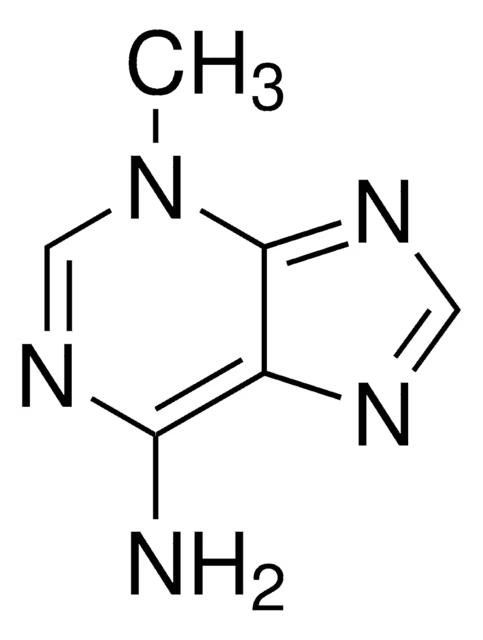
CAS Number5142-23-4
Synonyms3-Methyl-3H-purin-6-amine; EINECS 225-908-6; methyladenine; N(3)-methyladenine; 3-methyl-3H-adenine; 3-MA,6-Amino-3-methylpurine; 3-methylpurin-6-amine; MFCD00010531; 6-Amino-3-methylpurine; 3-Methyladenine; 3-MA
Molecular FormulaC6H7N5
Molecular Weight149.15
Purity≥99 (HPLC)%
Density1.6±0.1 g/cm3
Boiling Point240.1±50.0 °C at 760 mmHg
Melting Point~300 °C (dec.) (lit.)
Appearancepowder
EINECS225-908-6
Symbol
Signal WordWarning
| Chemical & Physical Properties | |
|---|---|
| CAS Number | 5142-23-4 |
| Catalog No. | 2A-0132061 |
| Chinese Name | 3-甲基腺嘌呤 |
| Synonyms | 3-Methyl-3H-purin-6-amine; EINECS 225-908-6; methyladenine; N(3)-methyladenine; 3-methyl-3H-adenine; 3-MA,6-Amino-3-methylpurine; 3-methylpurin-6-amine; MFCD00010531; 6-Amino-3-methylpurine; 3-Methyladenine; 3-MA |
| Molecular Formula | C6H7N5 |
| Molecular Weight | 149.15 |
| Purity | ≥99 (HPLC) |
| Density | 1.6±0.1 g/cm3 |
| Boiling Point | 240.1±50.0 °C at 760 mmHg |
| Melting Point | ~300 °C (dec.) (lit.) |
| Appearance | powder |
| Storage Condition | Store at room temperature, away from light, in a c |
| Application | 3-Methyladenine is an inhibitor of PI3K. It is widely used as an inhibitor of autophagy by inhibiting class III PI3K. |
| EINECS | 225-908-6 |
| HTC | 2933990090 |
| UN(IATA) | 0 |
| PubChem ID | 24897326 |
| MDL Number | MFCD00010531 |
| SMILES | Cn1cnc(N)c2ncnc12 |
| InChI | 1S/C6H7N5/c1-11-3-10-5(7)4-6(11)9-2-8-4/h2-3H,7H2,1H3 |
| InChI Key | FSASIHFSFGAIJM-UHFFFAOYSA-N |
| Beilstein/REAXYS | 146087 |
| NACRES Code | NA.51 |
| UNSPSC | 41106305 |
| Hazard Symbols | transportation |
| MSDS | msds/132061_1_5142_23_4.pdf |
| Bioactivity | 3-Methyladenine is a PI3K inhibitor. 3-Methyladenine is a widely used inhibitor of autophagy via its inhibitory effect on class III PI3K. Related Catalog Signaling Pathways >> Autophagy >> Autophagy Signaling Pathways >> Autophagy >> Mitophagy Signaling Pathways >> PI3K/Akt/mTOR >> PI3K Research Areas >> Cancer Natural Products >> Alkaloid Target PtdIns3Kγ:60 μM (IC50, Cell Assay) Vps34:25 μM (IC50, Cell Assay) Human Endogenous Metabolite Autophagy Mitophagy In Vitro 3-Methyladenine shows slight preference to binds to Vps34 in vitro, with an IC50 of 25 µM for Vps34 as compared with 60 µM for PtdIns3Kγ, and 3-Methyladenine (10 mM) can inhibit all PtdIns3Ks[1]. 3-Methyladenine (3-MA, 5 mM) suppresses autophagy in HeLa cells under both glucose-free conditions and normal conditions. 3-Methyladenine (2.5, 5 or 10 mM) induces caspase-dependent cell death in HeLa cells, and the death occurs independently of the inhibition of autophagy. Moreover, 3-Methyladenine (3-MA, 1 mM) significantly shortens the duration of nocodazole-induced-prometaphase arrest[2]. In Vivo 3-Methyladenine (1.5 mg/100 g, i.p.) treatment alleviates sodium taurocholate-induced severe acute pancreatitis (SAP) in rats at both 12 and 24 h. 3-Methyladenine inhibits autophagy of pancreatic acinar cells in sodium taurocholate-tnduced SAP. 3-Methyladenine also shows inhibitory effects on PI3K/Akt signaling pathway and NF-κB signaling pathway in sodium taurocholate-tnduced SAP[3]. Cell Assay Cell viability is determined by a trypan blue exclusion assay. Cells are cultured in the medium with 3-Methyladenine. Both adherent and floating cells are collected and suspended in phosphate buffered saline (PBS, pH 7.4) at a final density of 1-2×10⁶/mL. An equal volume of 0.4% trypan blue solution (w/v, in PBS) is added to the cell suspension and mixed thoroughly. After incubation at room temperature for 3 min, cell counting is performed using a hemacytometer. Animal Admin All rats are fasted for 12 h with free access to water prior to operation. After anesthesia by intraperitoneal (i.p.) injection of 2% sodium pentobarbital (0.25 mL/100 g), they are laid and fixed on the table, routinely shaven, disinfected, and draped. The rat SAP model is induced by 0.1 mL/min speed uniformly retrograde infusion of a freshly prepared 3.5% sodium taurocholate solution (0.1 mL/100 g) into the biliopancreatic duct after laparotomy. Equivalent volume of normal saline solution is substituted for 3.5% sodium taurocholate solution in the sham-operation (SO) control group. The incision is closed with a continuous 3-0-silk suture, and 2 mL/100 g of saline is injected into the back subcutaneously to compensate for the fluid loss. 180 rats are randomly divided into four groups: (1) Acanthopanax treatment group (Aca group, n = 45) where the rats are injected with 0.2% Acanthopanax injection at a dose of 3.5 mg/100 g 3 h after successful modeling via the vena caudalis once, knowing that this dosage is effective; (2) 3-Methyladenine treatment group (3-methyladenine group, n = 45) where the rats are injected with 100 nmol/μL 3-methyladenine solution at a dose of 1.5 mg/100 g 3 h after successful modeling via the intraperitoneal route once, knowing that this dosage is effective; (3) SAP model group (SAP group, n = 45) where these rats receive an equivalent volume of the normal saline instead of Acanthopanax injection 3 h after successful modeling via the vena caudalis once; (4) SO group (control, n = 45) where these rats receive an equivalent volume of the normal saline instead of Acanthopanax injection 3 h after successful sham-operation via the vena caudalis once. The 45 animals in each of the four groups are equally randomized into 3, 12, and 24 h subgroups for postoperative observations[3]. References [1]. Miller S, et al. Finding a fitting shoe for Cinderella: searching for an autophagy inhibitor. Autophagy. 2010 Aug;6(6):805-807. [2]. Hou H, et al. Inhibitors of phosphatidylinositol 3'-kinases promote mitotic cell death in HeLa cells. PLoS One. 2012;7(4):e35665. [3]. Wang X, et al. Acanthopanax versus 3-Methyladenine Ameliorates Sodium Taurocholate-Induced Severe Acute Pancreatitis by Inhibiting the Autophagic Pathway in Rats. Mediators Inflamm. 2016;2016:8369704. [4]. Meng Li, et al. Alda-1 Ameliorates Liver Ischemia-Reperfusion Injury by Activating Aldehyde Dehydrogenase 2 and Enhancing Autophagy in Mice. J Immunol Res. 7 August 2018. Chemical & Physical Properties Density 1.6±0.1 g/cm3 Boiling Point 240.1±50.0 °C at 760 mmHg Melting Point -300ºC (dec.)(lit.) Molecular Formula C6H7N5 Molecular Weight 149.153 Flash Point 99.0±30.1 °C Exact Mass 149.070145 PSA 69.62000 LogP -2.36 Appearance of Characters Powder | White Vapour Pressure 0.0±0.5 mmHg at 25°C Index of Refraction 1.807 Storage condition Store at +4°C |
| Use of | 3-Methyladenine is a PI3K inhibitor. 3-Methyladenine is a widely used inhibitor of autophagy via its inhibitory effect on class III PI3K. Properties Articles431 Name 3-methyladenine Synonym More Synonyms 3-Methyladenine Biological Activity Description 3-Methyladenine is a PI3K inhibitor. 3-Methyladenine is a widely used inhibitor of autophagy via its inhibitory effect on class III PI3K. Related Catalog Signaling Pathways >> Autophagy >> Autophagy Signaling Pathways >> Autophagy >> Mitophagy Signaling Pathways >> PI3K/Akt/mTOR >> PI3K Research Areas >> Cancer Natural Products >> Alkaloid PtdIns3Kγ:60 μM (IC50, Cell Assay) Vps34:25 μM (IC50, Cell Assay) Human Endogenous Metabolite References [1]. Miller S, et al. Finding a fitting shoe for Cinderella: searching for an autophagy inhibitor. Autophagy. 2010 Aug;6(6):805-807. [2]. Hou H, et al. Inhibitors of phosphatidylinositol 3'-kinases promote mitotic cell death in HeLa cells. PLoS One. 2012;7(4):e35665. [3]. Wang X, et al. Acanthopanax versus 3-Methyladenine Ameliorates Sodium Taurocholate-Induced Severe Acute Pancreatitis by Inhibiting the Autophagic Pathway in Rats. Mediators Inflamm. 2016;2016:8369704. [4]. Meng Li, et al. Alda-1 Ameliorates Liver Ischemia-Reperfusion Injury by Activating Aldehyde Dehydrogenase 2 and Enhancing Autophagy in Mice. J Immunol Res. 7 August 2018. Chemical & Physical Properties Molecular Formula C6H7N5 Exact Mass 149.070145 PSA 69.62000 LogP -2.36 Appearance of Characters Powder | White Index of Refraction 1.807 |
| Tax Rebate | 13.0% |
| Supervision | None. MFN tariff: 6.5%. Ordinary tariff: 20.0% |
| Transport Info | Shipping Name: UN |
| MSDS Transport Info | Module 14. Shipping information 14.1 UN dangerous goods number European Land Transport Dangerous Regulations: -International Maritime Dangerous Regulations: -International Air Transport Dangerous Regulations: - 14.2 United Nations shipping name European Land Transport Dangerous Regulations: Non-dangerous goods IMDG Code: Non-dangerous goods International air transport dangerous goods regulations: non-dangerous goods 14.3 Transport hazard categories European Land Transport Dangerous Regulations: -International Maritime Dangerous Regulations: -International Air Transport Dangerous Regulations: - 14.4 Package group European Land Transport Dangerous Regulations: -International Maritime Dangerous Regulations: -International Air Transport Dangerous Regulations: - 14.5 Environmental hazards European Land Transport Danger Regulations: No International Maritime Danger Regulations International Air Transport Danger Regulations: No Marine pollutants (yes/no): No 14.6 Special reminder to users No data available |
| Related Products in Specialty Chemicals | ||
|---|---|---|
| 3-METHYL-1H-PYRAZOLO[3,4-B]PYRIDIN-5-AMINE | 1186608-73-0 | 2A-0132000 |
| 3-METHYL-2-(METHYLSULFONAMIDO)BENZOIC ACID | 926206-21-5 | 2A-0132019 |
| 3-METHYL-2-NITROBENZONITRILE | 1885-77-4 | 2A-0132028 |
| 3-METHYL-2-PHENYLBUTANENITRILE | 5558-29-2 | 2A-0132034 |
| 3-METHYL-3'-NITRO-1,1'-BIPHENYL | 952-03-4 | 2A-0132047 |
| 3-METHYL-4'-NITRO-1,1'-BIPHENYL | 952-21-6 | 2A-0132062 |
| 3-METHYL-4-(4-METHYLPIPERAZIN-1-YL)ANILINE DIHYDROCHLORIDE | 1177349-04-0 | 2A-0132073 |
| 3-METHYL-4-(METHYLSULFONAMIDO)BENZOIC ACID | 892878-60-3 | 2A-0132075 |
| 3-METHYL-4-NITRO-1-(4-NITROPHENYL)-1H-PYRAZOL-5-OL | 132-42-3 | 2A-0132085 |
| 3-METHYL-4-NITRO-1H-PYRAZOL-5-AMINE | 76143-53-8 | 2A-1132086 |
| Browse all Specialty Chemicals products » | ||
Phone:
630-322-8886
630-322-8887
Email:
Office Locations:
Chicago, IL, USA
San Francisco, CA, USA


 EN
EN


 SDS
SDS