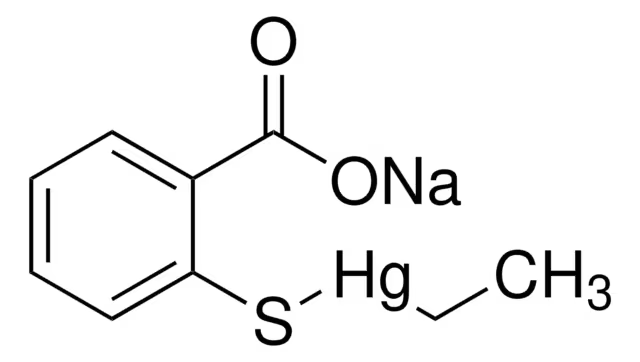
CAS Number54-64-8
Synonymssodium ethyl[2-(mercapto-kS)benzoato(2-)]mercurate(1-); Thimersalate; MFCD00013062; Thiomersalate; Thimerosalate; Merthiolate sodium; Thiomersal; Thimerosal; MERTHIOLATE; sodium salt of (2-carboxyphenylthio)ethylmercury; mercurate(1-), ethyl[2-(mercapto-κS)benzoato(2-)]-, sodium; Mercurate(1-), ethyl[2-(mercapto-κS)benzoato(2-)]-, sodium (1:1); Sodium ethyl[2-(sulfanyl-κS)benzoato(2-)]mercurate(1-); sodium ethyl[2-(mercapto-κS)benzoato(2)-κO]mercurate(1); Thimerosalum; EINECS 200-210-4; Mercurothiolate; Sodium merthiolate; sodium 2-(ethylmercuriothio)benzoate; Natriumethyl[2-(sulfanyl-κS)benzoeato(2-)]mercurate(1-); Sodium ethylmercurithiosalicylate
Molecular Formula2-(C2H5HgS)C6H4CO2Na
Molecular Weight404.81
Purity97.0-101.0 (on dried substance, titration)%
Boiling Point298.6ºC at 760mmHg
Melting Point234-237 °C (dec.) (lit.)
Appearancepowder or crystals
EINECS200-210-4
Symbol
Signal WordWarning


Please Login or Create an Account to: See VlP prices and availability
US Stock: ship in 0-1 business day
Global Stock: ship in 5-7 days
| Chemical & Physical Properties | |
|---|---|
| CAS Number | 54-64-8 |
| Catalog No. | 2A-9012684 |
| Chinese Name | 硫柳汞钠 |
| Synonyms | sodium ethyl[2-(mercapto-kS)benzoato(2-)]mercurate(1-); Thimersalate; MFCD00013062; Thiomersalate; Thimerosalate; Merthiolate sodium; Thiomersal; Thimerosal; MERTHIOLATE; sodium salt of (2-carboxyphenylthio)ethylmercury; mercurate(1-), ethyl[2-(mercapto-κS)benzoato(2-)]-, sodium; Mercurate(1-), ethyl[2-(mercapto-κS)benzoato(2-)]-, sodium (1:1); Sodium ethyl[2-(sulfanyl-κS)benzoato(2-)]mercurate(1-); sodium ethyl[2-(mercapto-κS)benzoato(2)-κO]mercurate(1); Thimerosalum; EINECS 200-210-4; Mercurothiolate; Sodium merthiolate; sodium 2-(ethylmercuriothio)benzoate; Natriumethyl[2-(sulfanyl-κS)benzoeato(2-)]mercurate(1-); Sodium ethylmercurithiosalicylate |
| Molecular Formula | 2-(C2H5HgS)C6H4CO2Na |
| Molecular Weight | 404.81 |
| Purity | 97.0-101.0 (on dried substance, titration) |
| Boiling Point | 298.6ºC at 760mmHg |
| Melting Point | 234-237 °C (dec.) (lit.) |
| Appearance | powder or crystals |
| Water Solubility | 1 G/ML (20 ºC) |
| Storage Condition | The warehouse is low-temperature, ventilated, dry, |
| Packaging | III |
| Application | Thimerosal is a mercury-containing vaccine preservative that is suspected in the cause of neurodevelopmental disorders. |
| EINECS | 200-210-4 |
| HTC | 29310095 |
| PubChem ID | 24900257 |
| MDL Number | MFCD00013062 |
| SMILES | [Na+].CC[Hg]Sc1ccccc1C([O-])=O |
| InChI | 1S/C7H6O2S.C2H5.Hg.Na/c8-7(9)5-3-1-2-4-6(5)10;1-2;;/h1-4,10H,(H,8,9);1H2,2H3;;/q;;2*+1/p-2 |
| InChI Key | RTKIYNMVFMVABJ-UHFFFAOYSA-L |
| Beilstein/REAXYS | 8169555 |
| NACRES Code | NA.21 |
| UNSPSC | 51473202 |
| Hazard Symbols | 6.1(b) |
| MSDS | msds/12684_1_54_64_8.pdf |
| Bioactivity | Thimerosal, a mercury-containing vaccine preservative, is a suspected factor in the etiology of neurodevelopmental disorders. Related Catalog Research Areas >> Neurological Disease In Vivo The Thimerosal (THIM) administration increases μ-opioid receptors (MORs) density in the periaqueductal gray (PAG) in a dose-dependent manner. Treatment with higher doses of Thimerosal statistically significantly increases MOR density in the dorsomedial periaqueductal gray (DMPAG) and lateral periaqueductal gray (LPAG) regions. At the dose 3,000 μg Hg/kg, Thimerosal also augments MOR density in the caudate putamen (CPU). In contrast, the administration of Thimerosal at both higher doses decreases MOR density in the dentate gyrus (DG)[1]. Thimerosal administration (4 injections, i.m., 240 μg Hg/kg on postnatal days 7, 9, 11, 15) induces lasting changes in amino acid overflow: an increase of glutamate and aspartate accompanied by a decrease of glycine and alanine; measured 10 to 14 weeks after the injections. Four injections of Thimerosal at a dose of 12.5 μg Hg/kg do not alter glutamate and aspartate concentrations at microdialysis time. Application of Thimerosal to the prefrontal cortex (PFC) in perfusion fluid evokes a rapid increase of glutamate overflow. Coadministration of the neurosteroid, dehydroepiandrosterone sulfate (DHEAS; 80 mg/kg; i.p.) prevents the Thimerosal effect on glutamate and aspartate; the steroid alone has no influence on these amino acids. Coapplication of dehydroepiandrosterone sulfate (DHEAS) with Thimerosal in perfusion fluid also blocks the acute action of Thimerosal on glutamate[2]. Animal Admin Male rats are used in this study. On the 20th postnatal week, the animals are euthanized by pentobarbital overdosing, and then decapitated. The rats treated with two higher doses of Thimerosal (THIM) (1,440 and 3,000 μg Hg/kg) are from the original litters, which are used for different behavioral and pathological tests, but are experimentally naïve. A separate group of experimentally naïve rats, treated with two lower doses of Thimerosal, 12 and 240 μg Hg/kg (4 litters per each drug-treatment) is sacrificed on the 8th postnatal week according to the same procedure. Each experimental group is composed of 5 animals, with 2 at the most coming from the same litter[1]. References [1]. Olczak M, et al. Neonatal administration of thimerosal causes persistent changes in mu opioid receptors in the ratbrain. Neurochem Res. 2010 Nov;35(11):1840-7. [2]. Duszczyk-Budhathoki M, et al. Administration of thimerosal to infant rats increases overflow of glutamate and aspartate in the prefrontal cortex: protective role of dehydroepiandrosterone sulfate. Neurochem Res. 2012 Feb;37(2):436-47. Chemical & Physical Properties Boiling Point 298.6ºC at 760mmHg Melting Point 234-237 °C (dec.)(lit.) Molecular Formula C9H9HgNaO2S Molecular Weight 404.811 Flash Point 250 °C Exact Mass 405.992706 PSA 65.43000 LogP 1.57790 InChIKey RTKIYNMVFMVABJ-UHFFFAOYSA-L SMILES CC[Hg]Sc1ccccc1C(=O)[O-].[Na+] Stability Stable. May degrade in sunlight. Incompatible with strong acids, strong bases, strong oxidizing agents, iodine, heavy metal salts. Water Solubility 1 G/ML (20 ºC) |
| Use of | Thimerosal, a mercury-containing vaccine preservative, is a suspected factor in the etiology of neurodevelopmental disorders. Properties Articles52 Name thimerosal Synonym More Synonyms Thiomersal Biological Activity Description Thimerosal, a mercury-containing vaccine preservative, is a suspected factor in the etiology of neurodevelopmental disorders. Related Catalog Research Areas >> Neurological Disease References [1]. Olczak M, et al. Neonatal administration of thimerosal causes persistent changes in mu opioid receptors in the ratbrain. Neurochem Res. 2010 Nov;35(11):1840-7. [2]. Duszczyk-Budhathoki M, et al. Administration of thimerosal to infant rats increases overflow of glutamate and aspartate in the prefrontal cortex: protective role of dehydroepiandrosterone sulfate. Neurochem Res. 2012 Feb;37(2):436-47. Chemical & Physical Properties Molecular Formula C9H9HgNaO2S Exact Mass 405.992706 PSA 65.43000 LogP 1.57790 InChIKey RTKIYNMVFMVABJ-UHFFFAOYSA-L Stability Stable. May degrade in sunlight. Incompatible with strong acids, strong bases, strong oxidizing agents, iodine, heavy metal salts. Water Solubility 1 G/ML (20 ºC) |
| Transport Info | Shipping Name: UN |
| MSDS Transport Info | Module 14. Shipping information 14.1 UN dangerous goods number European Land Transport Dangerous Regulations: 2025 International Maritime Transport Dangerous Regulations: 2025 International Air Transport Dangerous Regulations: 2025 14.2 United Nations shipping name European Land Transport Dangerous Regulations: MERCURY COMPOUND, SOLID, N.O.S. (Thimerosal) IMDG Code: MERCURY COMPOUND, SOLID, N.O.S. (Thimerosal) International Air Transport Regulations: Mercury compound, solid, n.o.s. (Thimerosal) 14.3 Transport hazard categories European Land Transport Danger Regulations: 6.1 International Maritime Transport Danger Regulations: 6.1 International Air Transport Danger Regulations: 6.1 14.4 Package group European Land Transport Danger Regulations: III International Maritime Transport Danger Regulations: III International Air Transport Danger Regulations: III 14.5 Environmental hazards European Land Transport Dangerous Regulations: Yes International Maritime Transport Dangerous Regulations International Air Transport Dangerous Regulations: No Marine Pollutants (Yes/No): Yes 14.6 Special reminder to users No data available |
| Related Products in Specialty Chemicals | ||
|---|---|---|
| Thiamylal | 77-27-0 | 2A-9012677 |
| Thianthol | 135-58-0 | 2A-9012678 |
| Thiazinamium | 2338-21-8 | 2A-9012679 |
| Thiazinamium metilsulfate | 58-34-4 | 2A-9012680 |
| Thiazopyr | 117718-60-2 | 2A-9012681 |
| Thiometon | 640-15-3 | 2A-9012686 |
| Thiophanate-ethyl | 23564-06-9 | 2A-9012687 |
| Thiophanate-Methyl | 23564-05-8 | 2A-9012688 |
| Thioproperazine Dimesylate | 2347-80-0 | 2A-9012689 |
| Thiosophorose | 92051-25-7 | 2A-9012690 |
| Browse all Specialty Chemicals products » | ||
Phone:
630-322-8886
630-322-8887
Email:
Office Locations:
Chicago, IL, USA
San Francisco, CA, USA


 EN
EN

 SDS
SDS