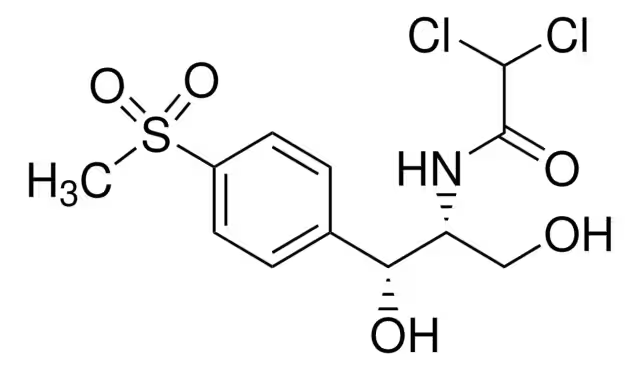
CAS Number15318-45-3
Synonyms2,2-Dichloro-N-[(1R,2R)-1,3-dihydroxy-1-[4-(methylsulfonyl)phenyl]-2-propyl]acetamide; thiophenicol; D-Thiocymetin; EINECS 239-355-3; MFCD00467983; thiocymetin; D-Thiophenicol; win-5063-2; 2,2-Dichloro-N-{(1S,2S)-1,3-dihydroxy-1-[4-(methylsulfonyl)phenyl]-2-propanyl}acetamide; Neomyson; ThiaMphenicol; Dextrosulphenidol; THIAMPHENICHOL
Molecular FormulaC12H15Cl2NO5S
Molecular Weight356.22
Purity97%
Density1.5±0.1 g/cm3
Boiling Point695.9±55.0 °C at 760 mmHg
Melting Point163-166ºC
Appearancepowder
EINECS239-355-3
Symbol
Signal WordWarning
| Chemical & Physical Properties | |
|---|---|
| CAS Number | 15318-45-3 |
| Catalog No. | 2A-9012676 |
| Chinese Name | 甲砜霉素 |
| Synonyms | 2,2-Dichloro-N-[(1R,2R)-1,3-dihydroxy-1-[4-(methylsulfonyl)phenyl]-2-propyl]acetamide; thiophenicol; D-Thiocymetin; EINECS 239-355-3; MFCD00467983; thiocymetin; D-Thiophenicol; win-5063-2; 2,2-Dichloro-N-{(1S,2S)-1,3-dihydroxy-1-[4-(methylsulfonyl)phenyl]-2-propanyl}acetamide; Neomyson; ThiaMphenicol; Dextrosulphenidol; THIAMPHENICHOL |
| Molecular Formula | C12H15Cl2NO5S |
| Molecular Weight | 356.22 |
| Purity | 97 |
| Density | 1.5±0.1 g/cm3 |
| Boiling Point | 695.9±55.0 °C at 760 mmHg |
| Melting Point | 163-166ºC |
| Appearance | powder |
| Storage Condition | Room Temperature |
| Application | Thiamphenicol is an antibiotic and is the methanesulfonyl analog of chloramphenicol. |
| EINECS | 239-355-3 |
| HTC | 2941400000 |
| PubChem ID | 24899874 |
| MDL Number | MFCD00467983 |
| SMILES | CS(=O)(=O)c1ccc(cc1)[C@@H](O)[C@@H](CO)NC(=O)C(Cl)Cl |
| InChI | 1S/C12H15Cl2NO5S/c1-21(19,20)8-4-2-7(3-5-8)10(17)9(6-16)15-12(18)11(13)14/h2-5,9-11,16-17H,6H2,1H3,(H,15,18)/t9-,10-/m1/s1 |
| InChI Key | OTVAEFIXJLOWRX-NXEZZACHSA-N |
| Beilstein/REAXYS | 2819542 |
| NACRES Code | NA.85 |
| UNSPSC | 51284303 |
| Hazard Symbols | Transport |
| MSDS | msds/12676_1_15318_45_3.pdf |
| Bioactivity | Thiamphenicol is an antimicrobial antibiotic and a methyl-sulfonyl analogue of chloramphenicol.Target: AntibacterialThiamphenicol (also known as thiophenicol and dextrosulphenidol) is an antibiotic. It is the methyl-sulfonyl analogue of chloramphenicol and has a similar spectrum of activity, but is 2.5 to 5 times as potent. Like chloramphenicol, it is insoluble in water, but highly soluble in lipids. It is used in many countries as a veterinary antibiotic, but is available in China, Morocco and Italy for use in humans. Its main advantage over chloramphenicol is that it has never been associated with aplastic anaemia. Thiamphenicol is a derivative of chloramphenicol characterized by a spectrum comparable to that of the parent compound against multiresistant pathogens but showing satisfactory tolerability. Thiamphenicol showed a significant PAE (0.33 to 2.9h) on all pathogens studied and a powerful bactericidal effect against beta-lactamase-positive and -negative H. influenzae. These results indicate a good in vitro activity of thiamphenicol against difficult-to-treat multiply resistant pathogens [1, 2]. Related Catalog Signaling Pathways >> Anti-infection >> Bacterial Research Areas >> Infection References [1]. http://en.wikipedia.org/wiki/Thiamphenicol [2]. Marchese, A., et al., In vitro activity of thiamphenicol against multiresistant Streptococcus pneumoniae, Haemophilus influenzae and Staphylococcus aureus in Italy. J Chemother, 2002. 14(6): p. 554-61. Chemical & Physical Properties Density 1.5±0.1 g/cm3 Boiling Point 695.9±55.0 °C at 760 mmHg Melting Point 163-166ºC Molecular Formula C12H15Cl2NO5S Molecular Weight 356.222 Flash Point 374.7±31.5 °C Exact Mass 355.004791 PSA 112.08000 LogP -0.27 Vapour Pressure 0.0±2.3 mmHg at 25°C Index of Refraction 1.583 InChIKey OTVAEFIXJLOWRX-NXEZZACHSA-N SMILES CS(=O)(=O)c1ccc(C(O)C(CO)NC(=O)C(Cl)Cl)cc1 |
| Use of | Thiamphenicol is an antimicrobial antibiotic and a methyl-sulfonyl analogue of chloramphenicol.Target: AntibacterialThiamphenicol (also known as thiophenicol and dextrosulphenidol) is an antibiotic. It is the methyl-sulfonyl analogue of chloramphenicol and has a similar spectrum of activity, but is 2.5 to 5 times as potent. Like chloramphenicol, it is insoluble in water, but highly soluble in lipids. It is used in many countries as a veterinary antibiotic, but is available in China, Morocco and Italy for use in humans. Its main advantage over chloramphenicol is that it has never been associated with aplastic anaemia. Thiamphenicol is a derivative of chloramphenicol characterized by a spectrum comparable to that of the parent compound against multiresistant pathogens but showing satisfactory tolerability. Thiamphenicol showed a significant PAE (0.33 to 2.9h) on all pathogens studied and a powerful bactericidal effect against beta-lactamase-positive and -negative H. influenzae. These results indicate a good in vitro activity of thiamphenicol against difficult-to-treat multiply resistant pathogens [1, 2]. Properties Articles47 Name thiamphenicol Synonym More Synonyms Thiamphenicol Biological Activity Description Thiamphenicol is an antimicrobial antibiotic and a methyl-sulfonyl analogue of chloramphenicol.Target: AntibacterialThiamphenicol (also known as thiophenicol and dextrosulphenidol) is an antibiotic. It is the methyl-sulfonyl analogue of chloramphenicol and has a similar spectrum of activity, but is 2.5 to 5 times as potent. Like chloramphenicol, it is insoluble in water, but highly soluble in lipids. It is used in many countries as a veterinary antibiotic, but is available in China, Morocco and Italy for use in humans. Its main advantage over chloramphenicol is that it has never been associated with aplastic anaemia. Thiamphenicol is a derivative of chloramphenicol characterized by a spectrum comparable to that of the parent compound against multiresistant pathogens but showing satisfactory tolerability. Thiamphenicol showed a significant PAE (0.33 to 2.9h) on all pathogens studied and a powerful bactericidal effect against beta-lactamase-positive and -negative H. influenzae. These results indicate a good in vitro activity of thiamphenicol against difficult-to-treat multiply resistant pathogens [1, 2]. Related Catalog Signaling Pathways >> Anti-infection >> Bacterial Research Areas >> Infection References [1]. http://en.wikipedia.org/wiki/Thiamphenicol [2]. Marchese, A., et al., In vitro activity of thiamphenicol against multiresistant Streptococcus pneumoniae, Haemophilus influenzae and Staphylococcus aureus in Italy. J Chemother, 2002. 14(6): p. 554-61. Chemical & Physical Properties Exact Mass 355.004791 PSA 112.08000 LogP -0.27 Index of Refraction 1.583 InChIKey OTVAEFIXJLOWRX-NXEZZACHSA-N |
| Tax Rebate | 13.0% |
| Supervision | None. MFN tariff: 6.5%. Ordinary tariff: 30.0% |
| Transport Info | Shipping Name: UN |
| MSDS Transport Info | Module 14. Shipping information 14.1 UN dangerous goods number European Land Transport Dangerous Regulations: -International Maritime Dangerous Regulations: -International Air Transport Dangerous Regulations: - 14.2 United Nations shipping name European Land Transport Dangerous Regulations: Non-dangerous goods IMDG Code: Non-dangerous goods International air transport dangerous goods regulations: non-dangerous goods 14.3 Transport hazard categories European Land Transport Dangerous Regulations: -International Maritime Dangerous Regulations: -International Air Transport Dangerous Regulations: - 14.4 Package group European Land Transport Dangerous Regulations: -International Maritime Dangerous Regulations: -International Air Transport Dangerous Regulations: - 14.5 Environmental hazards European Land Transport Danger Regulations: No International Maritime Danger Regulations International Air Transport Danger Regulations: No Marine pollutants (yes/no): No 14.6 Special reminder to users No data available |
| Related Products in Specialty Chemicals | ||
|---|---|---|
| Tetrylammonium bromide | 2A-303753 | 2A-9012669 |
| Tetryzoline | 84-22-0 | 2A-9012670 |
| Theaflavin | 4670-05-7 | 2A-9012671 |
| Thenium closylate | 4304-40-9 | 2A-9012673 |
| Thenylchlor | 96491-05-3 | 2A-9012674 |
| Thiamylal | 77-27-0 | 2A-9012677 |
| Thianthol | 135-58-0 | 2A-9012678 |
| Thiazinamium | 2338-21-8 | 2A-9012679 |
| Thiazinamium metilsulfate | 58-34-4 | 2A-9012680 |
| Thiazopyr | 117718-60-2 | 2A-9012681 |
| Browse all Specialty Chemicals products » | ||
Phone:
630-322-8886
630-322-8887
Email:
Office Locations:
Chicago, IL, USA
San Francisco, CA, USA


 EN
EN


 SDS
SDS