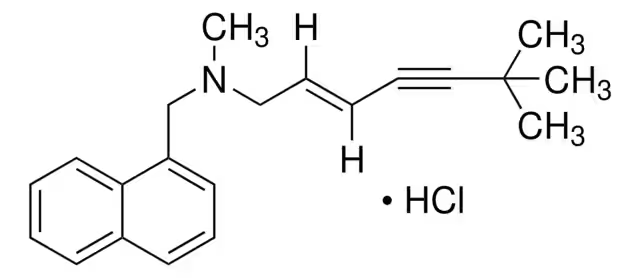
CAS Number78628-80-5
Synonyms(2E)-N,6,6-Trimethyl-N-(naphthalen-1-ylmethyl)hept-2-en-4-in-1-aminhydrochlorid; (2E)-N,6,6-trimethyl-N-(naphthalen-1-ylmethyl)hept-2-en-4-yn-1-amine hydrochloride (1:1); 1-Naphthalenemethanamine, N-[(2E)-6,6-dimethyl-2-hepten-4-yn-1-yl]-N-methyl-, hydrochloride (1:1); MFCD00145430; (2E)-N,6,6-Trimethyl-N-(1-naphthylmethyl)-2-hepten-4-yn-1-amine hydrochloride (1:1); (2E)-N,6,6-Trimethyl-N-(1-naphthylmethyl)hept-2-en-4-yn-1-amine hydrochloride (1:1); Lamisil; trans-N-Methyl-N-(1-naphthylmethyl)-6,6-dimethylhept-2-en-4-ynyl-1-amine hydrochloride; (2E)-N,6,6-trimethyl-N-(naphthalen-1-ylmethyl)hept-2-en-4-yn-1-amine hydrochloride; Terbinafine HCl; Terbinafine hydrochloride; EINECS 245-385-8; (E)-N-(6,6-Dimethyl-2-hepten-4-ynyl)-N-methyl-1-naphthalenemethanamine monohydrochloride
Molecular FormulaC21H26ClN
Molecular Weight327.89
Purity≥98%
Density1.007g/cm3
Boiling Point417.9ºC at 760 mmHg
Melting Point204-208°C
Appearancepowder
Symbol
Signal WordWarning
| Chemical & Physical Properties | |
|---|---|
| CAS Number | 78628-80-5 |
| Catalog No. | 2A-9012637 |
| Chinese Name | 盐酸特比萘芬 |
| Synonyms | (2E)-N,6,6-Trimethyl-N-(naphthalen-1-ylmethyl)hept-2-en-4-in-1-aminhydrochlorid; (2E)-N,6,6-trimethyl-N-(naphthalen-1-ylmethyl)hept-2-en-4-yn-1-amine hydrochloride (1:1); 1-Naphthalenemethanamine, N-[(2E)-6,6-dimethyl-2-hepten-4-yn-1-yl]-N-methyl-, hydrochloride (1:1); MFCD00145430; (2E)-N,6,6-Trimethyl-N-(1-naphthylmethyl)-2-hepten-4-yn-1-amine hydrochloride (1:1); (2E)-N,6,6-Trimethyl-N-(1-naphthylmethyl)hept-2-en-4-yn-1-amine hydrochloride (1:1); Lamisil; trans-N-Methyl-N-(1-naphthylmethyl)-6,6-dimethylhept-2-en-4-ynyl-1-amine hydrochloride; (2E)-N,6,6-trimethyl-N-(naphthalen-1-ylmethyl)hept-2-en-4-yn-1-amine hydrochloride; Terbinafine HCl; Terbinafine hydrochloride; EINECS 245-385-8; (E)-N-(6,6-Dimethyl-2-hepten-4-ynyl)-N-methyl-1-naphthalenemethanamine monohydrochloride |
| Molecular Formula | C21H26ClN |
| Molecular Weight | 327.89 |
| Purity | ≥98 |
| Density | 1.007g/cm3 |
| Boiling Point | 417.9ºC at 760 mmHg |
| Melting Point | 204-208°C |
| Appearance | powder |
| Storage Condition | Store in an airtight container in a cool, dry plac |
| Application | Terbinafine hydrochloride (TDT 067 hydrochloride) is an antifungal drug used to treat fungal infections. It is a potent, non-competitive inhibitor of squalene epoxygenase from Candida species with a K |
| HTC | 2921499090 |
| PubChem ID | 329826887 |
| MDL Number | MFCD00145430 |
| SMILES | Cl[H].[H]\C(CN(C)Cc1cccc2ccccc12)=C(\[H])C#CC(C)(C)C |
| InChI | 1S/C21H25N.ClH/c1-21(2,3)15-8-5-9-16-22(4)17-19-13-10-12-18-11-6-7-14-20(18)19;/h5-7,9-14H,16-17H2,1-4H3;1H/b9-5+; |
| InChI Key | BWMISRWJRUSYEX-SZKNIZGXSA-N |
| NACRES Code | NA.85 |
| UNSPSC | 51302503 |
| Hazard Symbols | Transport |
| MSDS | msds/12637_1_78628_80_5.pdf |
| Bioactivity | Terbinafine hydrochloride (TDT 067 hydrochloride) is an antifungal medication used to treat fungal infections. It is a potent non-competitive inhibitor of squalene epoxidase from Candida with a Ki of 30 nM. Related Catalog Signaling Pathways >> Anti-infection >> Fungal Research Areas >> Infection Target Ki: 30 nM (squalene epoxidase)[1] In Vitro Terbinafine has a primary fungicidal action in vitro against most fungal pathogens, including dermatophytes, and dimorphic and filamentous fungi. Terbinafine specifically inhibits fungal ergosterol biosynthesis at the point of squalene epoxidation. The treated fungal cells rapidly accumulate tlic intermediate squalene and become deficient in the end-product of the pathway, ergosterol[1]. In Vivo Terbinafine is not only active after topical application but is very effective in experimental dermatophytoses following oral administration. In fungi infected guinea-pigs, the skin temperature dropps dramatically after the fourth treatment of terbinafine[2]. Animal Admin Guinea-pigs: The backs (lumbar regions) of guinea-pigs, which have been mechanically depilated, are infected with 0.1 mL Sabouraud's dextrose 2% broth containing 106 c.f.u. of Truhophyton mentagrophytes. The treatments commence 48 h post-inoculation. The test compounds (Terbinafine) are suspended in 2% tylose and Tween 80 and administered via a stomach tube once daily on 9 consecutive days, or dissolved in a mixture of polyethylene glycol 400 and etbanol and spread on the infected part ot the body in a volume of 0.4 mL with a Hrigalski spatula once daily for 1-7 consecutive days[2]. References [1]. Ryder NS, et al. Terbinafine: mode of action and properties of the squalene epoxidase inhibition. Br J Dermatol. 1992 Feb;126 Suppl 39:2-8. [2]. Mieth H, et al. Preclinical evaluation of terbinafine in vivo. Clin Exp Dermatol. 1989 Mar;14(2):104-8. Chemical & Physical Properties Density 1.007g/cm3 Boiling Point 417.9ºC at 760 mmHg Melting Point 204-208°C Molecular Formula C21H26ClN Molecular Weight 327.891 Flash Point 183.7ºC Exact Mass 327.175385 PSA 3.24000 LogP 5.67930 Index of Refraction 1.586 InChIKey BWMISRWJRUSYEX-SZKNIZGXSA-N SMILES CN(CC=CC#CC(C)(C)C)Cc1cccc2ccccc12.Cl Storage condition -20°C Freezer |
| Use of | Terbinafine hydrochloride (TDT 067 hydrochloride) is an antifungal medication used to treat fungal infections. It is a potent non-competitive inhibitor of squalene epoxidase from Candida with a Ki of 30 nM. Properties Name terbinafine hydrochloride Synonym More Synonyms terbinafine hydrochloride Biological Activity Description Terbinafine hydrochloride (TDT 067 hydrochloride) is an antifungal medication used to treat fungal infections. It is a potent non-competitive inhibitor of squalene epoxidase from Candida with a Ki of 30 nM. Related Catalog Signaling Pathways >> Anti-infection >> Fungal Research Areas >> Infection Ki: 30 nM (squalene epoxidase)[1] In Vitro Terbinafine has a primary fungicidal action in vitro against most fungal pathogens, including dermatophytes, and dimorphic and filamentous fungi. Terbinafine specifically inhibits fungal ergosterol biosynthesis at the point of squalene epoxidation. The treated fungal cells rapidly accumulate tlic intermediate squalene and become deficient in the end-product of the pathway, ergosterol[1]. In Vivo Terbinafine is not only active after topical application but is very effective in experimental dermatophytoses following oral administration. In fungi infected guinea-pigs, the skin temperature dropps dramatically after the fourth treatment of terbinafine[2]. References [1]. Ryder NS, et al. Terbinafine: mode of action and properties of the squalene epoxidase inhibition. Br J Dermatol. 1992 Feb;126 Suppl 39:2-8. [2]. Mieth H, et al. Preclinical evaluation of terbinafine in vivo. Clin Exp Dermatol. 1989 Mar;14(2):104-8. Chemical & Physical Properties Exact Mass 327.175385 PSA 3.24000 LogP 5.67930 Index of Refraction 1.586 InChIKey BWMISRWJRUSYEX-SZKNIZGXSA-N |
| Tax Rebate | 9.0% |
| Supervision | None MFN tariff: 6.5% Ordinary tariff: 30.0% |
| Transport Info | Product name: Purity: 98.0% |
| MSDS Transport Info | Module 14. Shipping information European Land Transport Danger Regulations: 3077 International Maritime Transport Danger Regulations: 3077 International Air Transport Danger Regulations: 3077 14.2 Names specified by the United Nations (UN) European land transport hazard regulations: ENVIRONMENTALLY HAZARDOUS SUBSTANCE, SOLID, N.O.S. (Terbinafine hydrochloride) International Maritime Dangerous Regulations: ENVIRONMENTALLY HAZARDOUS SUBSTANCE, SOLID, N.O.S. (Terbinafine hydrochloride) International air transport hazard regulations: Environmentally hazardous substance, solid, n.o.s. (Terbinafine hydrochloride) 14.3 Transport hazard categories European land transport Dangerous Regulations: 9 International sea transport Dangerous Regulations: 9 International air transport Dangerous Regulations: 9 14.4 Package group European Land Transport Danger Regulations: III International Maritime Transport Danger Regulations: III International Air Transport Danger Regulations: III 14.5 Environmental hazards European Land Transport Dangerous Regulations: Yes International Maritime Transport Dangerous Regulations Maritime Pollutants: Yes International Air Transport Dangerous Regulations: Yes 14.6 Special reminder to users further information Dangerous goods are individually packaged, with liquids exceeding 5 liters or solids exceeding 5 kilograms. The outer packaging of each independent package and the combined independent inner package must have EHS on it. Identification (according to European ADR Regulation 2.2.9.1.10, IMDG Regulation 2.10.3), |
| Related Products in Specialty Chemicals | ||
|---|---|---|
| Teopranitol | 81792-35-0 | 2A-9012628 |
| Tepraloxydim | 149979-41-9 | 2A-9012629 |
| Teprenone | 6809-52-5 | 2A-9012630 |
| Terallethrin | 15589-31-8 | 2A-9012632 |
| Terbinafine | 91161-71-6 | 2A-9012636 |
| Terbufibrol | 56488-59-6 | 2A-9012638 |
| Terbuficin | 15534-92-6 | 2A-9012639 |
| Terbuprol | 13021-53-9 | 2A-9012640 |
| Terbuthylazine | 5915-41-3 | 2A-9012641 |
| Terbutryn | 886-50-0 | 2A-9012642 |
| Browse all Specialty Chemicals products » | ||
Phone:
630-322-8886
630-322-8887
Email:
Office Locations:
Chicago, IL, USA
San Francisco, CA, USA


 EN
EN


 SDS
SDS