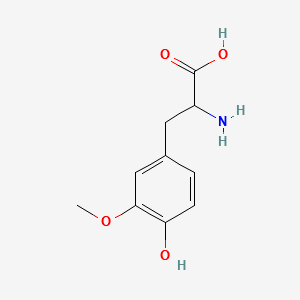
CAS Number7636-26-2
Synonyms3-Methoxytyrosine; 3-Methoxy-D,L-tyrosine; 2-amino-3-(4-hydroxy-3-methoxyphenyl)propanoic acid; 3-Methoxy-tyrosine; 3-METHOXY-DL-TYROSINE; UNII:SO86T1OB2P; 3-O-Methyldopa
Molecular FormulaC10H13NO4
Molecular Weight211.21
Purity96+%
Density1.3±0.1 g/cm3
Boiling Point407.3±45.0 °C at 760 mmHg
EINECS0
| Chemical & Physical Properties | |
|---|---|
| CAS Number | 7636-26-2 |
| Catalog No. | 2A-0118070 |
| Chinese Name | 2-氨基-3-(4-羟基-3-甲氧基苯基)丙酸 |
| Synonyms | 3-Methoxytyrosine; 3-Methoxy-D,L-tyrosine; 2-amino-3-(4-hydroxy-3-methoxyphenyl)propanoic acid; 3-Methoxy-tyrosine; 3-METHOXY-DL-TYROSINE; UNII:SO86T1OB2P; 3-O-Methyldopa |
| Molecular Formula | C10H13NO4 |
| Molecular Weight | 211.21 |
| Purity | 96+ |
| Density | 1.3±0.1 g/cm3 |
| Boiling Point | 407.3±45.0 °C at 760 mmHg |
| Storage Condition | Room temperature, sealed, dry |
| Application | 3-O-Methyl-DL-DOPA is an endogenous metabolite present in cerebrospinal fluid and can be used to study epilepsy, purine nucleoside phosphorylase deficiency and aromatic L-amino acid decarboxylase defi |
| EINECS | 0 |
| HTC | 0 |
| UN(IATA) | 0 |
| PubChem ID | 416198 |
| SMILES | COc1cc(CC(N)C(=O)O)ccc1O |
| InChI | InChI=1S/C10H13NO4/c1-15-9-5-6(2-3-8(9)12)4-7(11)10(13)14/h2-3,5,7,12H,4,11H2,1H3,(H,13,14) |
| InChI Key | PFDUUKDQEHURQC-UHFFFAOYSA-N |
| Bioactivity | 3-O-Methyl-DL-DOPA is an endogenous metabolite present in Cerebrospinal_Fluid that can be used for the research of Epilepsy, Purine Nucleoside Phosphorylase Deficiency and Aromatic L Amino Acid Decarboxylase Deficiency[1][2][3][4]. Related Catalog Research Areas >> Neurological Disease In Vitro Endogenous metabolites is defined as those that are annotated by Kyoto Encyclopedia of Genes and Genomes as substrates or products of the ~1900 metabolic enzymes encoded in our genome. It is clear in the body of literature that there are documented toxic properties for many of these metabolites[1]. References [1]. Lee N, et al. Endogenous toxic metabolites and implications in cancer therapy. Oncogene. 2020 Aug;39(35):5709-5720. [2]. Darin N, et al. Mutations in PROSC Disrupt Cellular Pyridoxal Phosphate Homeostasis and Cause Vitamin-B6-Dependent Epilepsy. Am J Hum Genet. 2016 Dec 1;99(6):1325-1337. [3]. Ormazabal A, et al. Pyridoxal 5'-phosphate values in cerebrospinal fluid: reference values and diagnosis of PNPO deficiency in paediatric patients. Mol Genet Metab. 2008 Jun;94(2):173-7. [4]. Abdenur JE, et al. Aromatic l-aminoacid decarboxylase deficiency: unusual neonatal presentation and additional findings in organic acid analysis. Mol Genet Metab. 2006 Jan;87(1):48-53. Chemical & Physical Properties Density 1.3±0.1 g/cm3 Boiling Point 407.3±45.0 °C at 760 mmHg Molecular Formula C10H13NO4 Molecular Weight 211.214 Flash Point 200.1±28.7 °C Exact Mass 211.084457 PSA 92.78000 LogP 0.08 Vapour Pressure 0.0±1.0 mmHg at 25°C Index of Refraction 1.591 InChIKey PFDUUKDQEHURQC-UHFFFAOYSA-N SMILES COc1cc(CC(N)C(=O)O)ccc1O |
| Use of | 3-O-Methyl-DL-DOPA is an endogenous metabolite present in Cerebrospinal_Fluid that can be used for the research of Epilepsy, Purine Nucleoside Phosphorylase Deficiency and Aromatic L Amino Acid Decarboxylase Deficiency[1][2][3][4]. Properties Articles25 Name 2-Amino-3-(4-hydroxy-3-methoxyphenyl)propanoic acid Synonym More Synonyms (DL)-3-O-Methyldopa Biological Activity Description 3-O-Methyl-DL-DOPA is an endogenous metabolite present in Cerebrospinal_Fluid that can be used for the research of Epilepsy, Purine Nucleoside Phosphorylase Deficiency and Aromatic L Amino Acid Decarboxylase Deficiency[1][2][3][4]. Related Catalog Research Areas >> Neurological Disease References [1]. Lee N, et al. Endogenous toxic metabolites and implications in cancer therapy. Oncogene. 2020 Aug;39(35):5709-5720. [2]. Darin N, et al. Mutations in PROSC Disrupt Cellular Pyridoxal Phosphate Homeostasis and Cause Vitamin-B6-Dependent Epilepsy. Am J Hum Genet. 2016 Dec 1;99(6):1325-1337. [3]. Ormazabal A, et al. Pyridoxal 5'-phosphate values in cerebrospinal fluid: reference values and diagnosis of PNPO deficiency in paediatric patients. Mol Genet Metab. 2008 Jun;94(2):173-7. [4]. Abdenur JE, et al. Aromatic l-aminoacid decarboxylase deficiency: unusual neonatal presentation and additional findings in organic acid analysis. Mol Genet Metab. 2006 Jan;87(1):48-53. Chemical & Physical Properties Molecular Formula C10H13NO4 Exact Mass 211.084457 PSA 92.78000 Index of Refraction 1.591 InChIKey PFDUUKDQEHURQC-UHFFFAOYSA-N |
| Transport Info | Product name: rac 3-O-methylDOPA |
| Related Products in Specialty Chemicals | ||
|---|---|---|
| 2-AMINO-3-(3-METHOXYPHENYL)PROPANOIC ACID | 7635-28-1 | 2A-0118057 |
| 2-AMINO-3-(4-BROMO-1H-INDOL-3-YL)PROPANOIC ACID | 25796-04-7 | 2A-0118061 |
| 2-AMINO-3-(4-BROMOPHENYL)PROPANOIC ACID HYDROCHLORIDE | 108540-72-3 | 2A-0118062 |
| 2-AMINO-3-(4-CHLOROPHENYL)PROPAN-1-OL | 35373-63-8 | 2A-0118063 |
| 2-AMINO-3-(4-HYDROXY-1H-INDOL-3-YL)PROPANOIC ACID | 16533-77-0 | 2A-0118066 |
| 2-AMINO-3-(4-METHOXY-1H-INDOL-3-YL)PROPANOIC ACID | 199540-73-3 | 2A-0118072 |
| 2-AMINO-3-(4-METHOXYPHENYL)PROPANOIC ACID | 7635-29-2 | 2A-0118073 |
| 2-AMINO-3-(5-CYANO-1H-INDOL-3-YL)PROPANOIC ACID | 139393-02-5 | 2A-0118075 |
| 2-AMINO-3-(6-BROMO-1H-INDOL-3-YL)PROPANOIC ACID | 33599-61-0 | 2A-0118077 |
| 2-AMINO-3-(6-HYDROXY-1H-INDOL-3-YL)PROPANOIC ACID | 18749-30-9 | 2A-0118078 |
| Browse all Specialty Chemicals products » | ||
Phone:
630-322-8886
630-322-8887
Email:
Office Locations:
Chicago, IL, USA
San Francisco, CA, USA


 EN
EN


 SDS
SDS