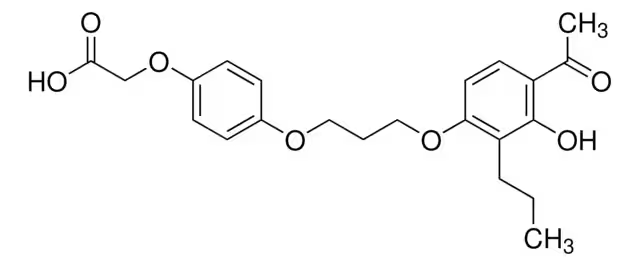
CAS Number79558-09-1
Synonyms{4-[3-(4-Acetyl-3-hydroxy-2-propylphenoxy)propoxy]phenoxy}acetic acid; l-165,041; L-165041
Molecular FormulaC22H26O7
Molecular Weight402.44
Purity96+%
Density1.2±0.1 g/cm3
Boiling Point600.8±55.0 °C at 760 mmHg
Melting Point127-128ºC(lit.)
EINECS0
Symbol
Signal WordWarning
| Chemical & Physical Properties | |
|---|---|
| CAS Number | 79558-09-1 |
| Catalog No. | 2A-0114958 |
| Chinese Name | L-165041 |
| Synonyms | {4-[3-(4-Acetyl-3-hydroxy-2-propylphenoxy)propoxy]phenoxy}acetic acid; l-165,041; L-165041 |
| Molecular Formula | C22H26O7 |
| Molecular Weight | 402.44 |
| Purity | 96+ |
| Density | 1.2±0.1 g/cm3 |
| Boiling Point | 600.8±55.0 °C at 760 mmHg |
| Melting Point | 127-128ºC(lit.) |
| Application | L-165041 is a cell-penetrating PPARδ agonist with Ki values of 6 nM and approximately 730 nM for PPARδ and PPARγ, respectively, and can induce adipocyte differentiation in NIH-PPARδ cells. |
| EINECS | 0 |
| HTC | 2918990090 |
| UN(IATA) | 0 |
| PubChem ID | 24278477 |
| SMILES | CCCc1c(OCCCOc2ccc(OCC(=O)O)cc2)ccc(C(C)=O)c1O |
| InChI Key | HBBVCKCCQCQCTJ-UHFFFAOYSA-N |
| Hazard Symbols | transportation |
| Bioactivity | L-165041 is a cell permeable PPARδ agonist, with Kis of 6 nM and appr 730 nM for PPARδ and PPARγ, respectively, and induces adipocyte differentiation in NIH-PPARδ cells. Related Catalog Research Areas >> Metabolic Disease Target PPARδ:6 nM (Ki) PPARγ:730 nM (Ki) In Vitro L-165041 is a PPARδ agonist, with Kis of 6 nM and appr 730 nM for PPARδ and PPARγ, respectively[1]. L-165041 (1 or 5 µM) inhibits VEGF-induced endothelial cells (ECs) proliferation and migration. L-165041 negatively affects cell cycle progression in VEGF-activated human umbilical vein ECs (HUVECs). L-165041 (10 µM)inhibits PPARδ-independent, VEGF-induced angiogenesis[2]. PPARδ ligand L-165041 inhibits PDGF-induced rVSMC proliferation and migration. With 1 h of L-165041 pretreatment, PDGF-induced cellular migration is inhibited. L-165041 (10 μM) significantly suppresses S phase transition induced by PDGF[4]. In Vivo L-165041 (5 mg/kg/day, i.p.) significantly lowers the formation of lipid droplets in mice. L-165041 markedly reduces the level of both the hepatic cholesterol and triglycerides in mice. L-165041 increases mRNA expression levels of PPARδ compared to the vehicle group. Lipoprotein lipase (LPL) expression in L-165041-treated mice is significantly higher than that in the vehicle group[3]. Cell Assay Human umbilical vein ECs (HUVECs) are cultured in EGM-2. Subconfluent HUVECs are made quiescent by serum starvation [EBM-2 containing 0.1% fetal bovine serum (FBS)] for 4 h. The cells are pretreated with the PPARδ ligand L-165041 or GW501516 for 6 h followed by VEGF (10 ng/mL) induction[2]. Animal Admin LDLR−/− mice are divided into vehicle (0.1 N NaOH) and L-165041 (5 mg/kg/day) group (9 animals in each group). LDLR−/− mice receive either NaOH or L-165041 via daily intraperitoneal injection (i.p.) for 16 weeks with the Western diet. Body weight is measured once a week and the blood samples for a serum parameter analysis are collected using an eye-bleeding method every 4 weeks. At the end of the experiment, LDLR−/− mice are fasted for 24 h before sacrificed and the liver samples are either fixed in formalin or frozen at −70°C for further analysis. All animals are housed in polycarbonate cages in a room with a 12-h light/12-h dark cycle, and maintained at a constant temperature of 22°C[3]. References [1]. Berger J, et al. Novel peroxisome proliferator-activated receptor (PPAR) gamma and PPARdelta ligands produce distinct biological effects. J Biol Chem. 1999 Mar 5;274(10):6718-25. [2]. Park, Jin-Hee., et al. The PPARδ ligand L-165041 inhibits vegf-induced angiogenesis, but the antiangiogenic effect is not related to PPARδ. Journal of Cellular Biochemistry (2012), 113(6), 1947-1954. [3]. Lim, Hyun-Joung., et al. PPARδ ligand L-165041 ameliorates Western diet-induced hepatic lipid accumulation and inflammation in LDLR-/- mice. European Journal of Pharmacology (2009), 622(1-3), 45-51. [4]. Lim, Hyun-Joung., et al. PPARδ agonist L-165041 inhibits rat vascular smooth muscle cell proliferation and migration via inhibition of cell cycle. Atherosclerosis (Amsterdam, Netherlands) (2009), 202(2), 446-454. Chemical & Physical Properties Density 1.2±0.1 g/cm3 Boiling Point 600.8±55.0 °C at 760 mmHg Melting Point 127-128ºC(lit.) Molecular Formula C22H26O7 Molecular Weight 402.438 Flash Point 206.5±25.0 °C Exact Mass 402.167847 PSA 102.29000 LogP 4.98 Vapour Pressure 0.0±1.8 mmHg at 25°C Index of Refraction 1.566 InChIKey HBBVCKCCQCQCTJ-UHFFFAOYSA-N SMILES CCCc1c(OCCCOc2ccc(OCC(=O)O)cc2)ccc(C(C)=O)c1O |
| Use of | L-165041 is a cell permeable PPARδ agonist, with Kis of 6 nM and appr 730 nM for PPARδ and PPARγ, respectively, and induces adipocyte differentiation in NIH-PPARδ cells. Properties Name 2-[4-[3-(4-acetyl-3-hydroxy-2-propylphenoxy)propoxy]phenoxy]acetic acid Synonym More Synonyms L-165041 Biological Activity Description L-165041 is a cell permeable PPARδ agonist, with Kis of 6 nM and appr 730 nM for PPARδ and PPARγ, respectively, and induces adipocyte differentiation in NIH-PPARδ cells. Related Catalog Research Areas >> Metabolic Disease PPARδ:6 nM (Ki) PPARγ:730 nM (Ki) In Vitro L-165041 is a PPARδ agonist, with Kis of 6 nM and appr 730 nM for PPARδ and PPARγ, respectively[1]. L-165041 (1 or 5 µM) inhibits VEGF-induced endothelial cells (ECs) proliferation and migration. L-165041 negatively affects cell cycle progression in VEGF-activated human umbilical vein ECs (HUVECs). L-165041 (10 µM)inhibits PPARδ-independent, VEGF-induced angiogenesis[2]. PPARδ ligand L-165041 inhibits PDGF-induced rVSMC proliferation and migration. With 1 h of L-165041 pretreatment, PDGF-induced cellular migration is inhibited. L-165041 (10 μM) significantly suppresses S phase transition induced by PDGF[4]. References [1]. Berger J, et al. Novel peroxisome proliferator-activated receptor (PPAR) gamma and PPARdelta ligands produce distinct biological effects. J Biol Chem. 1999 Mar 5;274(10):6718-25. [2]. Park, Jin-Hee., et al. The PPARδ ligand L-165041 inhibits vegf-induced angiogenesis, but the antiangiogenic effect is not related to PPARδ. Journal of Cellular Biochemistry (2012), 113(6), 1947-1954. [3]. Lim, Hyun-Joung., et al. PPARδ ligand L-165041 ameliorates Western diet-induced hepatic lipid accumulation and inflammation in LDLR-/- mice. European Journal of Pharmacology (2009), 622(1-3), 45-51. [4]. Lim, Hyun-Joung., et al. PPARδ agonist L-165041 inhibits rat vascular smooth muscle cell proliferation and migration via inhibition of cell cycle. Atherosclerosis (Amsterdam, Netherlands) (2009), 202(2), 446-454. Chemical & Physical Properties Molecular Formula C22H26O7 Exact Mass 402.167847 PSA 102.29000 Index of Refraction 1.566 InChIKey HBBVCKCCQCQCTJ-UHFFFAOYSA-N |
| Tax Rebate | 13.0% |
| Supervision | None. MFN tariff: 6.5%. Ordinary tariff: 30.0% |
| Transport Info | Product name: Purity: 98.0% |
| MSDS Transport Info | Module 14. Shipping information 14.1 UN dangerous goods number European Land Transport Dangerous Regulations: -International Maritime Dangerous Regulations: -International Air Transport Dangerous Regulations: - 14.2 Names specified by the United Nations (UN) European Land Transport Dangerous Regulations: Non-dangerous goods IMDG Code: Non-dangerous goods International air transport dangerous goods regulations: non-dangerous goods 14.3 Transport hazard categories European Land Transport Dangerous Regulations: -International Maritime Dangerous Regulations: -International Air Transport Dangerous Regulations: - 14.4 Package group European Land Transport Dangerous Regulations: -International Maritime Dangerous Regulations: -International Air Transport Dangerous Regulations: - 14.5 Environmental hazards European Land Transport Dangerous Regulations: No International Maritime Transport Dangerous Regulations Maritime Pollutants: No International Air Transport Risk Regulations: No 14.6 Special reminder to users No data available |
| Related Products in Specialty Chemicals | ||
|---|---|---|
| 2-(4-(2-AMINOTHIAZOL-4-YL)PHENOXY)ACETIC ACID | 168127-34-2 | 2A-0114942 |
| 2-(4-(2-BROMOPROPANOYL)PHENOXY)ACETIC ACID | 33254-93-2 | 2A-0114945 |
| 2-(4-(2-OXOIMIDAZOLIDIN-1-YL)PHENYL)ACETIC ACID | 492445-92-8 | 2A-0114953 |
| 2-(4-(2-PHENYLPROPAN-2-YL)PHENOXY)ACETIC ACID | 70757-61-8 | 2A-0114954 |
| 2-(4-(2-PHENYLPROPAN-2-YL)PHENOXY)PROPANOIC ACID | 70757-66-3 | 2A-0114956 |
| 2-(4-(3-CHLORO-2-HYDROXYPROPOXY)PHENYL)ACETAMIDE | 115538-83-5 | 2A-0114962 |
| 2-(4-(3-HYDROXY-3-METHYLBUTYL)PHENOXY)ACETIC ACID | 101268-32-0 | 2A-0114966 |
| 2-(4-(4,5-DIHYDROTHIAZOL-2-YL)PHENOXY)ACETONITRILE | 175276-95-6 | 2A-0114973 |
| 2-(4-(4-CHLOROBENZYL)-7-FLUORO-5-(METHYLSULFONYL)-1,2,3,4-TETRAHYDROCYCLOPENTA[B]INDOL-3-YL)ACETIC ACID | 571170-81-5 | 2A-0114983 |
| 2-(4-(4-FLUOROPHENYL)-2-METHYLTHIAZOL-5-YL)ACETIC ACID | 568543-71-5 | 2A-0114986 |
| Browse all Specialty Chemicals products » | ||
Phone:
630-322-8886
630-322-8887
Email:
Office Locations:
Chicago, IL, USA
San Francisco, CA, USA


 EN
EN


 SDS
SDS