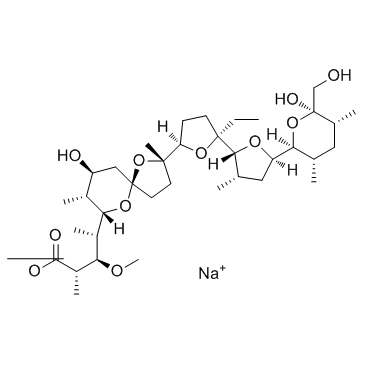
CAS Number22373-78-0
SynonymsMonensin sodium; Coban; MONENSINSODIUM,USP; RUMENSIN; EINECS 244-941-7; monensin A sodium; Monensin Sodium Salt; Sodium Monensin; Monensin A sodium salt; monensin,monosodiumsalt; Coban45; Monensim A sodium salt
Molecular FormulaC36H61NaO11
Molecular Weight692.85
Purity98%
Boiling Point766.3ºC at 760 mmHg
Melting Point267-269ºC
AppearanceAlmost white solid
Symbol
Signal WordWarning
| Chemical & Physical Properties | |
|---|---|
| CAS Number | 22373-78-0 |
| Catalog No. | 2A-9011493 |
| Chinese Name | 莫能霉素钠 |
| Synonyms | Monensin sodium; Coban; MONENSINSODIUM,USP; RUMENSIN; EINECS 244-941-7; monensin A sodium; Monensin Sodium Salt; Sodium Monensin; Monensin A sodium salt; monensin,monosodiumsalt; Coban45; Monensim A sodium salt |
| Molecular Formula | C36H61NaO11 |
| Molecular Weight | 692.85 |
| Purity | 98 |
| Boiling Point | 766.3ºC at 760 mmHg |
| Melting Point | 267-269ºC |
| Appearance | Almost white solid |
| Storage Condition | 2-8℃ |
| Packaging | II |
| Application | Monensin sodium salt is an antibiotic secreted by Streptomyces cinnamonensis. |
| SMILES | CCC1(C2OC(C3OC(O)(CO)C(C)CC3C)CC2C)CCC(C2(C)CCC3(CC(O)C(C)C(C(C)C(OC)C(C)C(=O)[O-])O3)O2)O1.[Na+] |
| InChI | InChI=1S/C36H62O11.Na/c1-10-34(31-20(3)16-26(43-31)28-19(2)15-21(4)36(41,18-37)46-28)12-11-27(44-34)33(8)13-14-35(47-33)17-25(38)22(5)30(45-35)23(6)29(42-9)24(7)32(39)40;/h19-31,37-38,41H,10-18H2,1-9H3,(H,39,40);/q;+1/p-1/t19-,20-,21+,22+,23-,24-,25-,26+,27+,28-,29+,30-,31+,33-,34-,35+,36-;/m0./s1 |
| InChI Key | XOIQMTLWECTKJL-UHFFFAOYSA-M |
| Hazard Symbols | 6.1(a) |
| MSDS | msds/11493_2_22373_78_0.pdf |
| Bioactivity | Monensin sodium salt is an antibiotic secreted by the bacteria Streptomyces cinnamonensis. Related Catalog Signaling Pathways >> Anti-infection >> Bacterial Research Areas >> Infection Target bacterial[1] In Vitro Monensin sodium salt is an antibiotic secreted by the bacteria Streptomyces cinnamonensis. Untreated cells display 2.5% apoptosis; 48 hours treatment with 1 μM Monensin sodium salt shows 4.5% apoptosis whereas 5 μM Monensin sodium salt for 48 hours induces a greater apoptotic response (16.4%). Pretreatment with either 1 or 5 μM Monensin sodium salt for 24 hours followed by 10 μM erlotinib treatment for another 24 hours results in a marked increases in apoptotic events (14.6% and 38.7%, respectively) when compare with either Monensin sodium salt or erlotinib treatments alone. Combination of 5 μM Monensin sodium salt with 10 μM erlotinib shows the highest percentage of apoptosis (38.7%)[1]. In Vivo Although the numbers of tumors do not change substantially, a significant (P=0.0144) reduction in the average size of lesions is observed in Monensin sodium salt-treated Apc+/Min mice when compare with control animals (mean 0.199 mm2 vs. 0.299 mm2). The total tumor area estimated in one animal is decreased in individuals receiving Monensin sodium salt (mean 10.16 mm2 vs. 16.46 mm2; P=0.0125). Monensin sodium salt treatment increases the numbers of apoptotic cells and cells expressing the p21 cell-cycle inhibitor at the surface area of the neoplastic outgrowths. No changes in the cell proliferation, differentiation, and tissue architecture in the healthy parts of mucosa are noted after exposure to Monensin sodium salt[2]. Cell Assay One million SCC25 cells are seeded in 10-cm plates and incubated overnight to allow for attachment and recovery. The following day, cells are pretreated with 0, 1, or 5 μM Monensin sodium salt for 24 hours then treated with 10 μM erlotinib alone or in combination with Monensin sodium salt for a further 24 hours. Adherent and cells in suspension are collected by centrifugation and fixed in 3 mL of cold 80% ethanol overnight at -20°C. Before analysis, cell pellets are washed with PBS resuspended in staining buffer containing 25 μg/mL propidium iodide and 40 μg/mL RNase A and incubated for a minimum of 1 hour in the dark at room temperature[1]. Animal Admin Multiple intestinal neoplasia (Min) mice are used in this study. Four-week-old pups are weaned, genotyped, and randomized. The animals are divided into two groups and treated with Monensin sodium salt (10 mg/kg) or vehicle (DMSO). Daily oral applications continue for 6 weeks. In addition, six pairs of Apc+/Min mice age 7, 10, 13, 16, 19, and 22 weeks are treated with Monensin sodium salt or vehicle for 5 weeks. The mice are sacrificed and the intestines are dissected, washed in PBS, and fixed in 4% formaldehyde (v/v) in PBS for 3 days. Fixed intestines are embedded in paraffin, sectioned and stained. The number and size of the neoplastic lesions are quantified using Ellipse software[2]. References [1]. Dayekh K, et al. Monensin inhibits epidermal growth factor receptor trafficking and activation: synergistic cytotoxicity in combination with EGFR inhibitors. Mol Cancer Ther. 2014 Nov;13(11):2559-71. [2]. Tumova L, et al. Monensin inhibits canonical Wnt signaling in human colorectal cancer cells and suppresses tumor growth in multiple intestinal neoplasia mice. Mol Cancer Ther. 2014 Apr;13(4):812-22. Chemical & Physical Properties Boiling Point 766.3ºC at 760 mmHg Melting Point 267-269ºC Molecular Formula C36H61NaO11 Molecular Weight 692.85 Flash Point 229.2ºC PSA 165.43000 LogP 2.87390 Vapour Pressure 4.13E-27mmHg at 25°C InChIKey XOIQMTLWECTKJL-UHFFFAOYSA-M SMILES CCC1(C2OC(C3OC(O)(CO)C(C)CC3C)CC2C)CCC(C2(C)CCC3(CC(O)C(C)C(C(C)C(OC)C(C)C(=O)[O-])O3)O2)O1.[Na+] |
| Use of | Monensin sodium salt is an antibiotic secreted by the bacteria Streptomyces cinnamonensis. Properties Articles41 Name Monensin sodium salt Synonym More Synonyms Monensin sodium salt Biological Activity Description Monensin sodium salt is an antibiotic secreted by the bacteria Streptomyces cinnamonensis. Related Catalog Signaling Pathways >> Anti-infection >> Bacterial Research Areas >> Infection bacterial[1] In Vitro Monensin sodium salt is an antibiotic secreted by the bacteria Streptomyces cinnamonensis. Untreated cells display 2.5% apoptosis; 48 hours treatment with 1 μM Monensin sodium salt shows 4.5% apoptosis whereas 5 μM Monensin sodium salt for 48 hours induces a greater apoptotic response (16.4%). Pretreatment with either 1 or 5 μM Monensin sodium salt for 24 hours followed by 10 μM erlotinib treatment for another 24 hours results in a marked increases in apoptotic events (14.6% and 38.7%, respectively) when compare with either Monensin sodium salt or erlotinib treatments alone. Combination of 5 μM Monensin sodium salt with 10 μM erlotinib shows the highest percentage of apoptosis (38.7%)[1]. References [1]. Dayekh K, et al. Monensin inhibits epidermal growth factor receptor trafficking and activation: synergistic cytotoxicity in combination with EGFR inhibitors. Mol Cancer Ther. 2014 Nov;13(11):2559-71. [2]. Tumova L, et al. Monensin inhibits canonical Wnt signaling in human colorectal cancer cells and suppresses tumor growth in multiple intestinal neoplasia mice. Mol Cancer Ther. 2014 Apr;13(4):812-22. Chemical & Physical Properties Molecular Formula C36H61NaO11 PSA 165.43000 LogP 2.87390 InChIKey XOIQMTLWECTKJL-UHFFFAOYSA-M |
| Transport Info | Shipping Name: UN |
| MSDS Transport Info | Module 14. Shipping information 14.1 UN dangerous goods number European Land Transport Danger Regulations: 3462 International Maritime Transport Danger Regulations: 3462 International Air Transport Danger Regulations: 3462 14.2 United Nations shipping name European Land Transport Dangerous Regulations: TOXINS EXTRACTED FROM LIVING SOURCES, SOLID, N.O.S. (Monensin, monosodium salt hydrate) IMDG Code: TOXINS, EXTRACTED FROM LIVING SOURCES, SOLID, N.O.S. (Monensin, monosodium salt hydrate) International air transport hazard regulations: Toxins, extracted from living sources, solid, n.o.s. (Monensin, monosodium salt hydrate) 14.3 Transport hazard categories European Land Transport Danger Regulations: 6.1 International Maritime Transport Danger Regulations: 6.1 International Air Transport Danger Regulations: 6.1 14.4 Package group European Dangerous Regulations for land transport: II International Dangerous Regulations for sea transport: II International Dangerous Regulations for air transport: II 14.5 Environmental hazards European Land Transport Danger Regulations: No International Maritime Danger Regulations International Air Transport Danger Regulations: No Marine pollutants (yes/no): No 14.6 Special reminder to users No data available |
| Related Products in Specialty Chemicals | ||
|---|---|---|
| Monalazone disodium | 61477-95-0 | 2A-9011488 |
| Monastrol | 329689-23-8 | 2A-9011489 |
| Monatepil | 132019-54-6 | 2A-9011490 |
| Monceren | 66063-05-6 | 2A-9011491 |
| Monensin | 17090-79-8 | 2A-9011492 |
| Monocrotophos | 6923-22-4 | 2A-9011494 |
| Monosultap | 52207-48-4 | 2A-9011496 |
| Monteplase | 156616-23-8 | 2A-9011499 |
| Mopidralazine | 75841-82-6 | 2A-9011500 |
| Moprolol | 5741-22-0 | 2A-9011501 |
| Browse all Specialty Chemicals products » | ||
Phone:
630-322-8886
630-322-8887
Email:
Office Locations:
Chicago, IL, USA
San Francisco, CA, USA


 EN
EN


 SDS
SDS