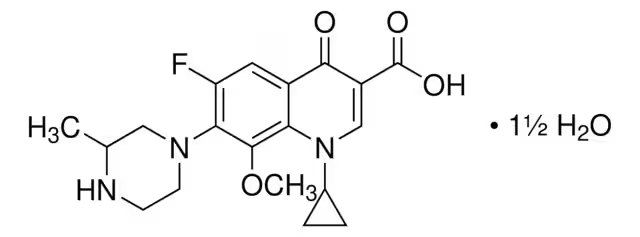
CAS Number180200-66-2
SynonymsGatifloxacin formic acid ethyl ester; TEQUIN; UNII:L4618BD7KJ; Gatifloxacin Tablet; Gatifloxacin Monohydrate; Gatifloxacin sesquihydrate
Molecular FormulaC19H22FN3O4.3/2H2O
Molecular Weight402.42
Purity≥98 (HPLC)%
Density1.386 g/cm3
Boiling Point607.8ºC at 760 mmHg
Appearancepowder
Symbol
Signal WordWarning
| Chemical & Physical Properties | |
|---|---|
| CAS Number | 180200-66-2 |
| Catalog No. | 2A-9001148 |
| Chinese Name | 加替沙星水合物 |
| Synonyms | Gatifloxacin formic acid ethyl ester; TEQUIN; UNII:L4618BD7KJ; Gatifloxacin Tablet; Gatifloxacin Monohydrate; Gatifloxacin sesquihydrate |
| Molecular Formula | C19H22FN3O4.3/2H2O |
| Molecular Weight | 402.42 |
| Purity | ≥98 (HPLC) |
| Density | 1.386 g/cm3 |
| Boiling Point | 607.8ºC at 760 mmHg |
| Appearance | powder |
| Storage Condition | Room temperature, dry |
| Application | Gatifloxacin sesquihydrate (AM-1155; BMS-206584; PD135432) is a potent fluoroquinolone antibiotic (antibiotic) with broad-spectrum antibacterial activity. Gatifloxacin sesquihydrate inhibits bacterial |
| HTC | 2933990090 |
| MDL Number | MFCD22373645 |
| SMILES | O=C(O)C1=CN(C2CC2)C3=C(OC)C(N4CCNC(C)C4)=C(F)C=C3C1=O.O=C(O)C5=CN(C6CC6)C7=C(OC)C(N8CCNC(C)C8)=C(F)C=C7C5=O.O.O.O |
| InChI | 1S/2C19H22FN3O4.3H2O/c2*1-10-8-22(6-5-21-10)16-14(20)7-12-15(18(16)27-2)23(11-3-4-11)9-13(17(12)24)19(25)26;;;/h2*7,9-11,21H,3-6,8H2,1-2H3,(H,25,26);3*1H2 |
| InChI Key | RMJMZKDEVNTXHE-UHFFFAOYSA-N |
| Beilstein/REAXYS | 14390028 |
| NACRES Code | NA.77 |
| UNSPSC | 12352200 |
| Hazard Symbols | Transport |
| MSDS | msds/1148_1_180200_66_2.pdf |
| Bioactivity | Gatifloxacin sesquihydrate (AM-1155; BMS-206584; PD135432) is a potent fluoroquinolone antibiotic with broad-spectrum antibacterial activity. Gatifloxacin sesquihydrate inhibits bacterial type II topoisomerases (IC50=13.8 μg/ml for S. aureus topoisomerase IV) and E. coli DNA gyrase (IC50 = 0.109 μg/ml)[1]. Gatifloxacin sesquihydrate can be used to treat bacterial conjunctivitis in vivo. Related Catalog Signaling Pathways >> Cell Cycle/DNA Damage >> Topoisomerase Research Areas >> Infection Research Areas >> Inflammation/Immunology Signaling Pathways >> Anti-infection >> Bacterial Target Topoisomerase II:36.7 μM (IC50) In Vitro Gatifloxacin sesquihydrate is against S. aureus MS5935 topoisomerase IV, E. coli NIHJ JC-2 DNA gyrase and HeLa cell topoisomerase II with IC50 values of 13.8 μg/ml, 0.109 μg/ml, and 265 μg/ml, respectively[1]. Gatifloxacin sesquihydrate is against S. aureus MS5935 topoisomerase IV, E. coli NIHJ JC-2 DNA gyrase and HeLa cell topoisomerase II with MIC values of 0.05 μg/ml, 0.0063 μg/ml, and 122 μg/ml, respectively[1]. Gatifloxacin sesquihydrate exhibits antibacterial activities for wild-type strains (MS5935, MS5952, MR5867 and MR6009) the first-, second-, third-, and fourth-step mutants with MIC values of 0.05 to 0.10 μg/ml, 0.20 μg/ml, 1.56 to 3.13 μg/ml, 1.56 to 6.25 μg/ml, and 50 to 200 μg/ml, respectively. Gatifloxacin sesquihydrate displays the most potent activity against the second- and third-step mutants (MS5952, MR5867 and MR6009) except for the second-step mutant of strain MS5935[2]. Gatifloxacin sesquihydrate has potent activity against norA transformant NY12 (MIC, 0.39 μg/ml)[2]. Gatifloxacin sesquihydrate (20-100 μM; 72 hours) significantly decreases insulin content to 60% at Day 1, and continues to be reduced to 50.1% and 44.7% at Day 3 by 20 μM and 100 μM Gatifloxacin sesquihydrate, respectively[3]. In Vivo Gatifloxacin sesquihydrate (subcutaneous injection; 100 mg/kg; 3 times a day; 30 days) significantly decreases the number of lesions in mouse footpad with Nocardia brasiliensis[4]. Animal Model: Female BALB/c mice with Nocardia brasiliensis in the right hind footpad[4] Dosage: 100 mg/kg Administration: Subcutaneous injection; 3 times a day; 30 days Result: Reduced the production of lesions in mice. References [1]. Takei M, et al. Inhibitory activities of Gatifloxacin mesylate (AM-1155), a newly developed fluoroquinolone, against bacterial and mammalian type II topoisomerases.Antimicrob Agents Chemother. 1998 Oct;42(10):2678-81. [2]. Fukuda H, et al. Antibacterial activity of Gatifloxacin mesylate (AM-1155, CG5501, BMS-206584), a newly developed fluoroquinolone, against sequentially acquired quinolone-resistant mutants and the norA transformant of Staphylococcus aureus. Antimicrob Agents Chemother. 1998 Aug;42(8):1917-22. [3]. Yamada C, et al. Gatifloxacin mesylate acutely stimulates insulin secretion and chronically suppresses insulin biosynthesis. Eur J Pharmacol. 2006 Dec 28;553(1-3):67-72. Epub 2006 Sep 28. [4]. Daw-Garza A, et al. In vivo therapeutic effect of Gatifloxacin mesylate on BALB/c mice infected with Nocardia brasiliensis.Antimicrob Agents Chemother. 2008 Apr;52(4):1549-50. Chemical & Physical Properties Density 1.386 g/cm3 Boiling Point 607.8ºC at 760 mmHg Molecular Formula C19H22FN3O4.3/2H2O Molecular Weight 804.834 Flash Point 321.4ºC Exact Mass 804.350586 PSA 195.29000 LogP 4.55550 Vapour Pressure 6.43E-23mmHg at 25°C InChIKey RMJMZKDEVNTXHE-UHFFFAOYSA-N SMILES COc1c(N2CCNC(C)C2)c(F)cc2c(=O)c(C(=O)O)cn(C3CC3)c12.COc1c(N2CCNC(C)C2)c(F)cc2c(=O)c(C(=O)O)cn(C3CC3)c12.O.O.O |
| Use of | Gatifloxacin sesquihydrate (AM-1155; BMS-206584; PD135432) is a potent fluoroquinolone antibiotic with broad-spectrum antibacterial activity. Gatifloxacin sesquihydrate inhibits bacterial type II topoisomerases (IC50=13.8 μg/ml for S. aureus topoisomerase IV) and E. coli DNA gyrase (IC50 = 0.109 μg/ml)[1]. Gatifloxacin sesquihydrate can be used to treat bacterial conjunctivitis in vivo. Properties Name 1-Cyclopropyl-6-fluoro-8-methoxy-7-(3-methylpiperazin-1-yl)-4-oxo-1,4-dihydroquinoline-3-carboxylic acid sesquihydrate Synonym More Synonyms Gatifloxacin sesquihydrate Biological Activity Description Gatifloxacin sesquihydrate (AM-1155; BMS-206584; PD135432) is a potent fluoroquinolone antibiotic with broad-spectrum antibacterial activity. Gatifloxacin sesquihydrate inhibits bacterial type II topoisomerases (IC50=13.8 μg/ml for S. aureus topoisomerase IV) and E. coli DNA gyrase (IC50 = 0.109 μg/ml)[1]. Gatifloxacin sesquihydrate can be used to treat bacterial conjunctivitis in vivo. Related Catalog Signaling Pathways >> Cell Cycle/DNA Damage >> Topoisomerase Research Areas >> Infection Research Areas >> Inflammation/Immunology Signaling Pathways >> Anti-infection >> Bacterial Topoisomerase II:36.7 μM (IC50) In Vitro Gatifloxacin sesquihydrate is against S. aureus MS5935 topoisomerase IV, E. coli NIHJ JC-2 DNA gyrase and HeLa cell topoisomerase II with IC50 values of 13.8 μg/ml, 0.109 μg/ml, and 265 μg/ml, respectively[1]. Gatifloxacin sesquihydrate is against S. aureus MS5935 topoisomerase IV, E. coli NIHJ JC-2 DNA gyrase and HeLa cell topoisomerase II with MIC values of 0.05 μg/ml, 0.0063 μg/ml, and 122 μg/ml, respectively[1]. Gatifloxacin sesquihydrate exhibits antibacterial activities for wild-type strains (MS5935, MS5952, MR5867 and MR6009) the first-, second-, third-, and fourth-step mutants with MIC values of 0.05 to 0.10 μg/ml, 0.20 μg/ml, 1.56 to 3.13 μg/ml, 1.56 to 6.25 μg/ml, and 50 to 200 μg/ml, respectively. Gatifloxacin sesquihydrate displays the most potent activity against the second- and third-step mutants (MS5952, MR5867 and MR6009) except for the second-step mutant of strain MS5935[2]. Gatifloxacin sesquihydrate has potent activity against norA transformant NY12 (MIC, 0.39 μg/ml)[2]. Gatifloxacin sesquihydrate (20-100 μM; 72 hours) significantly decreases insulin content to 60% at Day 1, and continues to be reduced to 50.1% and 44.7% at Day 3 by 20 μM and 100 μM Gatifloxacin sesquihydrate, respectively[3]. References [1]. Takei M, et al. Inhibitory activities of Gatifloxacin mesylate (AM-1155), a newly developed fluoroquinolone, against bacterial and mammalian type II topoisomerases.Antimicrob Agents Chemother. 1998 Oct;42(10):2678-81. [2]. Fukuda H, et al. Antibacterial activity of Gatifloxacin mesylate (AM-1155, CG5501, BMS-206584), a newly developed fluoroquinolone, against sequentially acquired quinolone-resistant mutants and the norA transformant of Staphylococcus aureus. Antimicrob Agents Chemother. 1998 Aug;42(8):1917-22. [3]. Yamada C, et al. Gatifloxacin mesylate acutely stimulates insulin secretion and chronically suppresses insulin biosynthesis. Eur J Pharmacol. 2006 Dec 28;553(1-3):67-72. Epub 2006 Sep 28. [4]. Daw-Garza A, et al. In vivo therapeutic effect of Gatifloxacin mesylate on BALB/c mice infected with Nocardia brasiliensis.Antimicrob Agents Chemother. 2008 Apr;52(4):1549-50. Chemical & Physical Properties Exact Mass 804.350586 PSA 195.29000 LogP 4.55550 InChIKey RMJMZKDEVNTXHE-UHFFFAOYSA-N |
| Tax Rebate | 13.0% |
| Supervision | None. MFN tariff: 6.5%. Ordinary tariff: 20.0% |
| Transport Info | Shipping Name: UN |
| MSDS Transport Info | Module 14. Shipping information 14.1 UN dangerous goods number European Land Transport Dangerous Regulations: -International Maritime Dangerous Regulations: -International Air Transport Dangerous Regulations: - 14.2 United Nations shipping name European Land Transport Dangerous Regulations: Non-dangerous goods IMDG Code: Non-dangerous goods International air transport dangerous goods regulations: non-dangerous goods 14.3 Transport hazard categories European Land Transport Dangerous Regulations: -International Maritime Dangerous Regulations: -International Air Transport Dangerous Regulations: - 14.4 Package group European Land Transport Dangerous Regulations: -International Maritime Dangerous Regulations: -International Air Transport Dangerous Regulations: - 14.5 Environmental hazards European Land Transport Danger Regulations: No International Maritime Danger Regulations International Air Transport Danger Regulations: No Marine pollutants (yes/no): No 14.6 Special reminder to users No data available The above information is believed to be correct, but is not all-inclusive and should be used as a guide only. The information in this document is based on our current knowledge and is Correct safety instructions apply to this product. This information does not represent a warranty as to the properties of this product. See reverse side of invoice or packing slip. |
| Related Products in Heterocyclic Building Blocks | ||
|---|---|---|
| 1-Cyclooctylpiperazine | 21043-43-6 | 2A-9001142 |
| 1-Cyclopentylpiperazine | 21043-40-3 | 2A-9001143 |
| 1-Cyclopropyl-6,7-difluoro-8-methoxy-4-oxo-1,4-dihydroquinoline-3-carboxylic acid | 1128-72-0 | 2A-9001145 |
| 1-Cyclopropyl-6,7-difluoro-8-methoxy-4-oxo-1,4-dihydroquinoline-3-carboxylic acid ethyl ester | 112811-71-9 | 2A-9001146 |
| 1-Cyclopropyl-6,7-difluoro-8-methoxy-4-oxo-3-quinolinecarboxylic acid | 112811-72-0 | 2A-9001147 |
| 1-Decylpiperazine | 63207-03-4 | 2A-9001149 |
| 1-Ethoxycarbonyl-4-(methylamino)piperidine | 73733-69-4 | 2A-9001157 |
| 1-Ethyl-1,2-dihydro-6-hydroxy-4-methyl-2-oxo-3-benzoylpyridine | 29097-12-9 | 2A-9001158 |
| 1-Ethyl-2,3-dioxopiperazine | 59702-31-7 | 2A-9001159 |
| 1-Ethyl-2-pyrrolidone | 2687-91-4 | 2A-9001160 |
| Browse all Heterocyclic Building Blocks products » | ||
Phone:
630-322-8886
630-322-8887
Email:
Office Locations:
Chicago, IL, USA
San Francisco, CA, USA


 EN
EN


 SDS
SDS