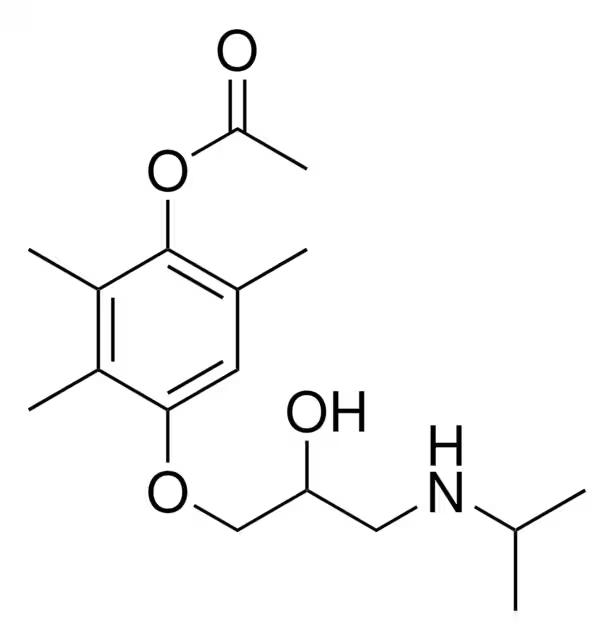
CAS Number22664-55-7
Synonymsmethypranol; 4-{2-hydroxy-3-[(1-methylethyl)amino]propoxy}-2,3,6-trimethylphenyl acetate; [4-[2-hydroxy-3-(propan-2-ylamino)propoxy]-2,3,6-trimethylphenyl] acetate; Trimepranol; Turoptin; Disorat; metipronalol; OptiPranolol; Metipranololum [INN-Latin]; Metipranololum
Molecular FormulaC17H27NO4
Molecular Weight309.409
Purity98.00%
Density1.068g/cm3
Boiling Point458.7ºC at 760mmHg
Symbol
Signal WordWarning
| Chemical & Physical Properties | |
|---|---|
| CAS Number | 22664-55-7 |
| Catalog No. | 2A-9011407 |
| Chinese Name | 美替洛尔 |
| Synonyms | methypranol; 4-{2-hydroxy-3-[(1-methylethyl)amino]propoxy}-2,3,6-trimethylphenyl acetate; [4-[2-hydroxy-3-(propan-2-ylamino)propoxy]-2,3,6-trimethylphenyl] acetate; Trimepranol; Turoptin; Disorat; metipronalol; OptiPranolol; Metipranololum [INN-Latin]; Metipranololum |
| Molecular Formula | C17H27NO4 |
| Molecular Weight | 309.409 |
| Purity | 98.00 |
| Density | 1.068g/cm3 |
| Boiling Point | 458.7ºC at 760mmHg |
| Application | Metipranolol is a non-selective, orally active beta-adrenergic receptor antagonist. Metipranolol is used in research into hypertension and glaucoma. |
| HTC | 2922509090 |
| MDL Number | MFCD00864567 |
| SMILES | CC(=O)Oc1c(C)cc(OCC(O)CNC(C)C)c(C)c1C |
| InChI | InChI=1S/C17H27NO4/c1-10(2)18-8-15(20)9-21-16-7-11(3)17(22-14(6)19)13(5)12(16)4/h7,10,15,18,20H,8-9H2,1-6H3 |
| InChI Key | BQIPXWYNLPYNHW-UHFFFAOYSA-N |
| Hazard Symbols | Transport |
| MSDS | msds/11407_1_22664_55_7.pdf |
| Bioactivity | Metipranolol is a nonselective and orally active β-adrenergic receptor antagonist. Metipranolol can be used for hypertension and glaucoma research[1][2]. Related Catalog Research Areas >> Cardiovascular Disease Signaling Pathways >> GPCR/G Protein >> Adrenergic Receptor Target β1 adrenoceptor:8.3 (pA2) β2 adrenoceptor:8.4 (pA2) In Vitro In vitro β1- and β2-adrenoceptor antagonism is evaluated using the guinea pig atrium and the rat uterus, respectively. The respective pA2 values are 8.3 and 8.4[2]. Metipranolol significantly reduces iron/ascorbate-induced lipid peroxidation in rat brain homogenates with an IC50 value of 6.9 μM . Metipranolol also concentration-dependently inhibits sodium nitroprusside-stimulated lipid peroxidation in rat brain homogenates, displaying an IC50 value of 25.1 μM[3]. In Vivo At postnatal day 35 (P35), rd10 mice given daily subcutaneous injections of 40 mg/kg of Metipranolol has reduction in markers of nitrosative stress, fewer TUNEL-positive cells, increased outer nuclear layer thickness, and substantially more staining for rhodopsin. At P50, Metipranolol-treated rd10 mice has decreased 3-nitrotyrosine staining in the retina, increased immunostaining for cone arrestin, a marker for cone photoreceptors, and significantly higher scotopic and photopic b-wave amplitudes at the highest stimulus intensity. At P65, cone density is significantly higher in Metipranolol-treated versus vehicle-injected rd10 mice[1]. References [1]. Yogita Kanan, et al. Metipranolol promotes structure and function of retinal photoreceptors in the rd10 mouse model of human retinitis pigmentosa. J Neurochem. 2019 Jan;148(2):307-318. [2]. M F Sugrue, et al. A study on the ocular and extraocular pharmacology of metipranolol. Graefes Arch Clin Exp Ophthalmol. 1985;222(3):123-7. [3]. José Melena, et al. Metipranolol attenuates lipid peroxidation in rat brain: a comparative study with other antiglaucoma drugs. Graefes Arch Clin Exp Ophthalmol. 2003 Oct;241(10):827-33. Chemical & Physical Properties Density 1.068g/cm3 Boiling Point 458.7ºC at 760mmHg Molecular Formula C17H27NO4 Molecular Weight 309.40100 Flash Point 231.2ºC Exact Mass 309.19400 PSA 67.79000 LogP 2.66570 Vapour Pressure 3.29E-09mmHg at 25°C Index of Refraction 1.512 InChIKey BQIPXWYNLPYNHW-UHFFFAOYSA-N SMILES CC(=O)Oc1c(C)cc(OCC(O)CNC(C)C)c(C)c1C |
| Use of | Metipranolol is a nonselective and orally active β-adrenergic receptor antagonist. Metipranolol can be used for hypertension and glaucoma research[1][2]. Properties Name metipranolol Synonym More Synonyms Metipranolol Biological Activity Description Metipranolol is a nonselective and orally active β-adrenergic receptor antagonist. Metipranolol can be used for hypertension and glaucoma research[1][2]. Related Catalog Research Areas >> Cardiovascular Disease Signaling Pathways >> GPCR/G Protein >> Adrenergic Receptor β1 adrenoceptor:8.3 (pA2) β2 adrenoceptor:8.4 (pA2) In Vitro In vitro β1- and β2-adrenoceptor antagonism is evaluated using the guinea pig atrium and the rat uterus, respectively. The respective pA2 values are 8.3 and 8.4[2]. Metipranolol significantly reduces iron/ascorbate-induced lipid peroxidation in rat brain homogenates with an IC50 value of 6.9 μM . Metipranolol also concentration-dependently inhibits sodium nitroprusside-stimulated lipid peroxidation in rat brain homogenates, displaying an IC50 value of 25.1 μM[3]. References [2]. M F Sugrue, et al. A study on the ocular and extraocular pharmacology of metipranolol. Graefes Arch Clin Exp Ophthalmol. 1985;222(3):123-7. [3]. José Melena, et al. Metipranolol attenuates lipid peroxidation in rat brain: a comparative study with other antiglaucoma drugs. Graefes Arch Clin Exp Ophthalmol. 2003 Oct;241(10):827-33. Chemical & Physical Properties Molecular Formula C17H27NO4 Exact Mass 309.19400 PSA 67.79000 LogP 2.66570 Index of Refraction 1.512 InChIKey BQIPXWYNLPYNHW-UHFFFAOYSA-N |
| Tax Rebate | 13.0% |
| Supervision | A. Customs clearance form for inbound goods B. Customs clearance form for outbound goods |
| Inspection | R. Hygiene supervision and inspection of imported food S. Hygiene supervision and inspection of exported food |
| Transport Info | Product name: Purity: 98.0% |
| MSDS Transport Info | Module 14. Shipping information European Land Transport Dangerous Regulations: -International Maritime Dangerous Regulations: -International Air Transport Dangerous Regulations: - 14.2 Names specified by the United Nations (UN) European Land Transport Dangerous Regulations: Non-dangerous goods IMDG Code: Non-dangerous goods International air transport dangerous goods regulations: non-dangerous goods 14.3 Transport hazard categories European Land Transport Dangerous Regulations: -International Maritime Dangerous Regulations: -International Air Transport Dangerous Regulations: - 14.4 Package group European Land Transport Dangerous Regulations: -International Maritime Dangerous Regulations: -International Air Transport Dangerous Regulations: - 14.5 Environmental hazards European Land Transport Dangerous Regulations: No International Maritime Transport Dangerous Regulations Maritime Pollutants: No International Air Transport Risk Regulations: No 14.6 Special reminder to users No data available |
| Related Products in Specialty Chemicals | ||
|---|---|---|
| Methyldymron | 42609-73-4 | 2A-9011399 |
| Methyloleanolate | 1724-17-0 | 2A-9011400 |
| Methyltrienolone | 965-93-5 | 2A-9011404 |
| Methysticin | 495-85-2 | 2A-9011405 |
| Metibride | 77989-60-7 | 2A-9011406 |
| Metobromuron | 3060-89-7 | 2A-9011408 |
| Metolazone | 17560-51-9 | 2A-9011412 |
| Metoquizine | 7125-67-9 | 2A-9011415 |
| Metosulam | 139528-85-1 | 2A-9011416 |
| Metrafazoline | 38349-38-1 | 2A-9011417 |
| Browse all Specialty Chemicals products » | ||
Phone:
630-322-8886
630-322-8887
Email:
Office Locations:
Chicago, IL, USA
San Francisco, CA, USA


 EN
EN


 SDS
SDS