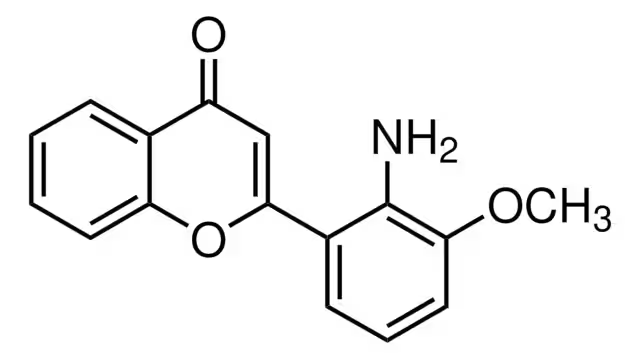
CAS Number167869-21-8
Synonyms2'-AMINO-3'-METHOXYFLAVONE; 2-(2-Amino-3-methoxyphenyl)-4H-chromen-4-one; 2-(2-Amino-3-methoxyphenyl)-4H-1-benzopyran-4-one; PD 98059; 2-(2-Amino-3-methoxyphenyl)chromone; MFCD00671789; 4H-1-Benzopyran-4-one,2-(2-Amino-3-methoxyphenyl); 2-(2-amino-3-methoxyphenyl)chromen-4-one; 2-(2-Amino-3-methoxyphenyl)-chromen-4-one; PD98059
Molecular FormulaC16H13NO3
Molecular Weight267.28
Purity96+%
Density1.3±0.1 g/cm3
Boiling Point453.1±45.0 °C at 760 mmHg
Melting Point170 °C
Appearanceyellow solid
EINECS0
Symbol
Signal WordWarning
| Chemical & Physical Properties | |
|---|---|
| CAS Number | 167869-21-8 |
| Catalog No. | 2A-0113868 |
| Chinese Name | PD 098,059 (2-(2-氨基-3-甲氧基苯基)- 4H-1-苯吡喃-4-酮 |
| Synonyms | 2'-AMINO-3'-METHOXYFLAVONE; 2-(2-Amino-3-methoxyphenyl)-4H-chromen-4-one; 2-(2-Amino-3-methoxyphenyl)-4H-1-benzopyran-4-one; PD 98059; 2-(2-Amino-3-methoxyphenyl)chromone; MFCD00671789; 4H-1-Benzopyran-4-one,2-(2-Amino-3-methoxyphenyl); 2-(2-amino-3-methoxyphenyl)chromen-4-one; 2-(2-Amino-3-methoxyphenyl)-chromen-4-one; PD98059 |
| Molecular Formula | C16H13NO3 |
| Molecular Weight | 267.28 |
| Purity | 96+ |
| Density | 1.3±0.1 g/cm3 |
| Boiling Point | 453.1±45.0 °C at 760 mmHg |
| Melting Point | 170 °C |
| Appearance | yellow solid |
| Water Solubility | ethanol: 0.6 mg/mL |
| Storage Condition | −20°C |
| Application | PD98059 is a potent, selective and cell-permeable inhibitor of MEK1 and MEK2 with IC50 of 4 μM and 50 μM, respectively. |
| EINECS | 0 |
| HTC | 2922509090 |
| UN(IATA) | 0 |
| SMILES | COc1cccc(-c2cc(=O)c3ccccc3o2)c1N |
| InChI | InChI=1S/C16H13NO3/c1-19-14-8-4-6-11(16(14)17)15-9-12(18)10-5-2-3-7-13(10)20-15/h2-9H,17H2,1H3 |
| InChI Key | QFWCYNPOPKQOKV-UHFFFAOYSA-N |
| Hazard Symbols | transportation |
| Bioactivity | PD98059 is a potent, selective and cell-permeable MEK1 and MEK2 inhibitor with IC50s of 4 μM and 50 μM respectively. Related Catalog Signaling Pathways >> Autophagy >> Autophagy Signaling Pathways >> MAPK/ERK Pathway >> MEK Research Areas >> Cancer Target MEK:5 μM (IC50) Autophagy In Vitro Concentrations of PD98059 of ≤20 μM are not cytotoxic to cultured MCF10A, MCF10A-Neo, and MCF10A-NeoT cells. However, PD98059 is weakly cytostatic to all three lines at concentrations of ≥10 μM. Treatment of MCF10A-Neo and MCF10A-NeoT cultures with concentrations of PD98059 up to 20 μM for 2-22 hr does not alter the total ERK content. However, treatment with PD98059 does result in concentration-dependent reductions in the dually phosphorylated forms of ERK1 and ERK2. Within 2 hr of a 10-μM treatment, phosphorylated ERK contents are reduced ~74% and ~86% in MCF10A-Neo and MCF10A-NeoT cultures, respectively (IC50=1 μM). Within 22 hr of treatment, phosphorylated ERK forms are almost completely eliminated in both cell lines[1]. PD98059 (PD 098059) prevents the activation of MAPKK1 by Raf or MEK kinase in vitro at concentrations (IC50=2-7 μM). PD98059 inhibits both the activation and phosphorylation of MAPKK1 in vitro by either c-Raf or MEK kinase with IC50 values of 4±2 μM. Incubation of Swiss 3T3 cells with PD98059 (50 μM) suppressed by 80-90% the activation of MAPKK induced by each agonist, but the activation of c-Raf is enhanced 2-3-fold[2]. In Vivo The treatment of mice with PD98059 significantly reduces the level of p-ERK1/2. Moreover, a significant increase in the phospho-p38 expression is observed in Zymosan-treated mice at 18 h after Zymosan administration compared to the sham-operated mice. The treatment with PD98059 significantly reduces the p38 expression[3]. Repeated treatment with PD98059 attenuates mechanical allodynia measured by the von Frey test three (18.0 g±0.8, n=10) and seven (20.21 g±0.67, n=26) days after CCI in comparison to the vehicle-treated CCI-exposed rats (15.1 g±1.3, n=7 and 14.21 g±0.44, n=28, respectively). Repeated injection of PD98059 diminishes thermal hyperalgesia, as is evaluated by the cold plate test, three (17.5 s±2.1, n=10) and seven (25.54 s±1.03, n=26) days following CCI compared to vehicle-treated CCI-exposed rats (11.5 s±1.8, n=7 and 11.4 s±0.88, n=28, respectively)[4]. Kinase Assay Kinase reactions are performed in 50 μL reaction volumes and contain 50 mM Tris, pH 7.4, 10 mM MgCl2, 2 mM EGTA, 10 μM ATP (containing 1 μCi of 3000 Ci/mmol [γ-32P]ATP), 7.6 μg of GST-MEK1, 7.2 μg of GST-ERK1, and 20 μg of MBP. PD98059 and other flavonoids are added to the reactions mixtures immediately after the addition of GST-MEK1 but before the addition of GST-ERK1 and ATP. Control reactions contain ERK1 and MBP but no MEK. Reaction mixtures are incubated at 30°C for 15 min before being stopped by the addition of Laemmli's SDS sample buffer. Proteins are separated on SDS-15% polyacrylamide gels. After vacuum drying of the gel, radioactivity is detected by autoradiography on X-ray film or phosphoimaging using a BioRad GS-525 Molecular Imager[1]. Cell Assay The MCF10A, MCF10A-Neo, and MCF10A-NeoT cell lines are used. Subconfluent cultures are treated with PD98059 (0-100 μM). Viability of cells after treatment is assessed by ability to exclude trypan blue. Cultures earmarked for RNA isolation are washed twice with phosphate-buffered saline (2.7 mM KCl, 1.5 mM KH2PO4, 137 mM NaCl, 8 mM Na2HPO4, pH 7.2) at harvesting and stored at -80°C[1]. Animal Admin Mice[3] Male CD mice (20-22 g) are randomly allocated into the following groups: 1. Zymosan+DMSO group. Mice are treated intraperitoneally (i.p.) with Zymosan (500 mg/kg, suspended in saline solution) and with the vehicle for PD98059 (10% DMSO, v/v) i.p. 1 and 6 h after Zymosan administration (N=10). 2. PD98059 group. Identical to the Zymosan+DMSO group but are administered PD98059 (10 mg/kg, i.p. bolus) at 1 and 6 h after Zymosan (N=10) instead of DMSO. 3. Sham+DMSO group. Identical to the Zymosan+DMSO group but are administered saline solution instead of Zymosan (N=10). 4. Sham+PD98059 group. Identical to Sham+DMSO group, except for the administration of PD98059 (10 mg/kg i.p. bolus) 1 and 6 h after saline administration (N=10). Rats[4] The rats (male Wistar, 300-350 g) are used. The PD98059 (2.5 μg/5 μL, i.t.) is single or repeated preemptively administered 16 h and 1 h before CCI and then once daily for 7 days. The Vehicle-treated CCI-exposed rats receive 75% DMSO according to the same schedule. There is no significant difference in pain behavior between no-treated and V(DMSO)-treated CCI-exposed rats. This method of PD98059 or vehicle administration is used throughout the study and is referred to in the text as "repeated administration". At day 7th after CCI 30 min after PD98059 administration tactile allodynia is measured using von Frey test and thermal hyperalgesia is conducted using cold plate test. Additionally, at day 7th after CCI the vehicle-treated and PD98059-treated rats receive a single i.t. vehicle, Morphine (2.5 μg/5 μL) or Buprenorphine (2.5 μg/5 μL) injection 30 min after PD98059, and then 30 min later the von Frey and/or cold plate tests are repeated. Since the dose of morphine 2.5 μg/5 μL in naive rats produces maximal analgesic effect in tail-flick test. Lower dose of Morphine are used for co-administration experiments, so that observing the possible enhancement of opioid effectiveness. The vehicle-treated and PD98059-treated naive rats (uninjured rats) receive a single i.t. vehicle, Morphine (0.5 μg/5 μL) or Buprenorphine (2.5 μg/5 μL) injection 30 min after PD98059, and then 30 min later the tail flick test is performed. References [1]. Reiners JJ Jr, et al. PD98059 is an equipotent antagonist of the aryl hydrocarbon receptor and inhibitor of mitogen-activated protein kinase kinase. Mol Pharmacol. 1998 Mar;53(3):438-45. [2]. Alessi DR, et al. PD 098059 is a specific inhibitor of the activation of mitogen-activated protein kinase kinase in vitro and in vivo. J Biol Chem, 1995, 270(46), 27489-27494. [3]. Di Paola R, et al. PD98059, a specific MAP kinase inhibitor, attenuates multiple organ dysfunction syndrome/failure (MODS) induced by zymosan in mice. Pharmacol Res. 2010 Feb;61(2):175-87. [4]. Rojewska E, et al. PD98059 Influences Immune Factors and Enhances Opioid Analgesia in Model of Neuropathy. PLoS One. 2015 Oct 1;10(10):e0138583. Chemical & Physical Properties Density 1.3±0.1 g/cm3 Boiling Point 453.1±45.0 °C at 760 mmHg Melting Point 170 °C Molecular Formula C16H13NO3 Molecular Weight 267.279 Flash Point 221.9±25.0 °C Exact Mass 267.089539 PSA 65.46000 LogP 2.43 Vapour Pressure 0.0±1.1 mmHg at 25°C Index of Refraction 1.652 InChIKey QFWCYNPOPKQOKV-UHFFFAOYSA-N SMILES COc1cccc(-c2cc(=O)c3ccccc3o2)c1N Storage condition −20°C Water Solubility ethanol: 0.6 mg/mL |
| Use of | PD98059 is a potent, selective and cell-permeable MEK1 and MEK2 inhibitor with IC50s of 4 μM and 50 μM respectively. Properties Articles144 Name 2-(2-amino-3-methoxyphenyl)chromen-4-one Synonym More Synonyms PD98059 Biological Activity Description PD98059 is a potent, selective and cell-permeable MEK1 and MEK2 inhibitor with IC50s of 4 μM and 50 μM respectively. Related Catalog Signaling Pathways >> Autophagy >> Autophagy Signaling Pathways >> MAPK/ERK Pathway >> MEK Research Areas >> Cancer MEK:5 μM (IC50) References [1]. Reiners JJ Jr, et al. PD98059 is an equipotent antagonist of the aryl hydrocarbon receptor and inhibitor of mitogen-activated protein kinase kinase. Mol Pharmacol. 1998 Mar;53(3):438-45. [2]. Alessi DR, et al. PD 098059 is a specific inhibitor of the activation of mitogen-activated protein kinase kinase in vitro and in vivo. J Biol Chem, 1995, 270(46), 27489-27494. [3]. Di Paola R, et al. PD98059, a specific MAP kinase inhibitor, attenuates multiple organ dysfunction syndrome/failure (MODS) induced by zymosan in mice. Pharmacol Res. 2010 Feb;61(2):175-87. [4]. Rojewska E, et al. PD98059 Influences Immune Factors and Enhances Opioid Analgesia in Model of Neuropathy. PLoS One. 2015 Oct 1;10(10):e0138583. Chemical & Physical Properties Molecular Formula C16H13NO3 Exact Mass 267.089539 PSA 65.46000 Index of Refraction 1.652 InChIKey QFWCYNPOPKQOKV-UHFFFAOYSA-N |
| Tax Rebate | 13.0% |
| Supervision | A. Customs clearance form for inbound goods B. Customs clearance form for outbound goods |
| Inspection | R. Hygiene supervision and inspection of imported food S. Hygiene supervision and inspection of exported food |
| Transport Info | Shipping Name: UN |
| MSDS Transport Info | Module 14. Shipping information 14.1 UN dangerous goods number European Dangerous Regulations for land transport: 2811 International Dangerous Regulations for sea transport: 2811 International Dangerous Regulations for air transport: 2811 14.2 United Nations shipping name European Land Transport Dangerous Regulations: TOXIC SOLID, ORGANIC, N.O.S. (2'-Amino-3'-methoxyflavone) IMDG Code: TOXIC SOLID, ORGANIC, N.O.S. (2'-Amino-3'-methoxyflavone) International air transport hazard regulations: Toxic solid, organic, n.o.s. (2'-Amino-3'-methoxyflavone) 14.3 Transport hazard categories European Land Transport Danger Regulations: 6.1 International Maritime Transport Danger Regulations: 6.1 International Air Transport Danger Regulations: 6.1 14.4 Package group European Land Transport Danger Regulations: III International Maritime Transport Danger Regulations: III International Air Transport Danger Regulations: III 14.5 Environmental hazards European Land Transport Danger Regulations: No International Maritime Danger Regulations International Air Transport Danger Regulations: No Marine pollutants (yes/no): No 14.6 Special reminder to users No data available |
| Related Products in Specialty Chemicals | ||
|---|---|---|
| 2-(2-(PYRIDIN-3-YL)THIAZOL-4-YL)ACETIC ACID | 31112-90-0 | 2A-0113844 |
| 2-(2-(TERT-BUTYL)PHENOXY)ACETIC ACID | 19271-90-0 | 2A-0113850 |
| 2-(2-ACETYL-4-FLUOROPHENOXY)ACETIC ACID | 34848-65-2 | 2A-0113862 |
| 2-(2-ACETYLPHENOXY)ACETIC ACID | 1878-62-2 | 2A-0113863 |
| 2-(2-AMINO-3-BENZOYLPHENYL)ACETIC ACID | 51579-82-9 | 2A-0113867 |
| 2-(2-AMINO-4-(3,4-DIMETHYLPHENYL)THIAZOL-5-YL)ACETIC ACID | 871478-85-2 | 2A-0113869 |
| 2-(2-AMINO-4-(4-CHLOROPHENYL)THIAZOL-5-YL)ACETIC ACID | 49779-99-9 | 2A-0113870 |
| 2-(2-AMINO-4-(4-FLUOROPHENYL)THIAZOL-5-YL)ACETIC ACID | 775519-63-6 | 2A-0113871 |
| 2-(2-AMINO-4-(P-TOLYL)THIAZOL-5-YL)ACETIC ACID | 726165-19-1 | 2A-0113872 |
| 2-(2-AMINO-4-(THIOPHEN-2-YL)THIAZOL-5-YL)ACETIC ACID | 300814-88-4 | 2A-0113873 |
| Browse all Specialty Chemicals products » | ||
Phone:
630-322-8886
630-322-8887
Email:
Office Locations:
Chicago, IL, USA
San Francisco, CA, USA


 EN
EN


 SDS
SDS