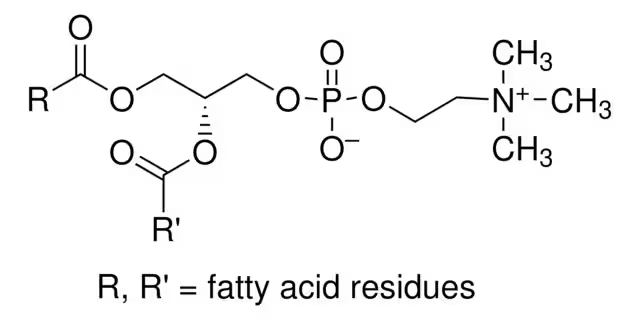
CAS Number8002-43-5
Synonyms(2R)-2-[(9Z,12Z)-9,12-Octadecadienoyloxy]-3-(palmitoyloxy)propyl 2-(trimethylammonio)ethyl phosphate; kelecin; Lecithin; 1-hexadecanoyl-2-(9Z,12Z-octadecadienoyl)-sn-glycero-3-phosphocholine; EINECS 232-307-2; Alcolec-S; froM Egg; granulestin; 2-[(9Z,12Z)-9,12-Octadecadienoyloxy]-3-(palmitoyloxy)propyl 2-(trimethylammonio)ethyl phosphate; Phospholutein
Molecular FormulaC42H80NO8P
Molecular Weight758.060
Purity≥99 (TLC)%
Density1.0305 g/cm3 (20ºC)
Melting Point236.1ºC
Appearancelyophilized powder
EINECS232-307-2
Symbol
Signal WordWarning
| Chemical & Physical Properties | |
|---|---|
| CAS Number | 8002-43-5 |
| Catalog No. | 2A-0202302 |
| Chinese Name | 大豆磷脂 |
| Synonyms | (2R)-2-[(9Z,12Z)-9,12-Octadecadienoyloxy]-3-(palmitoyloxy)propyl 2-(trimethylammonio)ethyl phosphate; kelecin; Lecithin; 1-hexadecanoyl-2-(9Z,12Z-octadecadienoyl)-sn-glycero-3-phosphocholine; EINECS 232-307-2; Alcolec-S; froM Egg; granulestin; 2-[(9Z,12Z)-9,12-Octadecadienoyloxy]-3-(palmitoyloxy)propyl 2-(trimethylammonio)ethyl phosphate; Phospholutein |
| Molecular Formula | C42H80NO8P |
| Molecular Weight | 758.060 |
| Purity | ≥99 (TLC) |
| Density | 1.0305 g/cm3 (20ºC) |
| Melting Point | 236.1ºC |
| Appearance | lyophilized powder |
| Water Solubility | Can be ignored |
| Storage Condition | Sealed packaging in brown glass bottles. Store in |
| Packaging | III |
| Application | Lecithin is considered a safe conventional source of phospholipids. Phospholipids can change the fatty acid composition and microstructure of animal cell membranes. |
| EINECS | 232-307-2 |
| HTC | 2923200000 |
| SMILES | [P](=O)([O-])(OC[C@H](OC(=O)CCCCCCC\C=C/C\C=C/CCCCC)COC(=O)CCCCCCCCCCCCCCC)OCC[N+](C)(C)C |
| InChI | 1S/C42H80NO8P/c1-6-8-10-12-14-16-18-20-21-23-25-27-29-31-33-35-42(45)51-40(39-50-52(46,47)49-37-36-43(3,4)5)38-48-41(44)34-32-30-28-26-24-22-19-17-15-13-11-9-7-2/h14,16,20-21,40H,6-13,15,17-19,22-39H2,1-5H3/b16-14-,21-20-/t40-/m1/s1 |
| InChI Key | JLPULHDHAOZNQI-ZTIMHPMXSA-N |
| Beilstein/REAXYS | 5209585 |
| NACRES Code | NA.25 |
| UNSPSC | 51321705 |
| Hazard Symbols | 3 |
| MSDS | msds/11140_1_8002_43_5.pdf |
| Bioactivity | Lecithin is regarded as a safe, conventional phospholipid source. Phospholipids are reported to alter the fatty acid composition and microstructure of the membranes in animal cells. Related Catalog Signaling Pathways >> Others >> Others Research Areas >> Others In Vitro After culturing in MRS broth with 0.2 to 1.0% soy Lecithin, the survival rate of harvested cells increases significantly (P<0.05) in the 0.3% bile challenge compare with the no added soy Lecithin group. The cells incubated with 0.6% soy Lecithin are able to grow in an MRS broth with a higher bile salt content. The cell surface hydrophobicity is enhanced and the membrane integrity in the bile challenge increases after culturing with soy Lecithin. A shift in the fatty acid composition is also observed, illustrating the cell membrane changes in the soy Lecithin culture[1]. Cell Assay MRS broths are supplemented with soy Lecithin concentrations of 0, 0.2, 0.4, 0.6, 0.8 and 1.0%. Each broth is inoculated with a tested strain culture (2%, v/v) and anaerobically incubated at 37°C for 20 h. After incubation, the bacterium cells are harvested by centrifugation at 8000 g for 10 min at 4°C and washed twice in PBS (pH 6.5) plus ethanol (5%, v/v). Strain bile resistance is assessed. The numbers of viable cells are counted by the pouring plate method, and each batch is tested three times[1]. References [1]. Hu B, et al. Enhancement of bile resistance in Lactobacillus plantarum strains by soy lecithin. Lett Appl Microbiol. 2015 Jul;61(1):13-9. Chemical & Physical Properties Density 1.0305 g/cm3 (20ºC) Melting Point 236.1ºC Molecular Formula C42H80NO8P Molecular Weight 758.060 Flash Point 57 °C Exact Mass 757.562134 PSA 121.00000 LogP 10.90 InChIKey JLPULHDHAOZNQI-JLOPVYAASA-N SMILES CCCCCC=CCC=CCCCCCCCC(=O)OC(COC(=O)CCCCCCCCCCCCCCC)COP(=O)([O-])OCC[N+](C)(C)C Storage condition 2-8°C Stability Stable, but light, heat, moisture and air-sensitive. Incompatible with strong oxidizing agents. |
| Use of | Properties Articles22 Name phosphatidylcholine(1+) Synonym More Synonyms Soybean phospholipid Biological Activity Related Catalog Signaling Pathways >> Others >> Others Research Areas >> Others In Vitro After culturing in MRS broth with 0.2 to 1.0% soy Lecithin, the survival rate of harvested cells increases significantly (P<0.05) in the 0.3% bile challenge compare with the no added soy Lecithin group. The cells incubated with 0.6% soy Lecithin are able to grow in an MRS broth with a higher bile salt content. The cell surface hydrophobicity is enhanced and the membrane integrity in the bile challenge increases after culturing with soy Lecithin. A shift in the fatty acid composition is also observed, illustrating the cell membrane changes in the soy Lecithin culture[1]. References [1]. Hu B, et al. Enhancement of bile resistance in Lactobacillus plantarum strains by soy lecithin. Lett Appl Microbiol. 2015 Jul;61(1):13-9. Chemical & Physical Properties Molecular Formula C42H80NO8P Exact Mass 757.562134 PSA 121.00000 LogP 10.90 InChIKey JLPULHDHAOZNQI-JLOPVYAASA-N SMILES CCCCCC=CCC=CCCCCCCCC(=O)OC(COC(=O)CCCCCCCCCCCCCCC)COP(=O)([O-])OCC[N+](C)(C)C Stability Stable, but light, heat, moisture and air-sensitive. Incompatible with strong oxidizing agents. |
| Transport Info | Product name: Purity: 98.0% |
| MSDS Transport Info | Module 14. Shipping information 14.1 UN dangerous goods number European Land Transport Dangerous Regulations: -International Maritime Dangerous Regulations: -International Air Transport Dangerous Regulations: - 14.2 Names specified by the United Nations (UN) European Land Transport Dangerous Regulations: Non-dangerous goods IMDG Code: Non-dangerous goods International air transport dangerous goods regulations: non-dangerous goods 14.3 Transport hazard categories European Land Transport Dangerous Regulations: -International Maritime Dangerous Regulations: -International Air Transport Dangerous Regulations: - 14.4 Package group European Land Transport Dangerous Regulations: -International Maritime Dangerous Regulations: -International Air Transport Dangerous Regulations: - 14.5 Environmental hazards European Land Transport Dangerous Regulations: No International Maritime Transport Dangerous Regulations Maritime Pollutants: No International Air Transport Risk Regulations: No 14.6 Special reminder to users No data available See reverse side of invoice or packing slip. |
| Related Products in Nutritional Ingredients | ||
|---|---|---|
| Isepamicin sulphate | 58152-03-7 | 2A-9011038 |
| isoxepac | 55453-87-7 | 2A-9011068 |
| L-alpha-dipalmitoyl phosphatidylcholine | 63-89-8 | 2A-9011116 |
| L-Carnitine fumarate | 90471-79-7 | 2A-9011135 |
| L-Carnitine orotate | 160468-17-7 | 2A-9011137 |
| Lutein; Xanthophyll | 127-40-2 | 2A-0201815 |
| Lycopene | 502-65-8 | 2A-9011262 |
| Medazepam | 2898-12-6 | 2A-9011307 |
| Melatonin | 73-31-4 | 2A-9011324 |
| Menaquinone-7 | 2124-57-4 | 2A-9011333 |
| Browse all Nutritional Ingredients products » | ||
Phone:
630-322-8886
630-322-8887
Email:
Office Locations:
Chicago, IL, USA
San Francisco, CA, USA


 EN
EN


 SDS
SDS