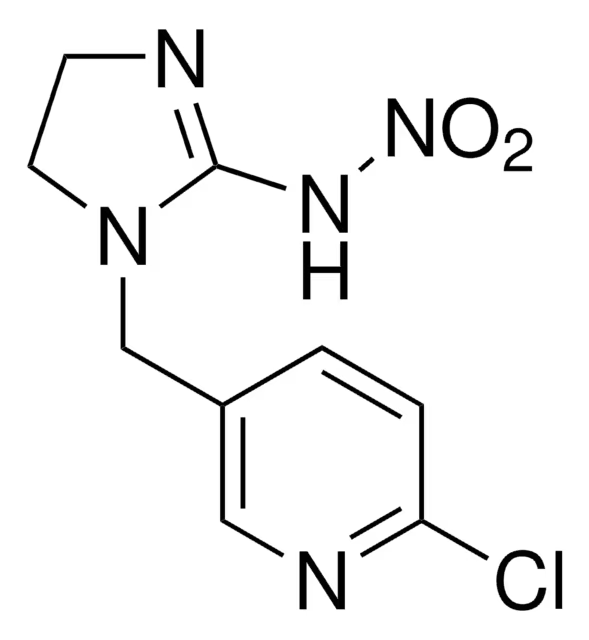
CAS Number138261-41-3
Synonyms1-((6-chloropyridin-3-yl)methyl)-3-nitroimidazolidin-2-imine; MFCD01721131; EINECS 200-835-2; Imidacloprid; 1-((6-Chloro-3-pyridinyl)methyl)-N-nitro-imidazolidinimine
Molecular FormulaC9H10ClN5O2
Molecular Weight255.66
Purity95%
Density1.6±0.1 g/cm3
Boiling Point442.3±55.0 °C at 760 mmHg
Melting Point140-146 °C
AppearanceSolid;White to Light yellow powder to crystal
Symbol
Signal WordWarning
| Chemical & Physical Properties | |
|---|---|
| CAS Number | 138261-41-3 |
| Catalog No. | 2A-9010921 |
| Chinese Name | 吡虫啉 |
| Synonyms | 1-((6-chloropyridin-3-yl)methyl)-3-nitroimidazolidin-2-imine; MFCD01721131; EINECS 200-835-2; Imidacloprid; 1-((6-Chloro-3-pyridinyl)methyl)-N-nitro-imidazolidinimine |
| Molecular Formula | C9H10ClN5O2 |
| Molecular Weight | 255.66 |
| Purity | 95 |
| Density | 1.6±0.1 g/cm3 |
| Boiling Point | 442.3±55.0 °C at 760 mmHg |
| Melting Point | 140-146 °C |
| Appearance | Solid;White to Light yellow powder to crystal |
| Water Solubility | 0.061 g/100mL at 20 ºC |
| Storage Condition | 0-6°C |
| Packaging | III |
| Application | Imidacloprid is an effective and widely used neonicotinoid pesticide for controlling pests in cereals, vegetables, tea and cotton. |
| HTC | 2933399026 |
| PubChem ID | 329755710 |
| MDL Number | MFCD00468059 |
| SMILES | [O-][N+](=O)NC1=NCCN1Cc2ccc(Cl)nc2 |
| InChI | 1S/C9H10ClN5O2/c10-8-2-1-7(5-12-8)6-14-4-3-11-9(14)13-15(16)17/h1-2,5H,3-4,6H2,(H,11,13) |
| InChI Key | YWTYJOPNNQFBPC-UHFFFAOYSA-N |
| NACRES Code | NA.24 |
| UNSPSC | 41116107 |
| Hazard Symbols | 6.1(b) |
| MSDS | msds/10921_1_138261_41_3.pdf |
| Bioactivity | Imidacloprid is an effective and widely used neonicotinoid pesticide to control pests of cereals, vegetables, tea and cotton. Related Catalog Signaling Pathways >> Others >> Others Research Areas >> Metabolic Disease Research Areas >> Neurological Disease In Vitro Insulin stimulated glucose uptake is reduced by imidacloprid in adipocytes (3T3-L1), hepatocytes (HepG2), and myotubes (C2C12) cell culture models. Treatment with imidacloprid reduced phosphorylation of protein kinase B (AKT), one of the major regulators of insulin signaling, without changing overall AKT expression. imidacloprid reduced phosphorylation of ribosomal S6 kinase (S6K), which is a downstream target of AKT and also a feed-back inhibitor of insulin signaling[1]. In Vivo Imidacloprid in high doses causes deterioration in cognitive functions particularly in infant rats, and this deterioration may be associated with changes in the expressions of related genes. Learning activities are diminished significantly at 2 and 8 mg/kg doses in the infant model groups and at 8 mg/kg dose in adult rats. Also, expression levels of GRIN1, SYP and GAP-43 are found to be insignificantly altered[2]. Early developmental exposure to imidacloprid has both early-life and persisting effects on neurobehavioral function in zebrafish. In larvae, developmental imidacloprid exposure at both doses significantly decreased swimming activity. In adolescent and adult fish, developmental exposure to imidacloprid significantly decreased novel tank exploration and increased sensorimotor response to startle stimuli[3]. Decrease in the body weight gain is observed at 20 mg/kg/day and at necropsy the relative body weights of liver, kidney and adrenal is also significantly increased at this dose level. The spontaneous locomotor activity is also decreased at highest dose exposure where as there are no significant changes in hematological and urine parameters. The brain, liver and kidney of rats exposed with high dose of imidacloprid has showed mild pathological changes[4]. Imidacloprid at 20 mg/kg has produced significant changes in SOD, CAT, GPx, GSH, LPO in liver; SOD, CAT, and GPx in brain and LPO in kidney[5]. Imidacloprid at high dose, specifically suppresses cell-mediated immune response as is evident from decreased DTH response and decreased stimulation index of T-lymphocytes to PHA. Prominent histopathological alterations are also observed in spleen and liver. Histopathological analysis of footpad sections of mice reveal dose-related suppression of DTH response[6]. Animal Admin Rats: Adult females are divided into four groups. One group is served as control and is given corn oil as vehicle through gavage. Three groups are given 5, 10, and 20 mg/kg/day imidacloprid to female rats for 90 days. Body weight, food consumption and clinical signs of toxicity are recorded throughout the period of experiment. Urine is collected at initial and 90 days for urine analysis. Individual animals from each group are weighed weekly and body weight is recorded[4]. Mice: Imidacloprid is administered orally daily at 10, 5, or 2.5mg/kg over 28 days. Specific parameters of humoral and cellular immune response including hemagglutinating antibody (HA) titer to sheep red blood cells (SRBC; T-dependent antigen), delayed type hypersensitivity (DTH) response to SRBC, and T-lymphocyte proliferation in response to phytohemagglutinin (PHA) are evaluated[6]. References [1]. Kim J, et al. Imidacloprid, a neonicotinoid insecticide, induces insulin resistance. J Toxicol Sci. 2013;38(5):655-60. [2]. Kara M, et al. Insecticide imidacloprid influences cognitive functions and alters learning performance and related gene expression in a rat model. Int J Exp Pathol. 2015 Oct;96(5):332-7. [3]. Crosby EB, et al. Neurobehavioral impairments caused by developmental imidacloprid exposure in zebrafish. Neurotoxicol Teratol. 2015 May-Jun;49:81-90. [4]. Bhardwaj S, et al. A 90 days oral toxicity of imidacloprid in female rats: morphological, biochemical and histopathological evaluations. Food Chem Toxicol. 2010 May;48(5):1185-90. [5]. Kapoor U, et al. Effect of imidacloprid on antioxidant enzymes and lipid peroxidation in female rats to derive its No Observed Effect Level (NOEL). J Toxicol Sci. 2010 Aug;35(4):577-81. [6]. Badgujar PC, et al. Immunotoxic effects of imidacloprid following 28 days of oral exposure in BALB/c mice. Environ Toxicol Pharmacol. 2013 May;35(3):408-18. Chemical & Physical Properties Density 1.6±0.1 g/cm3 Boiling Point 442.3±55.0 °C at 760 mmHg Melting Point 144ºC Molecular Formula C9H10ClN5O2 Molecular Weight 255.661 Flash Point 221.3±31.5 °C Exact Mass 255.052307 PSA 89.04000 LogP -0.43 Vapour Pressure 0.0±1.1 mmHg at 25°C Index of Refraction 1.706 InChIKey YWTYJOPNNQFBPC-UHFFFAOYSA-N SMILES O=[N+]([O-])N=C1NCCN1Cc1ccc(Cl)nc1 Storage condition 0-6°C Water Solubility 0.061 g/100mL at 20 ºC |
| Use of | Imidacloprid is an effective and widely used neonicotinoid pesticide to control pests of cereals, vegetables, tea and cotton. Properties Articles29 Name (E)-imidacloprid Synonym More Synonyms Imidacloprid Biological Activity Description Imidacloprid is an effective and widely used neonicotinoid pesticide to control pests of cereals, vegetables, tea and cotton. Related Catalog Signaling Pathways >> Others >> Others Research Areas >> Metabolic Disease Research Areas >> Neurological Disease References [1]. Kim J, et al. Imidacloprid, a neonicotinoid insecticide, induces insulin resistance. J Toxicol Sci. 2013;38(5):655-60. [2]. Kara M, et al. Insecticide imidacloprid influences cognitive functions and alters learning performance and related gene expression in a rat model. Int J Exp Pathol. 2015 Oct;96(5):332-7. [3]. Crosby EB, et al. Neurobehavioral impairments caused by developmental imidacloprid exposure in zebrafish. Neurotoxicol Teratol. 2015 May-Jun;49:81-90. [4]. Bhardwaj S, et al. A 90 days oral toxicity of imidacloprid in female rats: morphological, biochemical and histopathological evaluations. Food Chem Toxicol. 2010 May;48(5):1185-90. [5]. Kapoor U, et al. Effect of imidacloprid on antioxidant enzymes and lipid peroxidation in female rats to derive its No Observed Effect Level (NOEL). J Toxicol Sci. 2010 Aug;35(4):577-81. [6]. Badgujar PC, et al. Immunotoxic effects of imidacloprid following 28 days of oral exposure in BALB/c mice. Environ Toxicol Pharmacol. 2013 May;35(3):408-18. Chemical & Physical Properties Exact Mass 255.052307 PSA 89.04000 LogP -0.43 Index of Refraction 1.706 InChIKey YWTYJOPNNQFBPC-UHFFFAOYSA-N |
| Transport Info | Product Name: Imidacloprid |
| Related Products in Agrochemical Intermediates | ||
|---|---|---|
| Haloxyfop | 69806-34-4 | 2A-9010822 |
| Haloxyfop-methyl | 69806-40-2 | 2A-9010823 |
| Haloxyfop-R-methyl | 72619-32-0 | 2A-9010824 |
| Imazamox | 114311-32-9 | 2A-9010914 |
| Imazethapyr | 81335-77-5 | 2A-9010916 |
| Indoxacarb | 173584-44-6 | 2A-9010950 |
| Iprodione | 36734-19-7 | 2A-9011015 |
| Iprovalicarb | 140923-17-7 | 2A-9011020 |
| Lactofen | 77501-63-4 | 2A-9011113 |
| Lambda-cyhalothrin | 91465-08-6 | 2A-9011117 |
| Browse all Agrochemical Intermediates products » | ||
Phone:
630-322-8886
630-322-8887
Email:
Office Locations:
Chicago, IL, USA
San Francisco, CA, USA


 EN
EN


 SDS
SDS