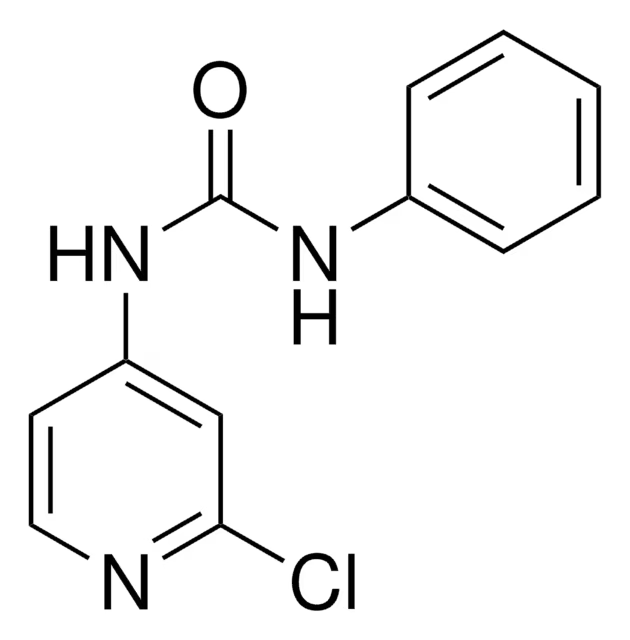
CAS Number68157-60-8
SynonymsN-(2-chloropyridin-4-yl)-N'-phenylurea; KT-30; N-(2-chloro-4-pyridinyl)-N'-phenylurea; 4pu30; CN-11-3183; CPPU; fulmet; 1-(2-Chloro-4-Pyridyl)-3-Phenylurea; MFCD00059898; SITOFEX; v3183; cn11-3138; 4-CPPU
Molecular FormulaC12H10ClN3O
Molecular Weight247.68
Purity98%
Density1.3±0.1 g/cm3
Boiling Point426.5±55.0 °C at 760 mmHg
Melting Point170-172°C
Appearancepowder
Symbol
Signal WordWarning
| Chemical & Physical Properties | |
|---|---|
| CAS Number | 68157-60-8 |
| Catalog No. | 2A-9010603 |
| Chinese Name | 氯吡脲 |
| Synonyms | N-(2-chloropyridin-4-yl)-N'-phenylurea; KT-30; N-(2-chloro-4-pyridinyl)-N'-phenylurea; 4pu30; CN-11-3183; CPPU; fulmet; 1-(2-Chloro-4-Pyridyl)-3-Phenylurea; MFCD00059898; SITOFEX; v3183; cn11-3138; 4-CPPU |
| Molecular Formula | C12H10ClN3O |
| Molecular Weight | 247.68 |
| Purity | 98 |
| Density | 1.3±0.1 g/cm3 |
| Boiling Point | 426.5±55.0 °C at 760 mmHg |
| Melting Point | 170-172°C |
| Appearance | powder |
| Water Solubility | Soluble in: methanol |
| Storage Condition | Store in an airtight container in a cool, dry plac |
| Application | Forchlorfenuron is a plant growth regulator and cytokinin; used to increase fruit size in fruits such as kiwis and grapes. |
| HTC | 2933399090 |
| PubChem ID | 24892531 |
| MDL Number | MFCD00059898 |
| SMILES | Clc1cc(NC(=O)Nc2ccccc2)ccn1 |
| InChI | 1S/C12H10ClN3O/c13-11-8-10(6-7-14-11)16-12(17)15-9-4-2-1-3-5-9/h1-8H,(H2,14,15,16,17) |
| InChI Key | GPXLRLUVLMHHIK-UHFFFAOYSA-N |
| NACRES Code | NA.72 |
| UNSPSC | 10171502 |
| Hazard Symbols | Transport |
| MSDS | msds/10603_1_68157_60_8.pdf |
| Bioactivity | Forchlorfenuron is plant growth regulator and cytokinin; can be used to increase fruit size of fruits, such as kiwi fruit and grapes. Related Catalog Signaling Pathways >> Others >> Others Research Areas >> Others In Vitro Forchlorfenuron is a plant growth regulator, applied extensively to increase kiwifruit size and weight. Cytotoxicity of forchlorfenuron and its metabolites are tested through Sulforhodamine B assays against CHO cells. Forchlorfenuron exhibits significant cytotoxicity against CHO cells with an IC50 of 12.12±2.14 μM[1]. The half-lives offorchlorfenuron were 15.8-23.0 days, the final residues of forchlorfenuron in pulp were all ≤0.002 mg/kg, and most of the residues were concentrated in the peel. The risk assessment revealed that no significant potential health risk would be induced by forchlorfenuron in citrus fruits. Therefore, it could be safe to apply forchlorfenuron in citrus fruits[2]. Cell Assay CHO cells are cultured in high-glucose DMEM medium. Forchlorfenuron and its kiwifruit metabolites are dissolved in DMSO and diluted in culture media. Cells are seeded in a 96-well flat microtiter plate for 24 h and are then incubated for an additional 48 h with various concentrations of the compounds. Next, cells are fixed with 10% trichloroacetic acid and incubated for 60 min at 4 °C. The supernatant is discarded, then the plates are washed. Using 0.4% SRB solution dissolved in 1% acetic acid, the cell layer is strained, then the plates are incubated for 20 min at room temperature. The stained cells is solubilized in 10 mM un-buffered Tris base and optical density (OD) is measured at 560 nm[1]. References [1]. Zhang Z, et al. Identification, synthesis, and safety assessment of forchlorfenuron (1-(2-chloro-4-pyridyl)-3-phenylurea) and its metabolites in kiwifruits. J Agric Food Chem. 2015 Mar 25;63(11):3059-66. [2]. Chen W, et al. Dissipation and residue of forchlorfenuron in citrus fruits. Bull Environ Contam Toxicol. 2013 Jun;90(6):756-60. Chemical & Physical Properties Density 1.3±0.1 g/cm3 Boiling Point 426.5±55.0 °C at 760 mmHg Melting Point 170-172°C Molecular Formula C12H10ClN3O Molecular Weight 247.680 Flash Point 211.7±31.5 °C Exact Mass 247.051239 PSA 54.02000 LogP 3.83 Vapour Pressure 0.0±1.1 mmHg at 25°C Index of Refraction 1.629 InChIKey GPXLRLUVLMHHIK-UHFFFAOYSA-N SMILES O=C(Nc1ccccc1)Nc1ccnc(Cl)c1 Storage condition 2-8°C |
| Use of | Forchlorfenuron is plant growth regulator and cytokinin; can be used to increase fruit size of fruits, such as kiwi fruit and grapes. Properties Articles29 Name forchlorfenuron Synonym More Synonyms forchlorfenuron Biological Activity Description Forchlorfenuron is plant growth regulator and cytokinin; can be used to increase fruit size of fruits, such as kiwi fruit and grapes. Related Catalog Signaling Pathways >> Others >> Others Research Areas >> Others References [1]. Zhang Z, et al. Identification, synthesis, and safety assessment of forchlorfenuron (1-(2-chloro-4-pyridyl)-3-phenylurea) and its metabolites in kiwifruits. J Agric Food Chem. 2015 Mar 25;63(11):3059-66. [2]. Chen W, et al. Dissipation and residue of forchlorfenuron in citrus fruits. Bull Environ Contam Toxicol. 2013 Jun;90(6):756-60. Chemical & Physical Properties Exact Mass 247.051239 PSA 54.02000 Index of Refraction 1.629 InChIKey GPXLRLUVLMHHIK-UHFFFAOYSA-N |
| Tax Rebate | 13.0% |
| Supervision | None. MFN tariff: 6.5%. Ordinary tariff: 20.0% |
| Transport Info | Shipping Name: UN |
| MSDS Transport Info | Module 14. Shipping information 14.1 UN dangerous goods number European Land Transport Danger Regulations: 3077 International Maritime Transport Danger Regulations: 3077 International Air Transport Danger Regulations: 3077 14.2 United Nations shipping name European land transport hazard regulations: ENVIRONMENTALLY HAZARDOUS SUBSTANCE, SOLID, N.O.S. (Urea, N-(2-chloro-4- pyridinyl)-N'-phenyl-) IMDG: ENVIRONMENTALLY HAZARDOUS SUBSTANCE, SOLID, N.O.S. (Urea, N-(2-chloro-4- pyridinyl)-N'-phenyl-) International air transport hazard regulations: Environmentally hazardous substance, solid, n.o.s. (Urea, N-(2-chloro-4-pyridinyl)-N'- phenyl-) 14.3 Transport hazard categories European land transport Dangerous Regulations: 9 International sea transport Dangerous Regulations: 9 International air transport Dangerous Regulations: 9 14.4 Package group European Land Transport Danger Regulations: III International Maritime Transport Danger Regulations: III International Air Transport Danger Regulations: III 14.5 Environmental hazards European Land Transport Dangerous Regulations: Yes International Maritime Transport Dangerous Regulations International Air Transport Dangerous Regulations: Yes Marine Pollutants (Yes/No): Yes 14.6 Special reminder to users further information Dangerous goods are individually packaged, with liquids exceeding 5 liters or solids exceeding 5 kilograms. The outer packaging of each independent package and the combined independent inner package must have EHS on it. Identification (according to European ADR Regulation 2.2.9.1.10, IMDG Regulation 2.10.3), If applicable, the chemical meets the requirements of the Regulations on the Safety Management of Hazardous Chemicals (adopted by the State Council on January 9, 2002). |
| Related Products in Agrochemical Intermediates | ||
|---|---|---|
| Fludioxonil | 131341-86-1 | 2A-9010549 |
| Flumioxazin | 103361-09-7 | 2A-9010560 |
| Fluoroglycofen-ethyl | 77501-90-7 | 2A-9010569 |
| Fluthiacet-methyl | 117337-19-6 | 2A-9010587 |
| Fomesafen | 72178-02-0 | 2A-9010598 |
| Gibberellic acid | 77-06-5 | 2A-9010722 |
| Haloxyfop | 69806-34-4 | 2A-9010822 |
| Haloxyfop-methyl | 69806-40-2 | 2A-9010823 |
| Haloxyfop-R-methyl | 72619-32-0 | 2A-9010824 |
| Imazamox | 114311-32-9 | 2A-9010914 |
| Browse all Agrochemical Intermediates products » | ||
Phone:
630-322-8886
630-322-8887
Email:
Office Locations:
Chicago, IL, USA
San Francisco, CA, USA


 EN
EN


 SDS
SDS