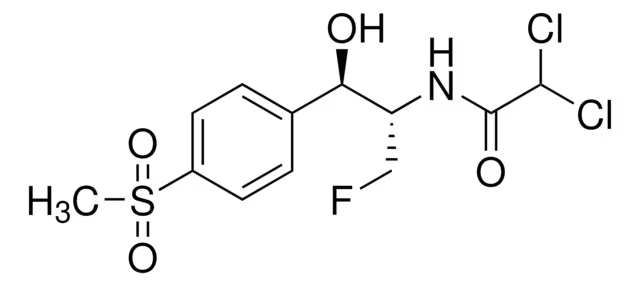
CAS Number73231-34-2
SynonymsFlorfenicol; 2R)-1-(fluoromethyl)-2-hydroxy-2-[4-(methanesulfonyl)phenyl]ethyl]acetamide; NUFLOR; 2,2-dichloro-N-[(1S; AQUAFEN; Fluorothiamphenicol; 2,2-DIBROMODECAFLUOROPENTANE; 2,2-Dichloro-N-[(1R,2S)-3-fluoro-1-hydroxy-1-(4-methylsulfonylphenyl)propan-2-yl]acetamide; Florfeniol; Aquaflor; MFCD00864834; EINECS 642-986-0
Molecular FormulaC12H14Cl2FNO4S
Molecular Weight358.21
Purity98%
Density1.5±0.1 g/cm3
Boiling Point617.5±55.0 °C at 760 mmHg
Melting Point153 °C
AppearanceWhite crystalline powder
| Chemical & Physical Properties | |
|---|---|
| CAS Number | 73231-34-2 |
| Catalog No. | 2A-9010532 |
| Chinese Name | 氟苯尼考 |
| Synonyms | Florfenicol; 2R)-1-(fluoromethyl)-2-hydroxy-2-[4-(methanesulfonyl)phenyl]ethyl]acetamide; NUFLOR; 2,2-dichloro-N-[(1S; AQUAFEN; Fluorothiamphenicol; 2,2-DIBROMODECAFLUOROPENTANE; 2,2-Dichloro-N-[(1R,2S)-3-fluoro-1-hydroxy-1-(4-methylsulfonylphenyl)propan-2-yl]acetamide; Florfeniol; Aquaflor; MFCD00864834; EINECS 642-986-0 |
| Molecular Formula | C12H14Cl2FNO4S |
| Molecular Weight | 358.21 |
| Purity | 98 |
| Density | 1.5±0.1 g/cm3 |
| Boiling Point | 617.5±55.0 °C at 760 mmHg |
| Melting Point | 153 °C |
| Appearance | White crystalline powder |
| Storage Condition | Store in a sealed container in a cool, dry place. |
| Application | Florfenicol is a common veterinary antibiotic that can treat cattle respiratory diseases. It can be used to control intestinal septicemia in catfish in the aquaculture industry. It can also induce ear |
| HTC | 2930909090 |
| MDL Number | MFCD00864834 |
| SMILES | CS(=O)(=O)c1ccc(cc1)[C@@H](O)[C@@H](CF)NC(=O)C(Cl)Cl |
| InChI | 1S/C12H14Cl2FNO4S/c1-21(19,20)8-4-2-7(3-5-8)10(17)9(6-15)16-12(18)11(13)14/h2-5,9-11,17H,6H2,1H3,(H,16,18)/t9-,10-/m1/s1 |
| InChI Key | AYIRNRDRBQJXIF-NXEZZACHSA-N |
| NACRES Code | NA.24 |
| UNSPSC | 41116107 |
| MSDS | msds/10532_1_73231_34_2.pdf |
| Bioactivity | Florfenicol, a commonly used veterinary antibiotic, is currently indicated for the treatment of bovine respiratory disease, and also used in aquaculture for the control of enteric septicemia in catfish. Florfenicol can induce early embryonic death in eggs, with an LC50 of 1.07 μg/g. Related Catalog Signaling Pathways >> Anti-infection >> Bacterial Research Areas >> Infection References [1]. Al-Shahrani S, et al. Florfenicol induces early embryonic death in eggs collected from treated hens. BMC Vet Res. 2015 Aug 18;11(1):213. [2]. Corinna Kehrenberg, et al. A new mechanism for chloramphenicol, florfenicol and clindamycin resistance: methylation of 23S ribosomal RNA at A2503. Molecular Microbiology Volume 57, Issue 4, pages 1064-1073, August 2005 Chemical & Physical Properties Density 1.5±0.1 g/cm3 Boiling Point 617.5±55.0 °C at 760 mmHg Melting Point 153 °C Molecular Formula C12H14Cl2FNO4S Molecular Weight 358.213 Flash Point 327.3±31.5 °C Exact Mass 357.000458 PSA 91.85000 LogP -0.12 Vapour Pressure 0.0±1.9 mmHg at 25°C Index of Refraction 1.548 InChIKey AYIRNRDRBQJXIF-NXEZZACHSA-N SMILES CS(=O)(=O)c1ccc(C(O)C(CF)NC(=O)C(Cl)Cl)cc1 Storage condition 0-6°C |
| Use of | Florfenicol, a commonly used veterinary antibiotic, is currently indicated for the treatment of bovine respiratory disease, and also used in aquaculture for the control of enteric septicemia in catfish. Florfenicol can induce early embryonic death in eggs, with an LC50 of 1.07 μg/g. Properties Articles22 Name florfenicol Synonym More Synonyms Florfenicol Biological Activity Description Florfenicol, a commonly used veterinary antibiotic, is currently indicated for the treatment of bovine respiratory disease, and also used in aquaculture for the control of enteric septicemia in catfish. Florfenicol can induce early embryonic death in eggs, with an LC50 of 1.07 μg/g. Related Catalog Signaling Pathways >> Anti-infection >> Bacterial Research Areas >> Infection References [1]. Al-Shahrani S, et al. Florfenicol induces early embryonic death in eggs collected from treated hens. BMC Vet Res. 2015 Aug 18;11(1):213. [2]. Corinna Kehrenberg, et al. A new mechanism for chloramphenicol, florfenicol and clindamycin resistance: methylation of 23S ribosomal RNA at A2503. Molecular Microbiology Volume 57, Issue 4, pages 1064-1073, August 2005 Chemical & Physical Properties Exact Mass 357.000458 PSA 91.85000 LogP -0.12 Index of Refraction 1.548 InChIKey AYIRNRDRBQJXIF-NXEZZACHSA-N |
| Tax Rebate | 13.0% |
| Supervision | None. MFN tariff: 6.5%. Ordinary tariff: 30.0% |
| Transport Info | Product name: Summary 2930909090. other organo-sulfur compounds. VAT:17.0%. Tax rebate rate:13.0%. . MFN tariff:6.5%. General tariff:30.0% |
| Related Products in Specialty Chemicals | ||
|---|---|---|
| Flesinoxan | 98206-10-1 | 2A-9010525 |
| Flesinoxan | 98205-89-1 | 2A-9010526 |
| Flestolol | 87721-62-8 | 2A-9010527 |
| Florasulam | 145701-23-1 | 2A-9010530 |
| Flordipine | 77590-96-6 | 2A-9010531 |
| Florfenicol | 76639-94-6 | 2A-9010533 |
| Flosatidil | 113593-34-3 | 2A-9010534 |
| Flosequinan | 76568-02-0 | 2A-9010535 |
| Fluacrypyrim | 229977-93-9 | 2A-9010536 |
| Fluazifop-P-butyl | 79241-46-6 | 2A-9010538 |
| Browse all Specialty Chemicals products » | ||
Phone:
630-322-8886
630-322-8887
Email:
Office Locations:
Chicago, IL, USA
San Francisco, CA, USA


 EN
EN


 SDS
SDS