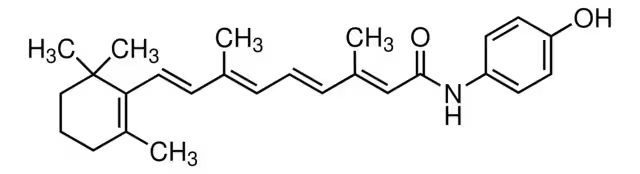
CAS Number65646-68-6
Synonyms4-Hydroxyphenyl retinamide; Fenretinide; 4-HPR; 15-[(4-Hydroxyphenyl)amino]retinal; fenretinida; fenretinidum; MFCD00792674
Molecular FormulaC26H33NO2
Molecular Weight391.55
Purity≥95%
Density1.1±0.1 g/cm3
Boiling Point597.6±42.0 °C at 760 mmHg
Melting Point162-163°C
Appearancepowder
Symbol
Signal WordWarning
| Chemical & Physical Properties | |
|---|---|
| CAS Number | 65646-68-6 |
| Catalog No. | 2A-9010494 |
| Chinese Name | 芬维A胺 |
| Synonyms | 4-Hydroxyphenyl retinamide; Fenretinide; 4-HPR; 15-[(4-Hydroxyphenyl)amino]retinal; fenretinida; fenretinidum; MFCD00792674 |
| Molecular Formula | C26H33NO2 |
| Molecular Weight | 391.55 |
| Purity | ≥95 |
| Density | 1.1±0.1 g/cm3 |
| Boiling Point | 597.6±42.0 °C at 760 mmHg |
| Melting Point | 162-163°C |
| Appearance | powder |
| Storage Condition | Store in an airtight container in a cool, dry plac |
| Application | Fenretinide is a synthetic retinoid derivative that binds to the retinoic acid receptor (RAR) to induce cell death. |
| PubChem ID | 24278472 |
| MDL Number | MFCD00792674 |
| SMILES | CC1=C(\C=C\C(C)=C\C=C\C(C)=C\C(=O)Nc2ccc(O)cc2)C(C)(C)CCC1 |
| InChI | 1S/C26H33NO2/c1-19(11-16-24-21(3)10-7-17-26(24,4)5)8-6-9-20(2)18-25(29)27-22-12-14-23(28)15-13-22/h6,8-9,11-16,18,28H,7,10,17H2,1-5H3,(H,27,29)/b9-6+,16-11+,19-8+,20-18+ |
| InChI Key | AKJHMTWEGVYYSE-FXILSDISSA-N |
| NACRES Code | NA.77 |
| UNSPSC | 12352106 |
| Hazard Symbols | Transport |
| MSDS | msds/10494_1_65646_68_6.pdf |
| Bioactivity | Fenretinide is a synthetic retinoid deriverative, binding to the retinoic acid receptors (RAR) at concentrations necessary to induce cell death. Related Catalog Signaling Pathways >> Autophagy >> Autophagy Signaling Pathways >> Metabolic Enzyme/Protease >> RAR/RXR Research Areas >> Cancer In Vitro Fenretinide exerts not just acute but also long term antitumor activity in selected T-ALL cell lines. Fenretinide inhibits DES activity in CCRF-CEM leukemia cells in a dose and time dependent manner, leading to a concomitant increase of the endogenous cellular dhCer content. Fenretinide (3 μM)-induced dhCer accumulation in both CCRF-CEM and Jurkat cells[1]. Ceramide inhibition with fenretinide protects insulin signaling. Fenretinide prevents lipid-induced reductions in insulin-stimulated glucose uptake[2]. Fenretinide inhibits OVCAR-5 cell proliferation and viability at concentrations higher than 1 microM, with 70-90% growth inhibition at 10 microM. Fenretinide (1 microM) significantly inhibits OVCAR-5 invasion after 3 days preincubation. Endothelial cells treated with 1 microM 4-HPR fails to form tubes, but forms small cellular aggregates[4]. In Vivo Fenretinide (10 mg/kg, i.p.) selectively inhibits ceramide accumulation HFD-fed male C57Bl/6 mice. Fenretinide treatment improves glucose tolerance and insulin sensitivity as determined by both glucose and insulin tolerance tests[2]. Addition of 25 mg/kg ketoconazole to Fenretinide in NOD/SCID mice increased 4-HPR plasma levels[3]. Cell Assay Standard XTT assay is used to determine cell viability. For fenretinide-only treatments, cells are plated in 96-well plates at 750,000 cells/mL and 100 μL/well. After 4 h, treatments are added on 50 μL/well obtaining a final density of 500,000 cells/mL and final volume of 150 μL/well. Four replicates are used per experimental condition. XTT reagent mixture is added 4 h before the end of selected treatment period and absorbance at 490 nm is determined per each well. A slightly modified protocol is used for analysis of the effect of myriocin (final concentration of 100 nM) or antioxidant on Fenretinide treatment. Briefly, cells are seeded on 60 mm culture dishes and myriocin or antioxidants added after 4 h. Fenretinide treatment is added 2 h later and cells are plated in quadruplicates in 96 well plates (150 μL/well). Animal Admin Male mice (C57Bl6) are fed a standard chow or a high-fat diet (HFD) from 5 to 17 weeks, at which point half of the HFD-fed mice begin receiving fenretinide in drinking water for 4 weeks. Fenretinide is dissolved in 100% ethanol and diluted in water to 10 μg/mL. Control treatment water receives an equal amount of ethanol (0.5%). FEN water is prepared in low-light conditions and administered in light-protective bottles. Water is replaced every 1-2 days, and no precipitation of FEN is noted at any time. Animal weights are recorded at the beginning and end of the treatment period. Following a 4-week FEN treatment, mice undergo intraperitoneal glucose and insulin tolerance tests. For both tests, mice are fasted for 6 h andreceive an injection of either glucose (1 g/kg of body weight) or insulin (0.75 units/kg of body weight). Blood glucose is determined at the times indicated by the Bayer Contour® glucose meter, and insulin is measured with the rat/mouse insulin ELISA kit. The insulin resistance index is assessed by using fasting blood glucose and insulin levels to compute the homeostatic model assessment of insulin resistance (HOMA-IR), where a higher number represents greater insulin resistance. References [1]. Apraiz, Aintzane., et al. Dihydroceramide accumulation and reactive oxygen species are distinct and nonessential events in 4-HPR-mediated leukemia cell death. Biochemistry and Cell Biology (2012), 90(2), 209-223. [2]. Bikman, Benjamin T., et al. Fenretinide Prevents Lipid-induced Insulin Resistance by Blocking Ceramide Biosynthesis. Journal of Biological Chemistry (2012), 287(21), 17426-17437. [3]. Cooper JP, et al. Fenretinide metabolism in humans and mice: utilizing pharmacological modulation of its metabolic pathway to increase systemic exposure. Br J Pharmacol. 2011 Jul;163(6):1263-75. [4]. Golubkov V, et al. Action of fenretinide (4-HPR) on ovarian cancer and endothelial cells. Anticancer Res. 2005 Jan-Feb;25(1A):249-53. Chemical & Physical Properties Density 1.1±0.1 g/cm3 Boiling Point 597.6±42.0 °C at 760 mmHg Melting Point 162-163°C Molecular Formula C26H33NO2 Molecular Weight 391.546 Flash Point 315.2±27.9 °C Exact Mass 391.251129 PSA 49.33000 LogP 7.41 Vapour Pressure 0.0±1.8 mmHg at 25°C Index of Refraction 1.607 InChIKey AKJHMTWEGVYYSE-FXILSDISSA-N SMILES CC(C=CC1=C(C)CCCC1(C)C)=CC=CC(C)=CC(=O)Nc1ccc(O)cc1 Storage condition −20°C Stability Light Sensitive - Protect from Light Exposure |
| Use of | Fenretinide is a synthetic retinoid deriverative, binding to the retinoic acid receptors (RAR) at concentrations necessary to induce cell death. Properties Articles47 Name 4-hydroxyphenyl retinamide Synonym More Synonyms Fenretinide Biological Activity Description Fenretinide is a synthetic retinoid deriverative, binding to the retinoic acid receptors (RAR) at concentrations necessary to induce cell death. Related Catalog Signaling Pathways >> Autophagy >> Autophagy Signaling Pathways >> Metabolic Enzyme/Protease >> RAR/RXR Research Areas >> Cancer References [1]. Apraiz, Aintzane., et al. Dihydroceramide accumulation and reactive oxygen species are distinct and nonessential events in 4-HPR-mediated leukemia cell death. Biochemistry and Cell Biology (2012), 90(2), 209-223. [2]. Bikman, Benjamin T., et al. Fenretinide Prevents Lipid-induced Insulin Resistance by Blocking Ceramide Biosynthesis. Journal of Biological Chemistry (2012), 287(21), 17426-17437. [3]. Cooper JP, et al. Fenretinide metabolism in humans and mice: utilizing pharmacological modulation of its metabolic pathway to increase systemic exposure. Br J Pharmacol. 2011 Jul;163(6):1263-75. [4]. Golubkov V, et al. Action of fenretinide (4-HPR) on ovarian cancer and endothelial cells. Anticancer Res. 2005 Jan-Feb;25(1A):249-53. Chemical & Physical Properties Molecular Formula C26H33NO2 Exact Mass 391.251129 PSA 49.33000 Index of Refraction 1.607 InChIKey AKJHMTWEGVYYSE-FXILSDISSA-N Stability Light Sensitive - Protect from Light Exposure |
| Transport Info | Shipping Name: UN |
| MSDS Transport Info | Module 14. Shipping information 14.1 UN dangerous goods number European Land Transport Dangerous Regulations: -International Maritime Dangerous Regulations: -International Air Transport Dangerous Regulations: - 14.2 United Nations shipping name European Land Transport Dangerous Regulations: Non-dangerous goods IMDG Code: Non-dangerous goods International air transport dangerous goods regulations: non-dangerous goods 14.3 Transport hazard categories European Land Transport Dangerous Regulations: -International Maritime Dangerous Regulations: -International Air Transport Dangerous Regulations: - 14.4 Package group European Land Transport Dangerous Regulations: -International Maritime Dangerous Regulations: -International Air Transport Dangerous Regulations: - 14.5 Environmental hazards European Land Transport Danger Regulations: No International Maritime Danger Regulations International Air Transport Danger Regulations: No Marine pollutants (yes/no): No 14.6 Special reminder to users No data available |
| Related Products in Specialty Chemicals | ||
|---|---|---|
| Fenoxedil | 54063-40-0 | 2A-9010487 |
| Fenperate | 55837-26-8 | 2A-9010488 |
| Fenpiclonil | 74738-17-3 | 2A-9010489 |
| Fenpiverinium bromide | 125-60-0 | 2A-9010490 |
| Fenpropathrin | 39515-41-8 | 2A-9010491 |
| Fenthion | 55-38-9 | 2A-9010496 |
| Fentiazac | 18046-21-4 | 2A-9010497 |
| Fenticonazole | 72479-26-6 | 2A-9010498 |
| Fenticonazole nitrate | 73151-29-8 | 2A-9010499 |
| Fentin Acetate | 900-95-8 | 2A-9010500 |
| Browse all Specialty Chemicals products » | ||
Phone:
630-322-8886
630-322-8887
Email:
Office Locations:
Chicago, IL, USA
San Francisco, CA, USA


 EN
EN


 SDS
SDS