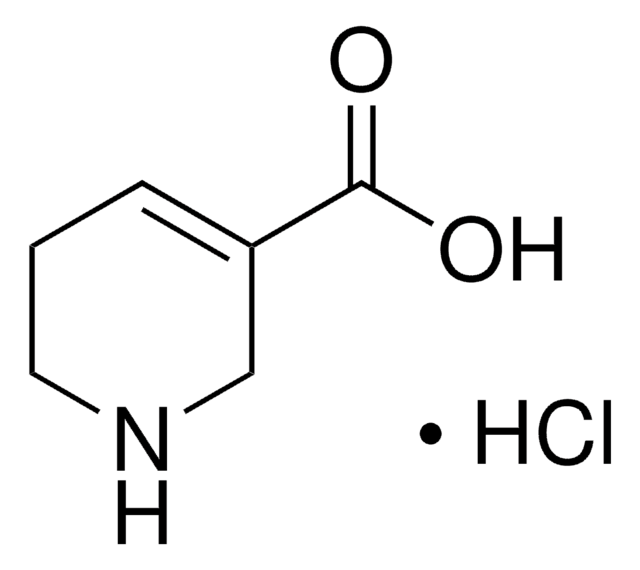
CAS Number6027-91-4
SynonymsGUVACINE HYDROCHLORIDE &3-Pyridinecarboxylic acid,1,2,5,6-tetrahydro-,hydrochloride; 1,2,5,6-Tetrahydro-pyridin-3-carbonsaeure,Hydrochlorid; 1,2,5,6-Tetrahydro-3-pyridinecarboxylic Acid Hydrochloride; Dilazep dihydrochloride; Guvacine hydrochloride; 1,2,5,6-Tetrahydro; GABA UPTAK; 1,2,5,6-Tetrahydropyridine-3-carboxylic acid hydrochloride; 1,2,5,6-tetrahydro-3-pyridinecarboxylic acid,hydrochloride salt
Molecular FormulaC6H10ClNO2
Molecular Weight163.60
Purity≥90.0 (HPLC)%
EINECS0
Symbol
Signal WordWarning
| Chemical & Physical Properties | |
|---|---|
| CAS Number | 6027-91-4 |
| Catalog No. | 2A-2102894 |
| Chinese Name | 去甲槟榔次碱盐酸盐 |
| Synonyms | GUVACINE HYDROCHLORIDE &3-Pyridinecarboxylic acid,1,2,5,6-tetrahydro-,hydrochloride; 1,2,5,6-Tetrahydro-pyridin-3-carbonsaeure,Hydrochlorid; 1,2,5,6-Tetrahydro-3-pyridinecarboxylic Acid Hydrochloride; Dilazep dihydrochloride; Guvacine hydrochloride; 1,2,5,6-Tetrahydro; GABA UPTAK; 1,2,5,6-Tetrahydropyridine-3-carboxylic acid hydrochloride; 1,2,5,6-tetrahydro-3-pyridinecarboxylic acid,hydrochloride salt |
| Molecular Formula | C6H10ClNO2 |
| Molecular Weight | 163.60 |
| Purity | ≥90.0 (HPLC) |
| Storage Condition | 2-8℃ |
| Application | Guvacine hydrochloride is an alkaloid obtained from areca nut. It is an inhibitor of GABA transporter and has moderate selectivity for several cloned GABA transporters. The IC50 values are 14 μM (huma |
| EINECS | 0 |
| HTC | 2933399090 |
| UN(IATA) | 0 |
| MDL Number | MFCD00055191 |
| SMILES | Cl.OC(=O)C1=CCCNC1 |
| InChI | 1S/C6H9NO2.ClH/c8-6(9)5-2-1-3-7-4-5;/h2,7H,1,3-4H2,(H,8,9);1H |
| InChI Key | FGNUNVVTHHKDAM-UHFFFAOYSA-N |
| NACRES Code | NA.24 |
| UNSPSC | 41116107 |
| Hazard Symbols | transportation |
| MSDS | msds/102894_2_6027_91_4.pdf |
| Bioactivity | Guvacine hydrochloride is an alkaloid from the nut of Areca catechu, acts as an inhibitor of GABA transporter, and dispalys modest selectivity for cloned GABA transporters with IC50s of 14 μM (human GAT-1), 39 μM (rat GAT-1), 58 μM (rat GAT-2), 119 μM (human GAT-3), 378 μM (rat GAT-3), and 1870 μM (human BGT-3). Related Catalog Signaling Pathways >> Membrane Transporter/Ion Channel >> GABA Receptor Signaling Pathways >> Neuronal Signaling >> GABA Receptor Natural Products >> Alkaloid Research Areas >> Neurological Disease Target IC50: 14 μM (human GAT-1), 39 μM (rat GAT-1), 58 μM (rat GAT-2), 119 μM (human GAT-3), 378 μM (rat GAT-3), 1870 μM (human BGT-3)[1] In Vitro Guvacine hydrochloride is a potent inhibitor of GABA transporter, dispalys modest selectivity forcloned GABA transporters with IC50s of 14 μM (human GAT-1), 39 μM (rat GAT-1), 58 μM (rat GAT-2), 119 μM (human GAT-3), 378 μM (rat GAT-3), and 1870 μM (human BGT-3). Guvacine has low affinity at hBGT-1 (IC50 >1 mM)[1]. Guvacine hydrochloride is a potent inhibitor of GABA uptake, but does not inhibit sodium-independent GABA binding, and is weak or inactive as a GABA receptor agonist[2]. Guvacine inhibits the uptake GABA and β-alanine with IC50s of 23 ± 2 μM, 66 ± 11 μM in the Cat spinal cord, and 8 ± 1 μM, 123 ± 28 μM in the rat cerebral cortex, respectively[3]. Cell Assay Cells grown in 24-well plates are washed 3 × with Hepes-buffered saline (HBS, in mM: NaC1, 150; Hepes, 20; CaCl2, 1; glucose, 10; KC1, 5; MgCl2, 1; pH 7.4) and allowed to equilibrate on a 37°C slide warmer. After 10 min the medium is removed and unlabeled drugs (Guvacine , etc.) in HBS are added (450 μL/well). Transport is initiated by adding 50 μL per well of a concentrated solution of [3H]GABA in HBS (final concentration = 50 nM). Non-specific uptake is defined in parallel wells with 1 mM unlabeled GABA, and is subtracted from total uptake to yield specific uptake; all data represent specific uptake. Plates are incubated at 37°C for 10 min, then washed rapidly 3 × with ice-cold HBS, using a 24-position plate washer. Cells are solubilized with 0.05% sodium deoxycholate/0.1 N NaOH (0.25 mL/well), an aliquot neutralized with 1 N HC1, and radioactivity is determined by scintillation counting. Protein is quantified in an aliquot of the solubilized cells using a BIO-RAD protein assay kit[1]. References [1]. Borden LA, et al. Tiagabine, SK&F 89976-A, CI-966, and NNC-711 are selective for the cloned GABA transporter GAT-1. Eur J Pharmacol. 1994 Oct 14;269(2):219-24. [2]. Krogsgaard-Larsen P, et al. Structure-activity studies on the inhibition of GABA binding to rat brain membranes by muscimol and related compounds. J Neurochem. 1978 Jun;30(6):1377-82. [3]. Lodge D, et al. Effects of the Areca nut constituents arecaidine and guvacine on the action of GABA in the cat central nervous system. Brain Res. 1977 Nov 18;136(3):513-22. Chemical & Physical Properties Molecular Formula C6H10ClNO2 Molecular Weight 163.60200 Exact Mass 163.04000 PSA 49.33000 LogP 1.12150 InChIKey FGNUNVVTHHKDAM-UHFFFAOYSA-N SMILES Cl.O=C(O)C1=CCCNC1 Storage condition 2-8℃ |
| Use of | Guvacine hydrochloride is an alkaloid from the nut of Areca catechu, acts as an inhibitor of GABA transporter, and dispalys modest selectivity for cloned GABA transporters with IC50s of 14 μM (human GAT-1), 39 μM (rat GAT-1), 58 μM (rat GAT-2), 119 μM (human GAT-3), 378 μM (rat GAT-3), and 1870 μM (human BGT-3). Properties Articles18 Name 1,2,5,6-Tetrahydro-pyridine-3-carboxylic acid hydrochloride Synonym More Synonyms Guvacine hydrochloride Biological Activity Description Guvacine hydrochloride is an alkaloid from the nut of Areca catechu, acts as an inhibitor of GABA transporter, and dispalys modest selectivity for cloned GABA transporters with IC50s of 14 μM (human GAT-1), 39 μM (rat GAT-1), 58 μM (rat GAT-2), 119 μM (human GAT-3), 378 μM (rat GAT-3), and 1870 μM (human BGT-3). Related Catalog Signaling Pathways >> Membrane Transporter/Ion Channel >> GABA Receptor Signaling Pathways >> Neuronal Signaling >> GABA Receptor Natural Products >> Alkaloid Research Areas >> Neurological Disease IC50: 14 μM (human GAT-1), 39 μM (rat GAT-1), 58 μM (rat GAT-2), 119 μM (human GAT-3), 378 μM (rat GAT-3), 1870 μM (human BGT-3)[1] References [1]. Borden LA, et al. Tiagabine, SK&F 89976-A, CI-966, and NNC-711 are selective for the cloned GABA transporter GAT-1. Eur J Pharmacol. 1994 Oct 14;269(2):219-24. [2]. Krogsgaard-Larsen P, et al. Structure-activity studies on the inhibition of GABA binding to rat brain membranes by muscimol and related compounds. J Neurochem. 1978 Jun;30(6):1377-82. [3]. Lodge D, et al. Effects of the Areca nut constituents arecaidine and guvacine on the action of GABA in the cat central nervous system. Brain Res. 1977 Nov 18;136(3):513-22. Chemical & Physical Properties Exact Mass 163.04000 PSA 49.33000 LogP 1.12150 InChIKey FGNUNVVTHHKDAM-UHFFFAOYSA-N SMILES Cl.O=C(O)C1=CCCNC1 Storage condition 2-8℃ |
| Tax Rebate | 13.0% |
| Supervision | None. MFN tariff: 6.5%. Ordinary tariff: 20.0% |
| Transport Info | Product name: Purity: 97.0% |
| MSDS Transport Info | Module 14. Shipping information 14.1 UN dangerous goods number European Land Transport Dangerous Regulations: -International Maritime Dangerous Regulations: -International Air Transport Dangerous Regulations: - 14.2 Names specified by the United Nations (UN) European Land Transport Dangerous Regulations: Non-dangerous goods IMDG Code: Non-dangerous goods International air transport dangerous goods regulations: non-dangerous goods 14.3 Transport hazard categories European Land Transport Dangerous Regulations: -International Maritime Dangerous Regulations: -International Air Transport Dangerous Regulations: - 14.4 Package group European Land Transport Dangerous Regulations: -International Maritime Dangerous Regulations: -International Air Transport Dangerous Regulations: - 14.5 Environmental hazards European Land Transport Dangerous Regulations: No International Maritime Transport Dangerous Regulations Maritime Pollutants: No International Air Transport Risk Regulations: No 14.6 Special reminder to users No data available |
| Related Products in Pharmaceutical Intermediates | ||
|---|---|---|
| 1,2,4]TRIAZOLO[4,3-A]PYRIDIN-7-AMINE | 1082448-58-5 | 2A-0102887 |
| 1,2,4]TRIAZOLO[4,3-A]PYRIDINE-3-CARBOXYLIC ACID | 5543-08-8 | 2A-0102888 |
| 1,2,4]TRIAZOLO[4,3-A]PYRIDINE-7-CARBOXYLIC ACID | 1234616-66-0 | 2A-0102890 |
| 1,2,4]TRIAZOLO[4,3-A]PYRIMIDIN-3(2H)-ONE | 63206-77-9 | 2A-0102891 |
| 1,2,4]TRIAZOLO[4,3-A]QUINOXALIN-4(5H)-ONE | 91895-36-2 | 2A-0102893 |
| 1,2-DIFLUORO-4-((1S,4R)-4-HEPTYLCYCLOHEXYL)BENZENE | 139136-72-4 | 2A-0103000 |
| 1,3,5-TRIMETHYL-3,7-DIAZABICYCLO[3.3.1]NONAN-9-OL | 169177-17-7 | 2A-0103106 |
| 1,3,5-TRIMETHYL-3,7-DIAZABICYCLO[3.3.1]NONANE | 169177-35-9 | 2A-0103107 |
| 1,3-DIFLUORO-2-IODO-5-((1S,4R)-4-PROPYLCYCLOHEXYL)BENZENE | 149705-66-8 | 2A-0103249 |
| 1,3-DIMETHYL-2,4-DIOXO-1,2,3,4-TETRAHYDROPYRIMIDINE-5-SULFONYL CHLORIDE | 124788-36-9 | 2A-0103302 |
| Browse all Pharmaceutical Intermediates products » | ||
Phone:
630-322-8886
630-322-8887
Email:
Office Locations:
Chicago, IL, USA
San Francisco, CA, USA


 EN
EN


 SDS
SDS