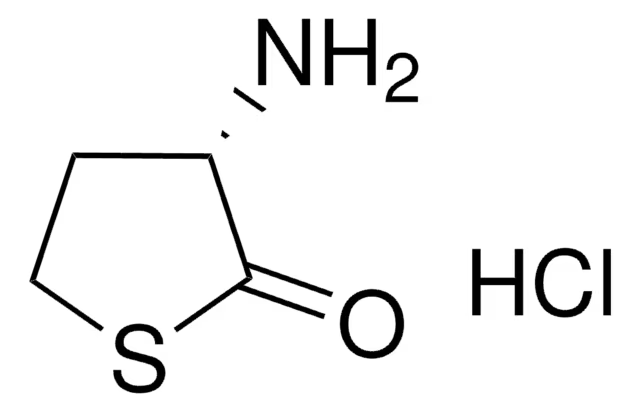
CAS Number31828-68-9
SynonymsMFCD00065494; (3S)-3-Aminodihydro-2(3H)-thiophenone hydrochloride (1:1); L-Homocysteine thiolactone hydrochloride; (3S)-3-Aminodihydrothiophen-2(3H)-one hydrochloride (1:1); 2(3H)-Thiophenone, 3-aminodihydro-, (3S)-, hydrochloride (1:1); (3S)-3-aminothiolan-2-one,hydrochloride; EINECS 250-824-1; L-Homocysteine thiolactone (hydrochloride)
Molecular FormulaC4H8ClNOS
Molecular Weight153.63
Purity≥98 (TLC)%
Boiling Point253.8ºC at 760mmHg
Melting Point185 °C
Appearancepowder
EINECS250-824-1
Symbol
Signal WordWarning
| Chemical & Physical Properties | |
|---|---|
| CAS Number | 31828-68-9 |
| Catalog No. | 2A-1101562 |
| Chinese Name | L-高半胱氨酸硫内酯盐酸盐 |
| Synonyms | MFCD00065494; (3S)-3-Aminodihydro-2(3H)-thiophenone hydrochloride (1:1); L-Homocysteine thiolactone hydrochloride; (3S)-3-Aminodihydrothiophen-2(3H)-one hydrochloride (1:1); 2(3H)-Thiophenone, 3-aminodihydro-, (3S)-, hydrochloride (1:1); (3S)-3-aminothiolan-2-one,hydrochloride; EINECS 250-824-1; L-Homocysteine thiolactone (hydrochloride) |
| Molecular Formula | C4H8ClNOS |
| Molecular Weight | 153.63 |
| Purity | ≥98 (TLC) |
| Boiling Point | 253.8ºC at 760mmHg |
| Melting Point | 185 °C |
| Appearance | powder |
| Storage Condition | Store in an airtight, cool and dry place, ensuring |
| Application | L-Homocysteine thiolactone hydrochloride is an intramolecular thioester of homocysteine; prevents the conversion of homocysteine into protein. |
| EINECS | 250-824-1 |
| HTC | 2934999090 |
| UN(IATA) | 0 |
| PubChem ID | 24895745 |
| MDL Number | MFCD00065494 |
| SMILES | Cl[H].N[C@H]1CCSC1=O |
| InChI | 1S/C4H7NOS.ClH/c5-3-1-2-7-4(3)6;/h3H,1-2,5H2;1H/t3-;/m0./s1 |
| InChI Key | ZSEGSUBKDDEALH-DFWYDOINSA-N |
| Beilstein/REAXYS | 3911455 |
| NACRES Code | NA.26 |
| eCl@ss | 32160406 |
| UNSPSC | 12352209 |
| Hazard Symbols | transportation |
| MSDS | msds/101562_1_31828_68_9.pdf |
| Bioactivity | L-Homocysteine thiolactone hydrochloride is an intramolecular thioester of homocysteine; prevents translational incorporation of homocysteine into proteins. Related Catalog Signaling Pathways >> Others >> Others Research Areas >> Cardiovascular Disease In Vitro In all cell types, from bacterial to human, homocysteine is metabolized to homocysteine thiolactone by methionyl-tRNA synthetase. Elevated levels of homocysteine are an independent risk factor for cardiovascular disease in humans. Homocysteine can be harmful to human cells because of its metabolic conversion to homocysteine thiolactone, a reactive thioester. This conversion occurs in all human cell types, including endothelial cells[1]. Homocysteine thiolactone induces cell death and features of apoptosis including increased phosphotidylserine exposure on the membrane surface, increased apoptotic cells with hypoploid DNA contents, and internucleosomal DNA fragmentation in HL-60 cells[2]. Homocysteine thiolactone is cytotoxic and capable of promoting cell death, as measured by caspase-3 activation and DNA fragmentation. HcyT strongly activates IL-8 release[3]. In Vivo Homocysteine thiolactone is toxic, induces epileptic seizures in rodents, and has been implicated in Alzheimer's disease[4]. Homocysteine thiolactone induces two types of seizures, the coexistence of convulsive and nonconvulsive epilepsy. The grade of seizures is dose dependent[5]. Cell Assay HUVEC are treated with homocysteine (1, 5, 10 mM) or homocysteine thiolactone (0.25, 0.5, 1 mM) for 3, 6, 12 and 24 h. Cell survival is determined by the MTT method. The optical density is measured at 570 nm with 630 nm as a reference[3]. Animal Admin Rats: Homocysteine thiolactone is freshly prepared in saline and administered in a volume of 1.0 mL/100 g body weight. Rats are divided into control (saline-injected) group and homocysteine thiolactone-treated group. The latter group receives different doses 5.5 mM/kg, 8.0 mM/kg, and 11.0 mM/kg, respectively. Each rat is used only once[5]. References [1]. Jakubowski H, et al. Homocysteine thiolactone: metabolic origin and protein homocysteinylation in humans. J Nutr. 2000 Feb;130(2S Suppl):377S-381S. [2]. Huang RF, et al. Homocysteine thiolactone induces apoptotic DNA damage mediated by increased intracellularhydrogen peroxide and caspase 3 activation in HL-60 cells. Life Sci. 2001 May 11;68(25):2799-811. [3]. Kerkeni M, et al. Comparative study on in vitro effects of homocysteine thiolactone and homocysteine on HUVECcells: evidence for a stronger proapoptotic and proinflammative homocysteine thiolactone. Mol Cell Biochem. 2006 Oct;291(1-2):119-26. [4]. Borowczyk K, et al. Metabolism and neurotoxicity of homocysteine thiolactone in mice: evidence for a protective role of paraoxonase 1. J Alzheimers Dis. 2012;30(2):225-31. [5]. Stanojlović O, et al. Two types of seizures in homocysteine thiolactone-treated adult rats, behavioral and electroencephalographic study. Cell Mol Neurobiol. 2009 May;29(3):329-39. Chemical & Physical Properties Boiling Point 253.8ºC at 760mmHg Melting Point 185-191ºC Molecular Formula C4H8ClNOS Molecular Weight 153.630 Flash Point 107.3ºC Exact Mass 153.001511 PSA 68.39000 LogP 1.47950 InChIKey ZSEGSUBKDDEALH-DFWYDOINSA-N SMILES Cl.NC1CCSC1=O Storage condition 2-8℃ |
| Use of | L-Homocysteine thiolactone hydrochloride is an intramolecular thioester of homocysteine; prevents translational incorporation of homocysteine into proteins. Properties Name L-2-Amino-4-mercaptobutyric acid 1,4-thiolactone hydrochloride Synonym More Synonyms L-Homocysteine thiolactone hydrochloride Biological Activity Description L-Homocysteine thiolactone hydrochloride is an intramolecular thioester of homocysteine; prevents translational incorporation of homocysteine into proteins. Related Catalog Signaling Pathways >> Others >> Others Research Areas >> Cardiovascular Disease In Vivo Homocysteine thiolactone is toxic, induces epileptic seizures in rodents, and has been implicated in Alzheimer's disease[4]. Homocysteine thiolactone induces two types of seizures, the coexistence of convulsive and nonconvulsive epilepsy. The grade of seizures is dose dependent[5]. References [1]. Jakubowski H, et al. Homocysteine thiolactone: metabolic origin and protein homocysteinylation in humans. J Nutr. 2000 Feb;130(2S Suppl):377S-381S. [3]. Kerkeni M, et al. Comparative study on in vitro effects of homocysteine thiolactone and homocysteine on HUVECcells: evidence for a stronger proapoptotic and proinflammative homocysteine thiolactone. Mol Cell Biochem. 2006 Oct;291(1-2):119-26. [4]. Borowczyk K, et al. Metabolism and neurotoxicity of homocysteine thiolactone in mice: evidence for a protective role of paraoxonase 1. J Alzheimers Dis. 2012;30(2):225-31. [5]. Stanojlović O, et al. Two types of seizures in homocysteine thiolactone-treated adult rats, behavioral and electroencephalographic study. Cell Mol Neurobiol. 2009 May;29(3):329-39. Chemical & Physical Properties Exact Mass 153.001511 PSA 68.39000 LogP 1.47950 InChIKey ZSEGSUBKDDEALH-DFWYDOINSA-N Storage condition 2-8℃ |
| Tax Rebate | 13.0% |
| Supervision | None. MFN tariff: 6.5%. Ordinary tariff: 20.0% |
| Transport Info | Product name: Purity: 95.0% |
| MSDS Transport Info | Module 14. Shipping information 14.1 UN dangerous goods number European Land Transport Dangerous Regulations: -International Maritime Dangerous Regulations: -International Air Transport Dangerous Regulations: - 14.2 Names specified by the United Nations (UN) European Land Transport Dangerous Regulations: Non-dangerous goods IMDG Code: Non-dangerous goods International air transport dangerous goods regulations: non-dangerous goods 14.3 Transport hazard categories European Land Transport Dangerous Regulations: -International Maritime Dangerous Regulations: -International Air Transport Dangerous Regulations: - 14.4 Package group European Land Transport Dangerous Regulations: -International Maritime Dangerous Regulations: -International Air Transport Dangerous Regulations: - 14.5 Environmental hazards European Land Transport Dangerous Regulations: No International Maritime Transport Dangerous Regulations Maritime Pollutants: No International Air Transport Risk Regulations: No 14.6 Special reminder to users No data available |
| Related Products in Pharmaceutical Intermediates | ||
|---|---|---|
| (S)-3-AMINO-4-((CARBOXYMETHYL)AMINO)-4-OXOBUTANOIC ACID | 3790-51-0 | 2A-0101545 |
| (S)-3-AMINO-4-(4-HYDROXYPHENYL)BUTANOIC ACID HYDROCHLORIDE | 336182-13-9 | 2A-0101549 |
| (S)-3-AMINO-4-METHYLPENTANOIC ACID | 40469-85-0 | 2A-0101551 |
| (S)-3-AMINO-4-PHENYLBUTANOIC ACID | 26250-87-3 | 2A-0101553 |
| (S)-3-AMINO-5-METHYLHEXANOIC ACID | 22818-43-5 | 2A-0101555 |
| (S)-3-AMINOHEPTAN-1-OL | 1158985-17-1 | 2A-0101563 |
| (S)-3-AMINOHEXAN-1-OL | 64197-80-4 | 2A-0101564 |
| (S)-3-AMINOPYRROLIDIN-2-ONE | 4128-00-1 | 2A-1101566 |
| (S)-3-BROMOPROPANE-1,2-DIOL | 137490-63-2 | 2A-0101573 |
| (S)-3-ETHOXYPYRROLIDINE | 143943-75-3 | 2A-0101579 |
| Browse all Pharmaceutical Intermediates products » | ||
Phone:
630-322-8886
630-322-8887
Email:
Office Locations:
Chicago, IL, USA
San Francisco, CA, USA


 EN
EN


 SDS
SDS