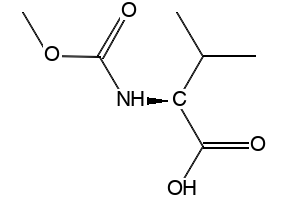
CAS Number74761-42-5
SynonymsMOC-L-Valine; (2S)-2-[(methoxycarbonyl)amino]-3-methylbutanoic acid; (S)-2-((Methoxycarbonyl)amino)-3-methylbutanoic acid; (S)-2-((METHOXYCARBONYL)AMINO)-3-METHYLBUTANOICACID; Moc-Val-OH; (S)-2-(Methoxycarbonylamino)-3-methylbutanoic acid; N-METHOXYCARBONYL-L-VALINE; METHOXYCARBONYL-VALINE; N-(Methoxycarbonyl)-L-valine; N-(methoxycarbonyl)-(L)-valine; MOC-VALINE
Molecular FormulaC7H13O4N1
Molecular Weight175.18
Purity96+%
Density1.154±0.06 g/cm3
Boiling Point315.9±25.0 °C at 760 mmHg
Melting Point109.0 to 113.0 °C
AppearanceSolid;White to Almost white powder to crystal
EINECS0
| Chemical & Physical Properties | |
|---|---|
| CAS Number | 74761-42-5 |
| Catalog No. | 2A-0101005 |
| Chinese Name | MOC-L-缬氨酸 |
| Synonyms | MOC-L-Valine; (2S)-2-[(methoxycarbonyl)amino]-3-methylbutanoic acid; (S)-2-((Methoxycarbonyl)amino)-3-methylbutanoic acid; (S)-2-((METHOXYCARBONYL)AMINO)-3-METHYLBUTANOICACID; Moc-Val-OH; (S)-2-(Methoxycarbonylamino)-3-methylbutanoic acid; N-METHOXYCARBONYL-L-VALINE; METHOXYCARBONYL-VALINE; N-(Methoxycarbonyl)-L-valine; N-(methoxycarbonyl)-(L)-valine; MOC-VALINE |
| Molecular Formula | C7H13O4N1 |
| Molecular Weight | 175.18 |
| Purity | 96+ |
| Density | 1.154±0.06 g/cm3 |
| Boiling Point | 315.9±25.0 °C at 760 mmHg |
| Melting Point | 109.0 to 113.0 °C |
| Appearance | Solid;White to Almost white powder to crystal |
| Water Solubility | Sparingly soluble (30 g/L) (25 ºC) |
| Storage Condition | room temperature, airtight |
| Application | MOC-Val-OH is a valine derivative [1]. |
| EINECS | 0 |
| HTC | 2924199090 |
| UN(IATA) | 0 |
| MDL Number | MFCD12795357 |
| SMILES | COC(=O)NC(C(=O)O)C(C)C |
| InChI Key | CEFVHPDFGLDQKU-YFKPBYRVSA-N |
| MSDS | msds/101005_1_74761_42_5.pdf |
| Use of | MOC-Val-OH is a valine derivative[1]. Properties Name (S)-2-((Methoxycarbonyl)amino)-3-methylbutanoic acid Synonym More Synonyms N-(Methoxycarbonyl)-L-valine Biological Activity Description MOC-Val-OH is a valine derivative[1]. Related Catalog Research Areas >> Others Signaling Pathways >> Others >> Others In Vitro Amino acids and amino acid derivatives have been commercially used as ergogenic supplements. They influence the secretion of anabolic hormones, supply of fuel during exercise, mental performance during stress related tasks and prevent exercise induced muscle damage. They are recognized to be beneficial as ergogenic dietary substances[1]. References [1]. Luckose F, et al. Effects of amino acid derivatives on physical, mental, and physiological activities. Crit Rev Food Sci Nutr. 2015;55(13):1793-1144. Chemical & Physical Properties Molecular Formula C7H13NO4 Exact Mass 175.084457 PSA 75.63000 Index of Refraction 1.457 InChIKey CEFVHPDFGLDQKU-YFKPBYRVSA-N SMILES COC(=O)NC(C(=O)O)C(C)C Safety Information Hazard Codes Xn HS Code 2924199090 |
| Tax Rebate | 13.0% |
| Supervision | None. MFN tariff: 6.5%. Ordinary tariff: 30.0% |
| Transport Info | Product name: Summary 2924199090. other acyclic amides (including acyclic carbamates) and their derivatives; salts thereof. VAT:17.0%. Tax rebate rate:13.0%. . MFN tariff:6.5%. General tariff:30.0% |
Phone:
630-322-8886
630-322-8887
Email:
Office Locations:
Chicago, IL, USA
San Francisco, CA, USA


 EN
EN


 SDS
SDS